





Most dog collar guides treat the Belgian Malinois as a large, active breed and suggest a heavy-duty collar in the right size. That framing misses several specific anatomy and handling considerations unique to this breed. The Malinois is not simply a smaller German Shepherd. It has a distinct head-to-neck proportion that creates a different escape risk, a drive level and speed of transition that changes what close-control hardware a handler needs, and in working and sport contexts, specific collar positioning requirements that don't exist for companion breeds.
This guide covers what makes Malinois collar selection distinctly different, the lean-head escape geometry specific to this breed, why the handle collar has become standard for serious Malinois handlers, thermal management for high-drive working dogs in Australian conditions, collar positioning in bite sport and protection work, the working dog versus companion Malinois distinction, and the Rogue Royalty collar range with exact sizing for this breed's proportions.
What Makes the Belgian Malinois Different from Other Large Breeds
The Malinois is a medium-to-large breed with a lean, athletic build and a narrow, elongated skull that sits proportionally narrower relative to the neck than blockier-headed breeds. An adult Malinois might weigh 25 to 35 kilograms, the same as a medium Labrador Retriever, but generate significantly higher peak collar force during a drive-state lunge because the breed's hindquarter drive and body mechanics are specifically optimised for explosive forward acceleration.
This combination of lean head, long neck, high drive, and explosive acceleration creates collar requirements that differ from both the large powerful breeds at one end of the spectrum and the fine-boned athletic breeds at the other. A collar appropriate for a Rottweiler is over-specified for a Malinois. A collar appropriate for a Greyhound misses the drive and force requirements. The Malinois occupies a specific working dog space that benefits from an understanding of both its physical proportions and its behavioural profile.
The Lean-Head Escape Geometry Specific to Belgian Malinois
This is the fitting detail no generic collar guide discusses for this breed, and it has practical consequences for collar selection. The Malinois skull is notably narrower relative to its neck circumference than in breeds like Rottweilers, German Shepherds, or Labradors. When a Malinois backs up rapidly, dips its head forward, and twists, the passage of the collar over the skull is geometrically more achievable than in blockier-headed breeds where the skull creates a more reliable physical stop.
This escape manoeuvre is not theoretical for Malinois handlers. The breed's high intelligence, physical flexibility, and drive to move freely mean that a poorly fitted or inappropriately narrow collar can be escaped under stress, startlement, or deliberate avoidance of a training situation. The consequences for a Malinois loose in an unfamiliar or high-stimulation environment are more severe than for lower-drive breeds because the dog's speed and focus on any target it identifies can make recapture very difficult.
Why the Handle Collar Is Standard Equipment for Serious Malinois Handlers
Working Malinois handlers, sport handlers, and many police and military handlers working with this breed add an integrated handle to the collar as a standard piece of equipment rather than an optional upgrade. The reason is specific to how the Malinois transitions between working states.
A Belgian Malinois at full drive can be in a state of intense forward momentum with significant focus on a target. The transition into that state from apparent calm can happen in less than a second. A handler whose only control point is the end of a 1.2-metre lead has approximately 1.2 metres of lead to gather, shorten, or redirect before that force reaches them. A handler whose lead is already at slack because the dog has been walking calmly has even less response time.
A built-in handle collar positions a grip point directly at the collar itself, approximately 10 centimetres from the dog's neck. Reaching forward to the handle requires no lead management, no equipment change, and no gathering of slack. The handler can establish close-range body control at collar level within the fraction of a second available before the dog's transition is complete.
For Malinois in public environments, at the vet, during obedience transitions in bite sport sessions, when transferring the dog between handlers, and in any situation where the dog's drive state can shift rapidly, the handle collar converts a reactive management moment from a lead-shortening exercise into a single forward-reach action. Police and military K9 handlers working with this breed standardised on handle collars for exactly this reason decades before the design became popular in the civilian market.
Thermal Management for High-Drive Working Dogs in Australian Conditions
This is a consideration that no Malinois collar guide in the Australian market addresses, and it is specific to working dogs rather than companion animals. A Belgian Malinois in active working drive, protection sport training, or IPO work generates significant body heat. The dog's core temperature rises rapidly during drive work, and the throat area, where the collar sits, is a region where the body attempts to release some of this heat.
A heavy, wide collar with significant padding and coverage at the throat reduces the surface area available for passive heat exchange through the neck skin during active work sessions. In Australian conditions where ambient temperatures during summer training periods can reach 30 degrees Celsius and above, this is a real physiological consideration for working dogs training through the warmer months.
The practical implication for collar selection is that working Malinois in active training benefit from collars that are wide enough to distribute force but do not create excessive bulk or coverage at the throat. Full-grain leather at 4.5 centimetres, without additional padding beyond the napa inner lining, strikes the functional balance between width-based escape resistance and force distribution on one side, and minimal thermal interference on the other. Heavily padded tactical collars with full foam lining throughout the inside circumference add bulk that covers more throat surface area without proportionally adding to functional control benefits.
Bite Sport and Protection Work Collar Positioning
For Malinois used in IPO, KNPV, Mondio Ring, or similar protection sport disciplines, collar positioning during active sleeve work creates a specific consideration that general collar guides don't address.
During a bite on a sleeve or suit, the dog's neck extends and the body posture changes significantly from normal walking position. A collar that sits at the correct base-of-neck position during walking can migrate upward toward the throat during the head-forward, neck-extended posture of an active bite. If the collar migrates to a throat position during bite work, it can restrict breathing during the sustained grip phase, which is neither comfortable for the dog nor beneficial for the bite quality the handler is developing.
Working sport Malinois handlers address this through two approaches. The first is choosing a collar width that provides enough surface area contact with the neck to resist migration during the posture change. The second is slightly higher collar placement on the neck than would be standard for everyday walking, which provides more distance below the skull for the collar to migrate before reaching a problematic throat position. A collar that feels slightly high during a standard walk sit is in the correct starting position for a dog transitioning into drive work on the flat.
Working Malinois vs Companion Malinois Collar Needs
The Belgian Malinois population in Australia includes both working and sport dogs in police, security, military, and protection sport roles, and an increasing companion dog population where the breed is kept as a family dog with moderate-to-high exercise requirements but without formal working roles. These two populations have different collar requirements in some meaningful ways.
Working and Sport Malinois
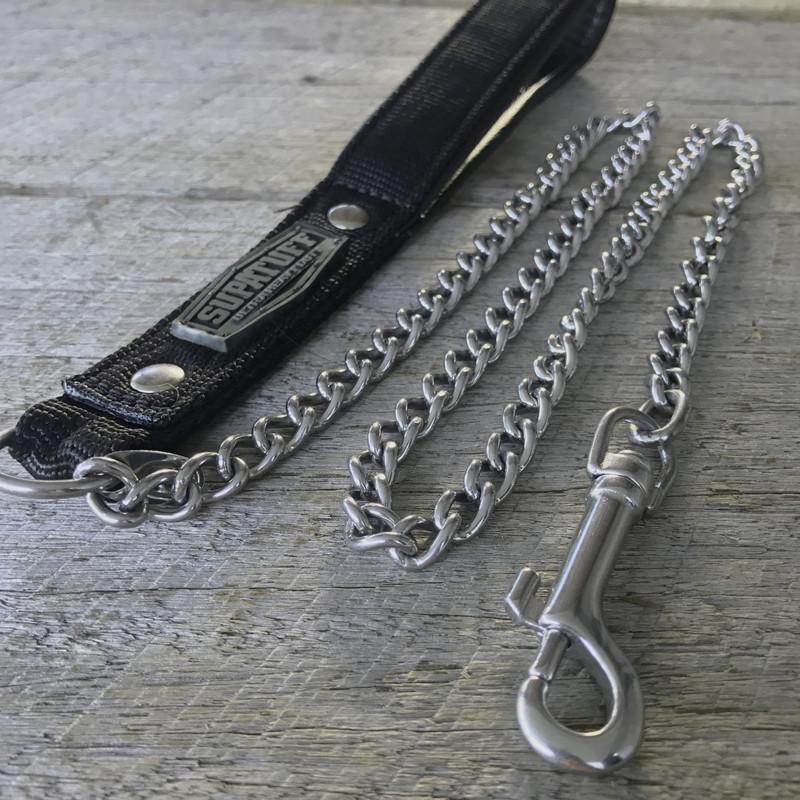
These dogs need the handle collar for training and handling transitions, hardware rated for the peak forces generated in drive work, collar width sufficient to resist the lean-head escape manoeuvre under high arousal, and material that can be cleaned between working sessions without deteriorating. For police and security dogs specifically, the collar may need to function correctly even after significant sweat, dirt, grass, and occasional water exposure across back-to-back working days. SupaTuff nylon with stainless hardware addresses the maintenance requirement, while leather with stainless hardware addresses the comfort and fit conformity requirement.
Companion and Sport-Developing Malinois
Companion Malinois and dogs in the early stages of sport development need the width and hardware quality appropriate for a high-drive, active dog, but may not need the integrated handle in everyday use. A wide-fit leather collar at 4.5 centimetres with solid metal hardware covers everyday walks, identification, and the occasional reactive moment without the bulk of a full handle collar. As the dog moves into structured sport or working training, adding a handle collar to the rotation is the logical next step.
How to Measure a Malinois for a Collar
Measure at the base of the neck where the collar will sit, not at mid-neck or near the skull. Part the coat at the measurement point and measure at skin level, as the Malinois medium-length coat can add 1 centimetre to the measurement if the tape rests on uncompressed coat rather than through to the skin.
Most adult male Malinois measure between 42 and 52 centimetres at the collar point. Most adult females measure between 38 and 47 centimetres. Working-conditioned males from sport or police lines can reach 50 to 56 centimetres due to heavier neck musculature. These ranges are population averages and individual dogs vary significantly, which is why direct measurement is always required.
| Malinois Profile | Typical Neck Range | Recommended Width | Wide-Fit Size |
|---|---|---|---|
| Adult female, companion or light sport | 38 to 47 cm | 4 to 4.5 cm | Medium to Large |
| Adult male, companion or light sport | 42 to 52 cm | 4.5 cm | Large to XL |
| Working or sport male, heavier build | 48 to 56 cm | 4.5 to 5.5 cm | XL to XXL |
Hardware Requirements for a Breed That Transitions Fast
The Belgian Malinois generates collar force through sudden, high-acceleration events rather than sustained pressure. A dog lunging at a decoy, transitioning rapidly to pursue a target, or reacting to a sudden environmental trigger creates a short-duration, high-peak-force loading at the D-ring and buckle that is different from the sustained low-to-moderate force of a larger dog walking consistently against a lead.
Plastic hardware under this type of sudden peak loading is significantly less reliable than under sustained lower loading, because the instantaneous force can exceed the plastic's rated strength before the material has time to deform. Metal hardware, by contrast, absorbs and distributes sudden peak loads more predictably. A stainless steel D-ring and solid metal buckle on a Malinois collar carries the sudden acceleration load in a way that plastic hardware cannot guarantee across repeated high-intensity events.
The Rogue Royalty Collar Range for Belgian Malinois
Three products from the Rogue Royalty range directly address the Belgian Malinois working dog collar requirements.
Leather Handle Dog Collar (Wide Fit)
For: working Malinois, sport dogs, police and security K9s, any handler needing instant close-range control
Full-grain bridle leather with napa inner lining. Built-in handle positioned close to the D-ring for immediate close-range control without lead management. Wide 4.5 to 5.5 cm profile distributes force and resists lean-head slip. Solid metal buckles and keepers, no plastic fittings. Wax-sealed stitching, reinforced joints, high-strength press studs and rivets. Available in sizes M through to XXL covering 33 to 64 cm neck circumference.
From $95.00 | View the Leather Handle Dog Collar
Classic Wide Fit Leather Collar
For: companion Malinois and sport dogs in development needing a wide-profile everyday collar without the handle
Full-grain bridle leather with napa inner lining. Wide 4.5 to 5.5 cm profile. Double-pin roller buckle. Solid non-rust metal hardware throughout, no plastic fittings. Available in multiple colourways from Medium (33 to 42 cm) through XXXL (62 to 74 cm). 10-year craftsmanship warranty.
From $95.00 | View the Classic Wide Fit Collar
SupaTuff Heavy Duty Collar
For: working Malinois in police, security, or sport roles requiring wash-and-go durability and all-weather performance
Custom double-ply SupaTuff nylon, 40 to 48mm width. All stainless steel hardware throughout, no plastic fittings. Waterproof, rot-resistant, UV-treated. Double-pronged stainless buckle for secure adjustment under repeated high-force events. Lifetime guarantee.
From $65.00 | View the SupaTuff Heavy Duty Collar
For leather collars used in active outdoor and working conditions, regular conditioning with the All Natural Leather Balm maintains the napa inner's soft contact against the Malinois coat and prevents the stiffening that reduces a leather collar's ability to conform correctly to the individual dog's neck shape.
Handle collars, wide-fit leather, and SupaTuff nylon in all-metal hardware. No plastic fittings. Sized from 33 cm through to 74 cm. 10-year leather warranty and lifetime SupaTuff guarantee.
Browse the Wide Fit Collar Range →The Dual-Collar Setup Used by Malinois Working Handlers
Many experienced Malinois handlers run two collars simultaneously, and understanding why is useful context for anyone setting up gear for this breed. The first collar is a flat identification collar worn at all times for legal compliance and ID tag attachment, typically a slim or regular-fit collar at 2 to 3 centimetres width. The second is the working collar, a wide-fit leather collar or handle collar, worn during training sessions, walks, and active use, then removed during unsupervised crating or rest periods.
This two-collar system addresses the snag risk covered in the harness-versus-collar guide in the Rogue Royalty blog series: a collar worn unsupervised can catch on crate bars, fencing, or other fixed structures. For a Malinois with the physical strength and panic response intensity of this breed, the consequences of a collar snag while unsupervised are more serious than for lower-drive dogs. The slim identification collar is left on because it is legally required and the low-profile construction reduces the snag surface area. The wide working collar comes off when the dog is unsupervised.
This setup also extends the life of the working collar significantly because it is not being worn during the hours when it is not needed. A leather handle collar worn only during active use and removed for rest periods will outlast one worn continuously by a significant margin.
A Malinois in regular working or sport use puts more wear on a collar in one week than a companion dog puts on in a month. Sweat from drive work, dirt from tracking, and the occasional water exposure from outdoor sessions all affect leather differently from the typical suburban walking conditions most collar care guides assume.
After any session involving significant sweat or environmental contact, wipe the collar clean with a damp cloth before sweat and salt deposits dry into the leather. Allow to dry naturally before conditioning. Inspect the stitching at the D-ring attachment and buckle joins after every week of active working use rather than monthly, since the higher loading frequency in working contexts accelerates the point at which stitching fatigue becomes visible. Any fraying or loosening at a load-bearing join warrants replacement rather than continued use.
The full leather dog collar range includes all wide-fit options for Belgian Malinois from the everyday classic through to the handle collar in multiple sizes and colourways, all with the same full-grain leather and all-metal hardware specification that working handlers require.
Frequently Asked Questions: Collars for Belgian Malinois in Australia
What collar width suits a Belgian Malinois?
4 to 5.5 centimetres suits most adult Malinois. The wider profile distributes leash force across more neck surface area and provides better resistance to the lean-head escape manoeuvre specific to this breed's skull-to-neck proportion. For working and sport dogs, 4.5 centimetres is the practical minimum starting point.
Why is a handle collar important for Belgian Malinois handlers?
Malinois can transition from calm to full working drive in less than a second. A handle collar adds a built-in grip point directly at collar level, giving the handler immediate close-range control without lead management. Police, military, and sport handlers standardised on handle collars for this breed specifically because the time available to establish control during a drive switch is often measured in fractions of a second.
Does a Belgian Malinois need a different collar to other large breeds?
Yes, in two specific ways: the lean skull-to-neck proportion creates a slip geometry that requires a wider collar for effective escape prevention, and the drive level and force generation speed require hardware rated for sudden peak loads rather than sustained moderate tension. These two factors together distinguish the Malinois collar requirement from both lower-drive large breeds and fine-boned sighthound breeds.
How do I measure a Belgian Malinois neck for a collar?
Measure at the base of the neck where the collar will sit. Part the coat to measure at skin level rather than over uncompressed coat, which can add 1 cm to the reading. Most adult males measure 42 to 52 cm and most adult females 38 to 47 cm. Working-conditioned males from sport or police lines can reach 50 to 56 cm. Always measure the individual dog.
Is leather or SupaTuff nylon better for a Belgian Malinois collar in Australia?
Leather suits companion and sport Malinois in everyday use, conforming to the neck over time and providing a smooth contact surface. SupaTuff nylon suits working dogs in police, security, or sport roles where the collar needs regular washing and all-weather performance. Many serious handlers use both: leather for daily wear and SupaTuff for active working sessions.
What neck circumference does an adult Belgian Malinois typically have?
Most adult males measure 42 to 52 cm, placing them in the Large to XL range. Working-conditioned males may reach 50 to 56 cm. Most adult females measure 38 to 47 cm, typically Medium to Large. Individual variation is significant in this breed, making direct measurement essential rather than relying on breed averages.
What Rogue Royalty collars are recommended for Belgian Malinois?
The leather handle dog collar is the primary recommendation for working and sport Malinois because it combines the wide leather profile with an integrated handle for immediate close-range control. The wide-fit classic leather collar suits companion dogs and sport dogs in development. The SupaTuff heavy-duty collar covers all-weather working roles. All three use solid metal hardware with no plastic fittings.

