





Border Collies present a specific set of collar challenges that most breed guides either skip entirely or handle with a generic "martingale is best" recommendation that ignores half the Australian Border Collie population. The lean head-to-neck ratio that makes escape more likely than in blockier breeds. The constant movement that accelerates coat matting at contact points faster than in calmer breeds. The UV sensitivity at skin gaps in merle coat patterns. The scrub snag risk that makes a martingale dangerous for a working dog in the field. None of these are covered well anywhere.
This guide covers the Border Collie's lean head escape geometry and what it means for width and fit selection, why this breed's constant motion creates an unusual coat matting pattern under the collar, the merle coat and UV skin consideration at contact points, the critical difference between companion and working Border Collie collar requirements, the adolescent phase hardware implications, exact sizing for rough and smooth-coated lines, and the Rogue Royalty range mapped to this breed's specific needs.
What Makes Border Collie Collar Selection Different from Other Breeds
The Border Collie is a medium-sized breed with a lean, athletic build and a proportionally narrow skull relative to its neck circumference. This skull-to-neck ratio creates the breed's most important collar fitting challenge: the escape geometry is more favourable for the dog than in blockier-headed breeds. A flat collar sized correctly by neck circumference provides less skull-slip resistance on a Border Collie than the same collar would on a breed with a proportionally wider skull at the same neck measurement.
Beyond the escape geometry, Border Collies move differently from most other breeds in ways that affect how gear behaves on their bodies. A Border Collie in typical daily life: chasing a ball, crouching into a herding posture, weaving between people's legs, lying flat and then launching upright in a single movement, generates more position changes per hour than a Labrador, German Shepherd, or Golden Retriever doing the same daily routine. Each position change shifts the contact relationship between the collar strap and the coat, creating friction that accumulates over time.
Australia also has a large and active working Border Collie population on sheep and cattle properties across New South Wales, Victoria, Queensland, South Australia, and Western Australia. The working dog context creates specific collar requirements that companion dog guides don't address, including the scrub snag risk that makes certain collar designs that are clearly unsafe in field conditions.
The Lean Head Escape Geometry: Why Width Matters More Than Fit Alone
The Border Collie's skull sits on the narrower end of the medium-breed range in terms of skull-to-neck width ratio. When a Border Collie dips its head forward and backward during an escape attempt, the collar must navigate over a skull that provides less physical obstruction than it would in a blocky-headed breed like a Rottweiler or Labrador.
Collar width changes this geometry. A 2 centimetre collar must navigate a short vertical distance over the back of the skull. A 3.5 to 4 centimetre collar must navigate a greater distance over the same skull, which requires the skull to compress and deform a larger collar radius, something that simply doesn't happen in a live dog. The wider the collar, the more the skull's physical profile acts as a genuine barrier to escape, regardless of how the neck circumference measurement reads.
The Constant Movement Problem: How Border Collies Matt Their Coat at the Collar Line
Most breed-specific collar guides discuss coat matting as a concern for long-coated breeds. The matting problem for Border Collies is not primarily about coat length. It is about contact frequency.
A Border Collie in an average suburban day performs more body position changes, head lowering and raising movements, lateral directional shifts, and sudden launches from rest to sprint than most other breeds of comparable coat length. Every position change shifts the contact relationship between the collar strap and the adjacent fur. The individual hairs at the strap edge are bent, straightened, bent again, and subjected to friction from the strap surface with each movement.
Over weeks of daily wear, this repeated bending and straightening of individual hairs at the collar contact line causes them to interlock, creating matting along the two parallel lines where the top and bottom edges of the collar strap contact the coat. The matting is typically denser than in calmer long-coated breeds because the total number of friction events per day is higher.
The material of the collar inner surface has the most significant impact on how quickly this matting develops. A rough or textured inner surface catches on individual hairs at each movement. A smooth napa calfskin inner slides against the coat rather than catching on it, reducing the friction at each contact event and proportionally slowing the matting rate. Border Collies wearing collars with smooth inner linings show significantly less coat damage at contact points than those wearing rough-surfaced nylon or unlined leather.
Merle Border Collies and UV Skin Sensitivity at Contact Points
This is a consideration that no Border Collie collar guide in the Australian market addresses, and it is specific to merle-coated dogs including blue merle and red merle Border Collies.
Merle coat patterning is caused by a genetic modifier that dilutes pigmentation in patches across the coat and underlying skin. Where the pigmentation is diluted, the skin beneath the coat has reduced melanin concentration. Melanin is the pigment responsible for UV absorption in the skin. In the diluted skin patches of a merle dog, the reduced melanin concentration means those areas absorb less UV radiation and are more vulnerable to UV damage.
At collar contact points, the coat is pressed flat against the skin and in some cases slightly parted, which reduces the fur's role as a UV barrier. On a solid-coloured Border Collie, this is less significant because the underlying skin has full melanin concentration. On a blue or red merle Border Collie, the contact points where the collar presses the coat flat may coincide with depigmented skin patches, increasing UV exposure at those specific points during outdoor activities.
The practical implication is not dramatic under ordinary suburban conditions where the dog is not in extended direct sun exposure. However, for merle Border Collies in working contexts with extended sun exposure, or in high-UV Australian summer conditions, choosing a collar width that distributes contact across more neck area and checking those contact points for any unusual skin changes during hot months is a relevant consideration that no other guide in this space discusses.
Working Border Collies and the Scrub Snag Risk
Australia has a large and active working Border Collie population, and the working dog context creates collar requirements that are in direct conflict with the martingale recommendation that most companion dog guides make for this breed.
Martingale collars have a secondary loop, either fabric or chain, that tightens the collar to the dog's skull circumference when tension is applied. In a suburban walking context, this secondary loop hangs at the front or side of the collar and creates no issues. In a working field context, this loop is a snag point waiting to interact with wire fencing, brush, dense scrub, sheep yard rails, and any number of structures that a working Border Collie will crouch through, slide under, push past, or thread between during a working day.
A martingale loop snagged on a fence wire while a dog is moving can create sudden restraint that injures the neck, or in a worst case, can pull the tightening loop fully tight around the neck while the dog's body is still moving forward. This is not a hypothetical scenario for working dogs in field conditions.
Companion Border Collie vs Working Border Collie Collar Requirements
The Australian Border Collie population includes two distinct contexts that require different collar specifications in some meaningful ways.
Companion Border Collies
Companion Border Collies in suburban Australian homes need a collar that handles the escape geometry specific to this breed's skull proportions, protects the coat at contact points from the accelerated matting caused by constant movement, carries ID tags for Australian council compliance, and suits the active lifestyle of a high-energy breed in everyday environments. A wide flat buckle collar in full-grain leather with a smooth napa inner at 3 to 4 centimetres width addresses all of these requirements simultaneously.
Working Border Collies
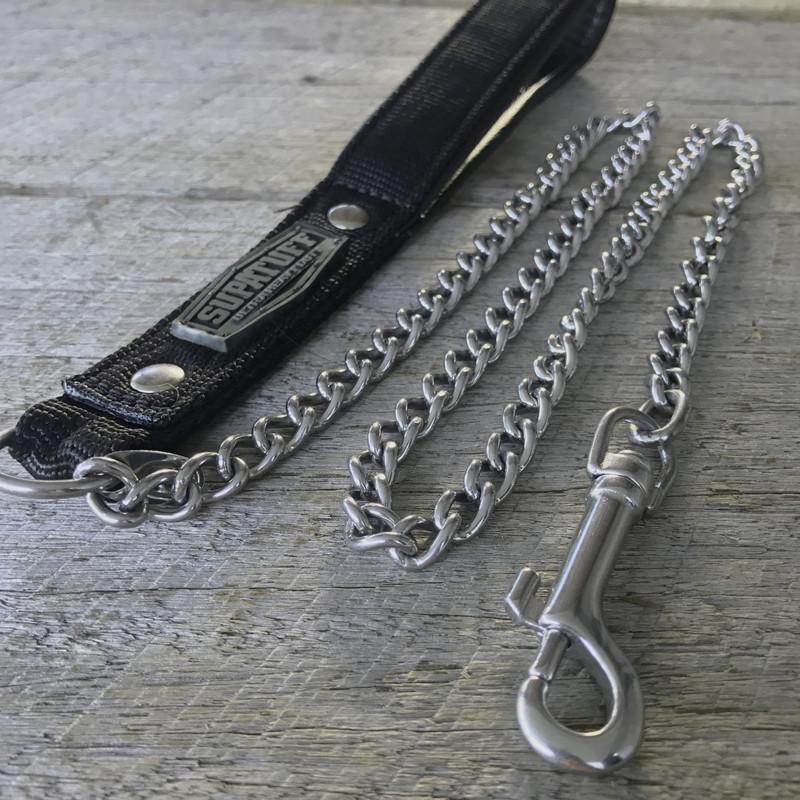
Farm and property Border Collies need equipment that functions safely in field conditions without creating snag hazards, can be washed quickly after a muddy working session, carries identification if the dog ranges away from the property, and withstands daily field conditions without requiring the conditioning maintenance leather needs. Double-ply SupaTuff nylon with all-stainless hardware and a flat buckle construction is the specification that meets all of these working requirements.
The Adolescent Phase: Six Months to Two Years
Border Collies between six months and two years of age are notoriously high energy even by Border Collie standards. The adolescent phase in this breed combines near-adult physical capability with an intense need for mental stimulation that, when unmet, produces the restless, high-movement behaviour that many owners find most challenging to manage.
For collar selection, the adolescent Border Collie's behaviour has two specific implications. First, the escape attempts are most frequent during this phase. A dog testing its environment for opportunities will test the collar more systematically than an adult with established routines. The skull clearance test is most important to apply during this period and should be checked monthly as the dog's neck muscles develop.
Second, the hardware load on the collar increases during the adolescent phase because the dog is more reactive to environmental triggers and generates more sudden leash-end events. Solid metal hardware at all connection points is the appropriate specification from the start of the adolescent phase. A puppy collar with lightweight hardware is not appropriate once the Border Collie is generating full-energy reactive lunges at stimuli.
How to Measure a Border Collie for a Collar
Measure at the base of the neck where the collar will sit, at skin level rather than over the uncompressed coat. Border Collies have a double coat with a noticeable neck ruff in rough-coated lines, which can add 1 to 2 centimetres to an over-coat reading compared to a skin-level measurement.
| Border Collie Type | Typical Neck Range | Collar Width | Rogue Royalty Size Range |
|---|---|---|---|
| Smooth-coated working line | 35 to 43 cm | 3 to 3.5 cm | Small to Medium (slim-fit range) |
| Rough-coated companion line | 38 to 47 cm | 3.5 to 4 cm | Small to Large (slim or regular) |
| Heavier show-line rough coat | 42 to 50 cm | 4 cm | Medium to Large (regular-fit range) |
Choose the size where the skin-level measurement falls in the middle of the adjustment range. Check fit monthly during the adolescent phase and after each seasonal blowout when coat volume changes.
Why Choose Rogue Royalty for Your Border Collie
Border Collies need gear that keeps pace with everything they do, and Rogue Royalty's leather and SupaTuff ranges have been built around exactly the demands that working and active dogs place on their equipment. Full-grain bridle leather with a smooth napa inner specifically addresses the coat matting problem that rough-surfaced materials cause on constantly moving breeds. All-metal hardware throughout handles the sudden peak loads of an adolescent or reactive Border Collie without the sudden failure risk of plastic fittings. The SupaTuff waterproof range handles the field and farm conditions that working Border Collies encounter without requiring maintenance between sessions.
Every product in the range carries either a 10-year craftsmanship warranty on leather or a lifetime guarantee on SupaTuff construction, which reflects the build quality that backs up these claims across daily working use rather than occasional wear.
The Rogue Royalty Collar Range for Border Collies
Slim Fit Leather Collar Range
For: smooth-coated and light-build Border Collies; companion dogs needing a proportional everyday profile
Full-grain bridle leather in a slim-fit profile appropriate for medium breeds. Smooth napa calfskin inner that slides against the Border Collie's double coat rather than catching on it, minimising contact-point matting from the breed's constant movement. All-metal hardware, no plastic fittings. Available from XXXS neck sizes upward.
From $55.00 | Browse the Slim Fit Leather Collar Range
Classic Wide Fit Leather Collar (Brown and Chrome)
For: rough-coated and heavier show-line Border Collies needing the escape-resistance benefits of a wider profile
Full-grain bridle leather outer with smooth napa inner lining. Wide 4 to 5.5 cm profile provides better skull-slip resistance for the Border Collie's lean head-to-neck geometry. Solid non-rust hardware. 10-year craftsmanship warranty. Available from Small through XXXL.
From $95.00 | View the Classic Wide Fit Leather Collar
SupaTuff Heavy Duty Collar
For: working Border Collies on farms and properties; any Border Collie that swims or works in muddy field conditions
Custom double-ply SupaTuff nylon, 40 to 48mm. Flat buckle construction, no secondary loop. All-stainless steel hardware, no plastic fittings. Waterproof, rot-resistant, UV-treated. Rinses clean after working sessions without conditioning maintenance. Lifetime guarantee. The flat buckle design specifically avoids the snag risk that makes martingales inappropriate for field-working dogs.
From $65.00 | View the SupaTuff Heavy Duty Collar
For leather collar maintenance in Australian conditions, the All Natural Leather Balm preserves the napa inner's soft contact surface and the bridle leather's suppleness through regular outdoor use, conditioned every six to eight weeks.
Slim-fit through wide-fit leather in all-metal hardware for companion dogs. Waterproof flat-buckle SupaTuff for working dogs in the field. No plastic fittings on any collar in the range.
Browse the Full Collar Range →Border Collie Collar Care in Australian Conditions
Border Collies' active lifestyle means their gear accumulates dirt, grass seeds, and moisture faster than sedentary breeds. The specific maintenance considerations for each material differ.
For leather collars on companion Border Collies: inspect the strap edges and buckle joins monthly for any early signs of coat contamination or stitching wear. The breed's constant movement means the strap flexes at many points throughout the day, which over time can reveal stitching fatigue at join points earlier than in calmer breeds. Condition every six weeks during regular active use. After any significant wet exposure, allow to dry naturally before conditioning to avoid trapping moisture between the leather layers. The full leather collar range includes all sizing options for companion Border Collies from the slim-fit lightweight profiles through to wide-fit options for heavier-built dogs.
For SupaTuff collars on working Border Collies: rinse after muddy field sessions and check the buckle mechanism monthly for smooth operation. Inspect the strap for any cuts or abrasion from scrub contact, which in field conditions can damage even quality webbing faster than everyday suburban wear.
Frequently Asked Questions: Collars for Border Collies in Australia
What size collar does a Border Collie need?
Most adult Border Collies measure 35 to 47 cm at the base of the neck at skin level. Rough-coated show lines typically measure 38 to 47 cm. Smooth-coated working lines often measure 35 to 43 cm. Measure at skin level through the coat, as the neck ruff can add 1 to 2 cm to an over-coat reading. Choose the size where the measurement falls in the middle of the adjustment range.
Why is the Border Collie's head shape a collar fitting concern?
Border Collies have a proportionally narrow skull relative to their neck circumference. A collar sized purely by neck measurement can slip over the skull during a backward escape attempt or the breed's characteristic head-lowering herding crouch. A wider collar at 3 to 4 cm and the skull clearance test, confirming the collar cannot pass over the skull with moderate forward pressure, both address this specifically.
What is the best collar material for a Border Collie in Australia?
Full-grain leather with a smooth napa inner for companion Border Collies in everyday suburban use. The napa inner reduces coat matting at contact points caused by the breed's constant movement. Waterproof SupaTuff nylon with all-stainless hardware for working Border Collies in field conditions requiring wash-and-go durability and no snag risk from secondary loops.
Should a Border Collie wear a martingale or flat buckle collar?
Companion Border Collies in suburban environments can use either a correctly fitted wide flat buckle or a martingale. Any dog working in field contexts should only use flat buckle collars. The martingale's secondary loop creates a serious snag risk when a dog is crouching through fences, scrub, and yard structures, and can tighten uncontrollably if snagged while the dog is moving. This is not a risk worth taking on a working farm dog.
How do I stop my Border Collie slipping out of its collar?
Three factors: collar width at 3 to 4 cm presents a larger skull-clearance geometry than narrow collars; the skull clearance test confirms the collar cannot slide over the skull under moderate pressure; and a quality buckle with no tendency to slip under tension. All three should be confirmed simultaneously. The collar needs to pass the two-finger check at the base of the neck AND the skull clearance test from the forward position.
What collar width is appropriate for a Border Collie?
Three to four centimetres suits most adult Border Collies. This provides meaningful escape resistance through skull geometry while remaining proportional to the breed's medium-sized neck. Very wide collars at 5 to 5.5 cm, appropriate for large breeds, are disproportionately wide for most Border Collies. Smooth-coated working lines suit 3 cm. Rough-coated show lines suit 3.5 to 4 cm.
What Rogue Royalty collars suit Border Collies?
The slim-fit leather range for smooth-coated and lighter working-line Border Collies. The classic wide-fit leather collar for heavier rough-coated dogs needing the escape-resistance of a wider profile. The SupaTuff Heavy Duty Collar for working dogs on farms, any dog that swims or works in muddy conditions, and any context where flat-buckle construction without a secondary loop is required for field safety.

