





Every Dobermann collar guide covers material choice, sizing, and the two-finger fit check. Very few go further to explain why a Dobermann's skin responds differently to collar materials than most other large breeds, how the neck taper that defines this breed's elegant silhouette creates a specific fitting challenge that the standard measurement advice doesn't address, or why Australian Dobermanns present a different collar escape geometry than the same breed in countries where ear cropping is legal.
This guide covers the Dobermann's sensitive skin chemistry and why it matters for leather selection, the neck taper fit problem and how to check for it, the natural-eared Australian Dobermann's collar geometry, hardware requirements for a high-drive breed that generates sudden intense leash force, exact sizing data for the Rogue Royalty collar range, and a lifestyle-based collar selection guide for this breed across different roles.
The Dobermann's Sensitive Skin: Why Material Selection Matters More Than for Most Breeds
Dobermanns have a fine, short coat with thin, close-lying skin that contacts collar material directly at every strap point. There is no fur buffer between collar and skin the way there is in German Shepherds, Golden Retrievers, or similar coated breeds. This direct contact creates two specific sensitivities that most collar guides mention briefly and none of them explain at a level that helps owners make an informed material choice.
Contact Chemistry and Tanning Processes
Leather is produced through a tanning process that stabilises the raw hide and determines the final material's properties. The most common commercial tanning process uses chromium salts, producing what is sold as chrome-tanned leather. Chrome-tanned leather is the majority of leather products on the market at all price points, including many pet collars.
Chrome-tanned leather can release trivalent chromium compounds, particularly when new and before the surface has been sealed and conditioned. In most dogs, any skin contact with these compounds is mediated through a coat layer and produces no reaction. In a short-coated, thin-skinned breed like the Dobermann where the collar contacts skin directly, the same chromium exposure creates a higher contact dose at the skin surface. Dobermanns as a breed have a documented predisposition to contact hypersensitivity reactions, and collar-induced contact dermatitis is a recognised presentation in the breed, appearing as redness, hair loss, and skin thickening at the collar contact line.
Full-grain leather processed with wax and oil-based conditioning rather than heavy chrome chemistry, or vegetable-tanned leather, minimises this risk. The napa calfskin inner lining on quality collars provides a further buffer between the outer leather and the skin surface, reducing direct contact between the Dobermann's skin and the outer leather material entirely.
Colour Dilution and Additional Skin Vulnerability
Blue Dobermanns and fawn Dobermanns carry the dilute gene that produces their distinctive coat colour. This dilution gene is also associated with colour dilution alopecia (CDA), a condition involving progressive hair loss and skin fragility in the affected areas. Blue and fawn Dobermanns with CDA have noticeably thinner, more fragile skin than their black and rust or red and rust counterparts. For these dogs, the material selection principle is even more important: any roughness, chemical residue, or abrasive texture in the collar material accelerates skin damage at the collar contact points.
The Neck Taper Problem: Why Standard Measurement Advice Fails on Dobermanns
A Dobermann has one of the most distinctive neck profiles of any large breed: a muscular, elegant neck that tapers noticeably from the wide, powerful base near the shoulders to a narrower circumference toward the skull. This taper is a defining aesthetic feature of the breed and also a specific collar fitting challenge that the standard two-finger measurement advice does not adequately address.
The standard advice is to measure the neck at the collar-wearing position, typically the base of the neck, and ensure two fingers fit between collar and neck. On most breeds, this single measurement point captures the relevant fit variable because the neck is relatively consistent in circumference between the wearing position and the skull. On a Dobermann, the circumference at the skull can be 3 to 6 centimetres smaller than at the base of the neck where the measurement was taken.
The practical consequence is this: a collar measured and fitted correctly at the base of the neck will ride forward toward the smaller-circumference upper neck when the dog drops its head, moves at speed, or attempts the backward head-dip escape manoeuvre. At the upper neck position, the same collar that had two fingers of clearance at the base may have four or five fingers of clearance, which is effectively too loose to prevent slip-over-skull escape.
Australian Dobermanns and Natural Ear Geometry
Ear cropping has been illegal in Australia since the 1980s. The Australian Dobermann population has natural, pendant ears, and this matters for collar selection in a specific way that no Australian Dobermann guide currently addresses.
Most collar guides for Dobermanns, particularly those from the United States where cropping remains legal and common, describe the breed's skull as having a clean narrow profile that makes collar slip a significant risk. This description is accurate for cropped dogs where the ear leather has been removed and the skull profile is uninterrupted from crown to jaw.
In a natural-eared Dobermann, the pendant ears fold down alongside the skull. When the ears are in their natural folded position, the effective width of the head at the ear attachment point is wider than the clean skull measurement alone. During a backward head-dip escape attempt where the collar would need to pass over the skull, the natural ears create additional contact width that the collar must clear. This is not a guarantee against escape from a loose collar, but it does mean the Australian natural-eared Dobermann is marginally less vulnerable to the slip-over-skull escape than the same breed in cropped form.
The practical implication: Australian Dobermann owners can weight their concern slightly more toward the neck taper problem and the forward-sliding fit issue described above, rather than focusing primarily on skull slip prevention as the cropped-breed guides emphasise.
Hardware Requirements for a High-Drive Breed
Dobermanns are working dogs with a history in personal protection, police, and military roles. Even companion Dobermanns in Australia retain significant drive, prey instinct, and the capacity for sudden intense reactive behaviour at the end of a lead. A Dobermann that spots a cat, another dog, or a bicycle across the road can go from a loose-lead walk to a full-drive lunge in under a second, generating peak leash force at the collar hardware that is significantly higher than the sustained walking tension the hardware experiences during a normal outing.
Plastic hardware fails at these sudden peak loads in a way that metal hardware does not. The failure is sudden rather than progressive, which means there is no visible warning before the clip or buckle gives way. Solid brass buckles and D-rings deform progressively under overload rather than failing suddenly, giving a visible indication of stress before structural failure occurs.
The D-ring attachment method also matters. A D-ring that is riveted or welded to the collar strap holds the ring in position regardless of the direction of leash force. A D-ring that is threaded through a loop in the collar strap can shift position under lateral leash force, creating uneven load distribution that stresses the strap edge at the contact point. For Dobermanns generating the sudden directional forces of a reactive lunge, a fixed D-ring attachment is the appropriate specification.
Exact Sizing for Dobermanns: Ruthless Wide Collar Specifications
Most adult male Dobermanns measure between 45 and 56 centimetres at the collar point, placing them in the XL to XXL range in Rogue Royalty's wide-fit collar sizing. Most adult females measure between 38 and 50 centimetres, typically in the L to XL range. Heavier-boned European working lines can reach the upper end or above these ranges.
| Size | Neck Circumference | Collar Width | Collar Length |
|---|---|---|---|
| M | 33 to 42 cm | 4.5 cm | 50 cm |
| L | 38 to 47 cm | 5.5 cm | 60 cm |
| XL | 45 to 53 cm | 5.5 cm | 70 cm |
| XXL | 53 to 64 cm | 5.5 cm | 80 cm |
| XXXL | 62 to 74 cm | 5.5 cm | 90 cm |
Measure snugly at the collar-wearing position without adding extra room. The fitting allowance is built into the Rogue Royalty sizing specifications. When the dog's measurement falls between two sizes, choose the larger size so the collar adjustment falls in the middle of the available range rather than at either extreme, giving room to tighten or loosen as needed across seasonal coat changes or condition fluctuations.
Collar by Lifestyle: Which Rogue Royalty Collar for Which Dobermann
Companion Dobermanns in Everyday Suburban Use
The Classic Wide Fit leather collar in brown and chrome covers the everyday companion Dobermann needing a clean, elegant collar in full-grain bridle leather with a napa inner and solid brass hardware. The wide profile at 4.5 to 5.5 centimetres distributes any leash pressure across more skin surface area than a narrow collar, protecting the Dobermann's sensitive thin skin during reactive moments.
Dobermanns Needing Style and Presence
The Ruthless Wide Leather Collar in Black and Brass is the most Dobermann-appropriate design in the Rogue Royalty range: full-grain leather, brass pyramid studs, solid brass hardware throughout, double-layered construction, wax-sealed stitching, reinforced joints, and a soft napa inner lining. The black and brass colourway is a classic pairing with the Dobermann's black and rust coat. Available from Medium through XXXL to cover every Dobermann neck size.
Working, Security, and Protection Sport Dobermanns
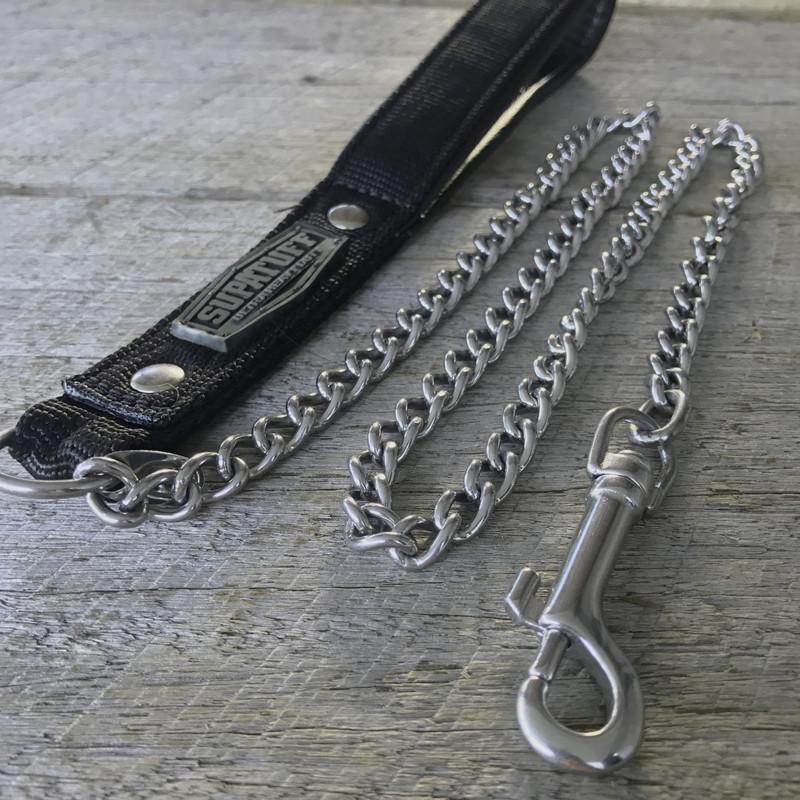
For Dobermanns in active working roles where the collar requires regular washing and all-weather durability, the SupaTuff Heavy Duty Collar provides custom double-ply nylon with all-stainless hardware in a wide 40 to 48mm profile. Waterproof, rot-resistant, and UV-treated. The stainless hardware completely eliminates any nickel exposure concern for sensitised Dobermanns.
Ruthless Wide Leather Collar (Black and Brass)
For: companion and working Dobermanns needing full-grain leather, napa inner, brass pyramid studs and solid brass hardware
Full-grain leather outer with soft napa leather inner throughout. Brass pyramid studs and solid brass buckles, rings, and keepers. Double-layered construction. Bevelled, wax-polished, and sealed edges. Wax-sealed stitching. Reinforced joints. High-strength press studs and rivets. Water and weather-resistant leather. Five sizes covering 33 to 74 cm neck circumference.
From $87.50 | View the Ruthless Wide Leather Collar
For leather collar maintenance in Australian conditions, the All Natural Leather Balm keeps the leather supple and the napa inner soft against the Dobermann's short coat, conditioned every six to eight weeks during regular use.
Five sizes from 33 to 74 cm neck circumference. No plastic fittings. No nickel hardware. Soft napa inner for direct-skin breed protection.
Browse the Wide Fit Collar Range →The Australian Dobermann Population: What Makes Local Guidance Different
Australia has a significant and active Dobermann community, including show lines, working protection sport dogs, and a large companion population. The ANKC registered Dobermann population in Australia follows the European breed standard rather than the American standard, which has implications for body size and neck proportions that overseas collar guides don't account for.
European-standard Dobermanns tend toward a larger, heavier frame than the leaner American show type that dominates many US collar guides. Australian Dobermanns from European lines, particularly those with German and Czech working backgrounds, can have neck circumferences toward the upper end of the breed range and require the XXL sizing that many generic guides don't list as a standard option. The Rogue Royalty wide-fit range extends to XXXL at 62 to 74 centimetres, covering the largest European-line males comfortably.
Protection Sport Dobermanns
Australia has an active IPO, IGP, and protection sport community with a significant Dobermann participation. Protection sport Dobermanns work in drive states that produce the collar loads described in the hardware section of this guide, and they typically require a collar that transitions from everyday walk wear to training session use without hardware changes. The same collar worn for a morning suburb walk needs to hold correctly during afternoon training when the dog is in full drive. For these dogs, the leather collar for daily wear combined with the SupaTuff for training sessions is the two-collar approach covered in the working Malinois section of the Rogue Royalty blog series, applied equally here.
Companion Dobermanns in Urban Australia
The companion Dobermann in an Australian city typically walks on shared suburban paths, encounters cyclists, dogs, and school children on a regular walk, and may have reactive moments driven by the breed's natural alert and watchdog temperament. For this dog, the collar needs to hold correctly during a sudden reactive lunge, carry ID tags legally, and contact skin directly without causing the friction irritation that the Dobermann's thin coat makes it vulnerable to. A wide-fit full-grain leather collar with a napa inner fits all three requirements simultaneously.
A Dobermann's collar in Australian conditions faces heat, UV, and for coastal dogs, salt spray. Leather collars on Dobermanns need slightly more frequent conditioning than on coated breeds because the short coat does not provide any moisture buffering between the leather and the environment. The collar is more directly exposed to sweat from the Dobermann's neck during active walks than it would be on a coated breed where the coat absorbs and slows the moisture transfer.
After any run, beach outing, or extended walk in warm conditions, wipe the inside of the collar with a damp cloth before any sweat deposits dry into the leather and accelerate ageing at the strap. Allow to air dry naturally before storing or refitting. Condition every four to six weeks during warm Australian summer months when the combination of sweat, UV, and heat draws oils from the leather more rapidly than in cooler periods.
The full leather dog collar collection covers the complete Rogue Royalty wide-fit collar selection in multiple colourways and sizes, all in the same full-grain leather and solid brass hardware specification appropriate for the Dobermann's specific material and skin requirements.
Frequently Asked Questions: Collars for Dobermanns in Australia
What collar width suits a Dobermann?
4 to 5.5 centimetres. The Dobermann's short coat means the collar contacts skin directly, so a wider collar distributes leash pressure across more skin surface area. For Dobermanns that pull or react, 4.5 to 5.5 centimetres is appropriate for both comfort and control.
Why are Dobermanns more prone to skin irritation from collars?
No fur buffer between collar material and skin. Chrome-tanned leather can release chromium compounds that trigger contact dermatitis at direct-skin contact points. Blue and fawn Dobermanns with colour dilution alopecia have additional skin fragility. Full-grain leather with a napa inner lining and solid brass hardware minimises contact irritation and eliminates nickel exposure.
What is the neck taper problem for Dobermann collar fit?
The Dobermann's neck tapers significantly from a wider base to a narrower upper section near the skull. A collar fitted correctly at the base can be effectively too loose when it slides forward to the narrower upper neck position. Check fit at both the base position and the forward position, and confirm the collar cannot pass over the skull from the forward position.
Why does the Australian Dobermann's natural ear affect collar fit?
Ear cropping is illegal in Australia, so Australian Dobermanns have natural pendant ears. The natural ears add width to the effective skull profile when folded, making skull slip slightly harder than in the cropped dogs described by most US guides. Australian Dobermann owners should prioritise the neck taper problem over skull-slip prevention as the primary fit concern.
How do I measure a Dobermann's neck for a collar?
Measure snugly at the base of the neck where the collar will sit. Do not add extra room as the fitting allowance is built into Rogue Royalty's sizing. Most adult males measure 45 to 56 cm and most adult females 38 to 50 cm. Measure the individual dog rather than using breed averages.
What hardware specifications does a Dobermann collar need?
Solid brass or stainless steel throughout, no plastic components. Solid brass eliminates nickel exposure for sensitised dogs. Metal hardware deforms progressively under overload, giving visible warning before failure. Plastic fails suddenly under the peak loads a drive-state Dobermann generates. A fixed D-ring attachment is appropriate for a breed generating sudden directional leash forces.
What Rogue Royalty collars suit Dobermanns?
The Ruthless Wide Leather Collar in black and brass is the flagship choice: full-grain leather, napa inner, brass pyramid studs, solid brass hardware, five sizes covering 33 to 74 cm. The Classic Wide Fit Leather Collar suits Dobermanns wanting a clean unadorned look in the same quality. The SupaTuff Heavy Duty Collar covers working and sport Dobermanns needing a waterproof wash-and-go option with all-stainless hardware and zero nickel exposure.

