




Golden Retrievers are one of Australia's most popular dog breeds, and they present a specific set of collar selection challenges that generic large-breed collar guides don't address. The thick neck ruff produces a systematic measurement error that most owners make without realising it. The seasonal coat blowout shifts collar fit twice a year in a way that catches owners off guard. The breed's deep love of water creates a specific skin problem when a wet leather collar is worn under a dense coat in warm Australian conditions. And the adolescent pulling phase between six and eighteen months puts loads on collar hardware that a puppy-phase collar wasn't specified for.
This guide covers each of these Golden-specific considerations, the measurement technique that avoids the coat inflation error, how to manage fit across seasonal coat changes, the waterlogged leather hot spot risk and how the dual-collar system solves it, collar width selection across life stages, and the Rogue Royalty collar range mapped to the Golden Retriever's specific needs.
The Coat Inflation Measurement Problem: Why Most Golden Retriever Owners Size Collars Wrong
A Golden Retriever's neck has a distinctive dense ruff of longer, thicker fur around the lower neck and chest junction. This ruff is one of the breed's most recognisable features and one of the most significant sources of collar sizing errors. When a tape measure is placed around a Golden's neck over the uncompressed ruff, the reading can be 2 to 3 centimetres larger than the actual neck circumference at skin level beneath the coat.
A collar ordered based on the over-coat measurement will be consistently too loose against the actual neck. The owner fits the collar, the two-finger check passes comfortably, and the collar looks right. What is actually happening is that the collar is sitting on top of the coat rather than against the neck, and the effective slack at skin level is considerably more than the two-finger check at the coat surface suggests.
Seasonal Coat Blowout and Collar Fit Shifts
Golden Retrievers shed their double coat twice yearly in what owners call a coat blowout. During blowout, the dense undercoat sheds out in large quantities over several weeks. The neck ruff is one of the areas where this undercoat density is most pronounced, meaning the effective circumference of the neck at the collar contact point reduces noticeably after blowout compared to peak coat.
A collar fitted correctly at peak coat, passing the skin-level two-finger test in winter, can have noticeably more slack after the summer blowout because the ruff volume has reduced even though the actual neck size has not changed. This collar is not dangerous in most cases, but it is looser than intended and in some dogs can move forward on the neck more freely than it should during exercise or play.
The practical management approach is to recheck collar fit after each seasonal blowout, not just when a problem becomes visible. Most Rogue Royalty collars have multiple buckle positions across their adjustment range specifically to accommodate this kind of seasonal fit change. If the collar can no longer be adjusted to the correct fit on either end of the adjustment range, the collar has moved from the appropriate size for the dog and should be replaced.
The Waterlogged Leather Hot Spot Risk for Water-Loving Goldens
Golden Retrievers have a strong instinct for water. Most Australian Golden owners have a dog that will enter any body of water at any opportunity, from the local creek to the beach surf to a backyard puddle. This water obsession creates a specific collar problem when a leather collar is the everyday wear.
When a leather collar gets wet and is then worn under a Golden's dense ruff in warm conditions, moisture becomes trapped between the wet leather and the dog's skin and undercoat. The ruff's insulating properties prevent this moisture from evaporating quickly. In Australian summer conditions where the ambient temperature helps warm the trapped moisture, this creates a microenvironment that is ideal for bacterial and fungal skin infections. Hot spots, which are acute moist dermatitis lesions, are the most common outcome, appearing as red, wet, itchy patches at the collar contact line that the dog scratches and worsens rapidly.
The Dual-Collar System That Solves the Problem
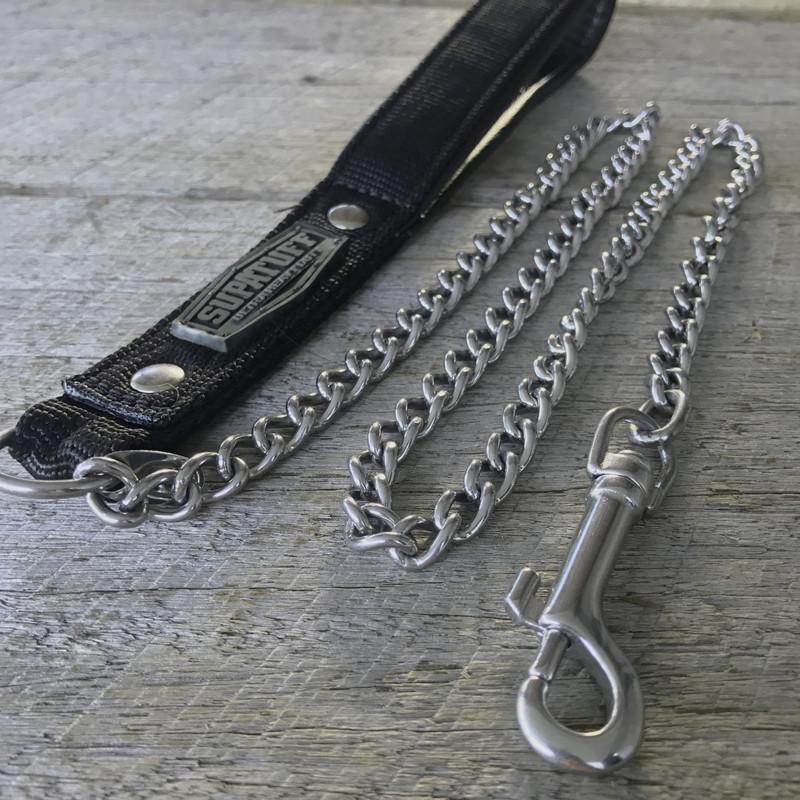
The most practical solution for Golden Retriever owners who want the comfort and quality of a leather collar without the moisture risk is running two collars: a leather collar for dry-condition everyday wear and a waterproof SupaTuff nylon collar for all water outings, beach visits, park visits where the dog is likely to find water, and any outing during Australian summer where the dog may swim.
The leather collar carries the ID tag and provides the comfortable everyday wear experience. It comes off when the dog enters any water. The SupaTuff collar goes on for water outings and can be rinsed clean and dried in minutes without the conditioning maintenance leather requires. The dog's skin and ruff stay dry after water outings because the waterproof collar does not hold moisture against the coat. Many Golden owners in Australia adopt this two-collar system naturally once they have experienced collar-related skin issues under the ruff.
The Adolescent Pulling Phase: Collar Considerations for Six to Eighteen Months
Golden Retrievers go through a period of adolescent behaviour between approximately six and eighteen months of age that is particularly pronounced in this breed. Their physical size and strength reaches near-adult levels while their impulse control, response to training cues, and ability to manage distraction are still developing. During this phase, most Goldens are enthusiastic, strong pullers who generate significant leash force at the collar during walks in distracting environments.
This pulling phase has two specific collar implications. First, the width of the collar affects how comfortably the dog experiences leash pressure during this phase. A narrow collar concentrates force along a thin line against the neck. A wider collar at 3.5 to 5.5 centimetres distributes the same leash force across more contact area, reducing the pressure per square centimetre at the collar-neck interface. For a Golden pulling enthusiastically, this width difference is noticeable in how the dog moves and whether it becomes desensitised to collar pressure during the phase.
Second, the hardware on the collar experiences more frequent peak loading during this phase than at any other point in the dog's life. An adolescent Golden lunging at a squirrel, another dog, or a tennis ball across the park generates sudden high-force loads at the D-ring and buckle that the collar's everyday walking use doesn't approach. Solid metal hardware throughout, with no plastic components, ensures these sudden loads are handled without hardware failure.
Collar Width Across Golden Retriever Life Stages
| Life Stage | Age Range | Recommended Width | Key Consideration |
|---|---|---|---|
| Puppy | 8 weeks to 6 months | 1.5 to 2.5 cm lightweight | Lightweight first collar; check fit weekly as the puppy grows rapidly |
| Adolescent | 6 to 18 months | 3 to 5.5 cm | Wider profile distributes pulling force; solid hardware for peak loads |
| Adult, active | 18 months to 7 years | 3 to 4 cm everyday; wider for activities | Napa inner prevents ruff matting; dual collar for water outings |
| Senior | 8 years and above | 3 to 4 cm; lighter weight preferred | Reduce collar weight; check for skin sensitivity changes with age |
Collar Material and the Golden's Dense Ruff: What Contact Surface Does to the Coat
A flat collar worn under a Golden's ruff contacts the fur at the ruff-to-neck junction at every strap point. Over weeks and months of daily wear, the collar material at these contact points affects the coat in ways that vary by material choice.
Napa Leather Inner and Coat Health
A collar with a smooth napa calfskin inner, as used in the Rogue Royalty leather collar range, creates a low-friction contact surface against the Golden's coat. The smooth napa slides against the ruff fur rather than catching on it, preserving the coat's natural alignment at the collar contact points. After months of wear, the coat under a well-fitted napa-lined collar should look the same as the coat elsewhere on the neck.
Rough or Unlined Nylon
Standard nylon webbing has a woven texture that creates friction against the Golden's fur at contact points. This friction causes progressive coat breakage and matting at the collar lines over weeks to months of daily wear. The damage accumulates invisibly under the ruff until the owner removes the collar and parts the coat to find a line of broken, matted fur along the collar contact area. Switching to a lined collar or a collar with a smooth contact surface reverses this damage over a complete coat cycle.
Exact Sizing for Golden Retrievers: Measuring Through the Ruff
Most adult male Golden Retrievers measure between 45 and 55 centimetres at skin level at the collar point. Most adult females measure between 40 and 50 centimetres. These ranges are population averages, and individual dogs vary. Field-line Goldens, which tend toward a leaner build, often have smaller neck circumferences than show-line dogs with a heavier head and neck.
Measure after parting the coat to skin level, snugly but not compressing neck tissue. Do not add extra room. Match the skin-level measurement directly to the collar size chart.
Australian Golden Retriever Lifestyle: Coastal, Suburban, and Rural Contexts
Australia's Golden Retriever population spans coastal beachside owners, suburban families, and rural properties, and the collar needs differ meaningfully across these three contexts in ways that generic Golden Retriever guides written for other markets don't address.
Coastal and Beach Goldens
Coastal Australian Goldens typically swim in salt water regularly, which adds a salt crystal accumulation concern to the wet-leather hot spot risk. Salt crystals that dry into leather under a dense ruff accelerate the leather's drying and cracking process and can irritate the skin at the collar contact line with each movement. For coastal Goldens, the dual-collar system with the SupaTuff collar designated as the beach collar is not optional but essential. After every salt water outing, the SupaTuff collar should be rinsed with fresh water to dissolve any salt crystal deposits before they dry into the webbing or hardware joints.
Suburban Goldens with Pool Access
Pool-accessing Goldens face the same wet-leather problem as ocean swimmers, with the additional consideration of pool chlorine. Chlorine in pool water is aggressive on both leather and on chrome-plated hardware, accelerating surface deterioration in either material. For Goldens that swim in pools regularly, the SupaTuff collar with all-stainless hardware is the appropriate pool collar, as stainless steel resists chloride attack significantly better than chrome-plated alternatives. Rinse after pool outings the same as after salt water.
Rural and Working Goldens
Goldens on rural properties in Australia often encounter creek crossings, dam swimming, and extended outdoor time in varying conditions. The collar wears faster on a rural dog than on a suburban one due to abrasion from grass seeds, grit, and vegetation. Inspect collar stitching and hardware function monthly rather than at the six-to-eight-week interval appropriate for suburban use, and replace at the first sign of stitching fraying at any join point.
Two collars from the Rogue Royalty range suit the Golden Retriever's specific needs across different lifestyle contexts, and the All Natural Leather Balm addresses the maintenance requirement for the leather collar after wet weather exposure.
Classic Wide Fit Leather Collar (Brown and Chrome)
For: everyday Golden Retriever wear, ID tag attachment, dry-condition walking and outings
Full-grain bridle leather outer with smooth napa inner lining at every contact point. The napa inner is the specific feature that prevents the coat breakage and matting that rough-surfaced collars cause under a Golden's ruff over time. Double-pin roller buckle. Solid non-rust metal hardware throughout. Available from Small through XXXL to cover every Golden neck size. 10-year craftsmanship warranty.
From $95.00 | View the Classic Wide Fit Leather Collar
SupaTuff Heavy Duty Collar
For: water outings, beach visits, summer swimming, and the adolescent pulling phase where wash-and-go durability is needed
Custom double-ply SupaTuff nylon webbing at 40 to 48mm. All stainless steel hardware, no plastic fittings. Waterproof, rot-resistant, UV-treated. Rinses clean in seconds after water outings without retaining moisture against the coat or requiring conditioning between uses. The correct collar for any outing where the Golden is likely to swim or get thoroughly wet. Lifetime guarantee.
From $65.00 | View the SupaTuff Heavy Duty Collar
For maintaining the leather collar after any significant moisture exposure, the All Natural Leather Balm restores the oils removed by wetting and drying and keeps the napa inner soft against the Golden's ruff. Apply after each session where the leather collar has been exposed to rain or damp conditions, before storing.
Full-grain leather with napa inner for coat protection, and SupaTuff nylon for water outings. The dual-collar system that suits the Golden Retriever's Australian lifestyle.
Browse the Wide Fit Collar Range →Collar Care for Golden Retrievers in Australian Conditions
Australian conditions are harder on collars than the northern hemisphere climates where most collar care guides originate. High UV, coastal salt spray, and the temperature extremes between an air-conditioned home and a 35-degree outdoor walk create wear patterns that require active maintenance rather than passive neglect.
For the leather everyday collar: check the coat underneath the collar weekly, particularly after any damp weather, to confirm no moisture is trapped at the contact line. Condition the leather every six weeks during normal use and immediately after any significant wetting. Store the collar in a cool, dry location when not in use.
For the SupaTuff water collar: rinse with fresh water after any salt water outing to remove chloride deposits from the hardware. Allow to dry naturally before storing. Inspect the clip mechanism monthly for smooth operation.
The full leather dog collar range and the SupaTuff collection at Rogue Royalty cover both components of the dual-collar system in the complete size range needed for Golden Retrievers from puppy through to senior.
Frequently Asked Questions: Collars for Golden Retrievers in Australia
What size collar does a Golden Retriever need?
Most adult Golden Retrievers measure 45 to 55 cm (males) or 40 to 50 cm (females) at skin level at the collar point. The critical detail is to part the neck ruff and measure at skin level, not over the uncompressed coat. The ruff can add 2 to 3 cm to the reading, producing a collar that is systematically too loose. Match the skin-level number directly to the size chart without adding extra room.
Do Golden Retrievers need a wide collar?
A 3 to 4 cm collar suits most adult Goldens for everyday ID and walking. A wider 4.5 to 5.5 cm collar is appropriate during the adolescent pulling phase from approximately six to eighteen months, when Goldens generate significant leash force and the wider profile distributes that pressure more comfortably.
Why does seasonal coat blowout affect Golden Retriever collar fit?
The Golden's undercoat sheds twice yearly in a heavy blowout. The neck ruff volume reduces after blowout, lowering the effective neck circumference at the collar contact point by 1 to 2 cm without any change in actual neck size. A collar fitted at peak coat can be effectively looser after blowout. Recheck fit after each seasonal blowout and adjust within the buckle range.
Can I use a leather collar on a Golden Retriever that swims?
Not as the swim collar. Wet leather under a Golden's dense ruff traps moisture against the skin and undercoat in warm conditions, creating conditions for hot spots and skin infections at the collar contact line. Use a waterproof SupaTuff collar for water outings and the leather collar for dry-condition everyday wear. Remove the leather collar before any water activity.
What is the adolescent pulling phase for Golden Retrievers?
Between approximately six and eighteen months, Goldens have adult body size and strength but still-developing impulse control, making them enthusiastic, strong pullers. During this phase a wider collar at 3 to 5.5 cm distributes leash pressure more comfortably, and solid metal hardware handles the sudden peak loads from lunging at distractions without the plastic hardware failure risk.
How do I measure a Golden Retriever's neck correctly?
Part the ruff and measure at skin level, not over the uncompressed coat. The thick ruff can add 2 to 3 cm to the reading. Measure snugly at the base of the neck where the collar will sit. No extra room needed. Recheck monthly during the first two years and after each seasonal blowout.
What Rogue Royalty collars suit Golden Retrievers?
The Classic Wide Fit Leather Collar with napa inner for everyday dry-condition wear. The smooth napa inner prevents coat breakage and matting under the ruff compared to rough-surfaced collars. The SupaTuff Heavy Duty Collar for water outings, the beach, and the adolescent pulling phase. Running both as a dual-collar system suits the Golden's active Australian lifestyle without the waterlogged leather hot spot risk.

