





Every collar guide for Siberian Huskies covers the same ground: martingales are best, Huskies are escape artists, measure high on the neck. Most of these guides were written for cold-climate markets where the Husky lives in conditions closer to those its physiology was designed for. Australian Husky owners face considerations that cold-climate guides don't address, including a thermal management problem created by the breed's cold-adapted double coat in Australian summer heat, and a seasonal fit shift cycle that happens without any true winter to drive it.
This guide covers the hot climate collar paradox specific to Australia, why Huskies escape collars and the positioning fix that most owners miss, the seasonal coat blowout fit shift cycle under Australian conditions, the sled dog heritage argument for why the harness is the primary walking tool and the collar is secondary, the flat buckle versus martingale decision, exact sizing for this breed in Australian conditions, and the Rogue Royalty collar range mapped to the Husky's anatomy and lifestyle.
What Makes Siberian Husky Collar Selection Different in Australia
The Siberian Husky is one of the most commonly owned large breeds in Australia, which is notable given that the breed was developed for temperatures between negative 50 and positive 10 degrees Celsius. Australian conditions in every capital city regularly reach 30 to 40 degrees Celsius in summer, and the breed's physiology manages this through panting, shade-seeking, and limited outdoor activity in peak heat rather than through any coat adaptation to the environment.
This thermal context is the starting point for Australian-specific Husky collar guidance. Every piece of equipment worn around a Husky's neck in Australian summer conditions needs to be assessed through a thermal lens, not just a control and escape-prevention lens. The choice of collar material, width, and position all carry thermal implications for a breed managing a thick Arctic double coat in Australian summer heat that no other collar guide in this space discusses.
The Hot Climate Paradox: Cold-Adapted Coat in Australian Summer
The Siberian Husky's double coat functions as bidirectional thermal insulation. The dense undercoat traps air and resists heat transfer in both directions, keeping Arctic cold out during Siberian winters and, in Australian conditions, keeping body heat from dispersing as efficiently as it would through a thinner coat. The outer guard hairs provide a UV-reflective layer that partially offsets the insulation problem in direct sun, but the underlying thermal insulation effect remains.
At collar contact points, the collar presses the double coat flat against the skin. The compressed coat at this contact zone loses its air-trapping insulation property and instead creates a mat of dense fur between the collar and the skin. In Australian summer conditions above 25 degrees Celsius, this compressed fur mat at the throat area reduces the passive heat dissipation from the skin surface at that specific location during outdoor activity.
Why Huskies Escape Collars and the Positioning Fix Most Owners Miss
Siberian Huskies are among the most notorious collar-escape breeds in the world, and most guides correctly identify two contributing factors: the dog's intelligence in testing escape routes, and the neck-to-skull geometry that allows collar slip-out. What very few guides explain is that collar positioning on the neck is as important as collar width in preventing escape, and that most Husky owners have the positioning wrong.
The Escape Geometry Explained
The Husky has a muscular, medium-width neck that tapers toward the skull. The skull itself is not dramatically narrower than the neck in the way a Greyhound's skull is, but there is enough differential between the widest neck measurement and the skull measurement that a collar sized for the neck can, under backward pressure with the head dipped forward, navigate over the skull if the geometry is favourable for the dog.
The key variable in this geometry is the circumference the collar must pass over during the escape attempt, which is determined by both the skull width and the position of the collar on the neck at the moment of the attempt. A collar worn at the base of the neck, near the shoulders, is at its maximum circumference and furthest from the skull. It has the largest gap to travel over the skull. A collar worn high on the neck, just behind the ears, is at a position closer to the skull where the neck circumference is smaller but the collar has minimal distance to travel before meeting the skull, which acts as a physical stop much earlier in the backward movement.
Why Width Still Matters Alongside Position
High-neck positioning improves escape resistance significantly but does not eliminate it entirely for determined dogs. Collar width adds a second layer of protection by changing the geometry the skull must pass through. A 4 to 5.5 centimetre collar presents a larger opening that requires the skull to deform or compress the collar more significantly during the escape movement. Combined with high-neck positioning, a 4 to 5.5 centimetre collar worn behind the ears provides the maximum passive escape resistance available without a tightening mechanism.
Seasonal Coat Blowout and Collar Fit Without a True Winter
Siberian Huskies evolved a coat blowout cycle timed to seasonal changes. The undercoat sheds heavily twice yearly in response to changing day length, which triggers the hormonal cycle regardless of temperature. In Australia, where most climates do not experience the cold winters that the breed's Arctic origins assumed, the blowout cycle continues on the same day-length-triggered schedule.
This means Australian Husky owners experience the same twice-yearly fit shift as cold-climate Husky owners, but without the temperature context that signals the change is coming. At peak coat, before a blowout, the Husky's neck ruff is at its maximum volume. After the blowout, the undercoat sheds significantly over several weeks and the effective neck circumference at the collar contact point reduces by 1 to 2 centimetres without any change in the dog's actual neck size.
A collar fitted correctly at peak coat, passing the two-finger test at the neck base and the skull clearance test at the high-neck position, can be effectively too loose after blowout. Checking fit monthly and specifically rechecking after each blowout period catches this change before it becomes an escape scenario. Both the two-finger check and the high-neck skull clearance test should be reapplied after blowout, not just the two-finger check alone.
Why the Harness Is the Primary Tool and the Collar Is Secondary for Huskies
This is the framing that most collar guides for Huskies entirely skip, and it changes how the collar selection question should be approached. Siberian Huskies were bred specifically to pull in a harness over long distances at sustained pace. Their chest, shoulder, and hindquarter musculature is optimised for this harness-based pulling motion. Their drive to pull forward is not a training problem to be corrected; it is a core breed characteristic that cannot be eliminated through equipment choices alone.
Walking a Husky on a collar as the lead attachment point means directing all of the breed's natural forward pulling drive through the collar at the neck. At the neck, the pulling force concentrates around the trachea, the thyroid gland, the cervical lymph nodes, and the cervical spine. For a breed generating the sustained pulling force of a sled dog, this neck concentration of force is neither comfortable for the dog nor appropriate for the anatomy the breed was built with.
The correct functional framework for a Husky's equipment is the harness as the walking tool and the lead attachment point for all walks, and the collar as the ID carrier, the legal compliance item for Australian council requirements, and the close-range handling point at the vet, in confined spaces, or when the harness is not being worn. A well-fitted harness for walking and a well-fitted collar for identification and handling is the correct equipment combination for this breed, not a collar that somehow manages the pulling problem on its own.
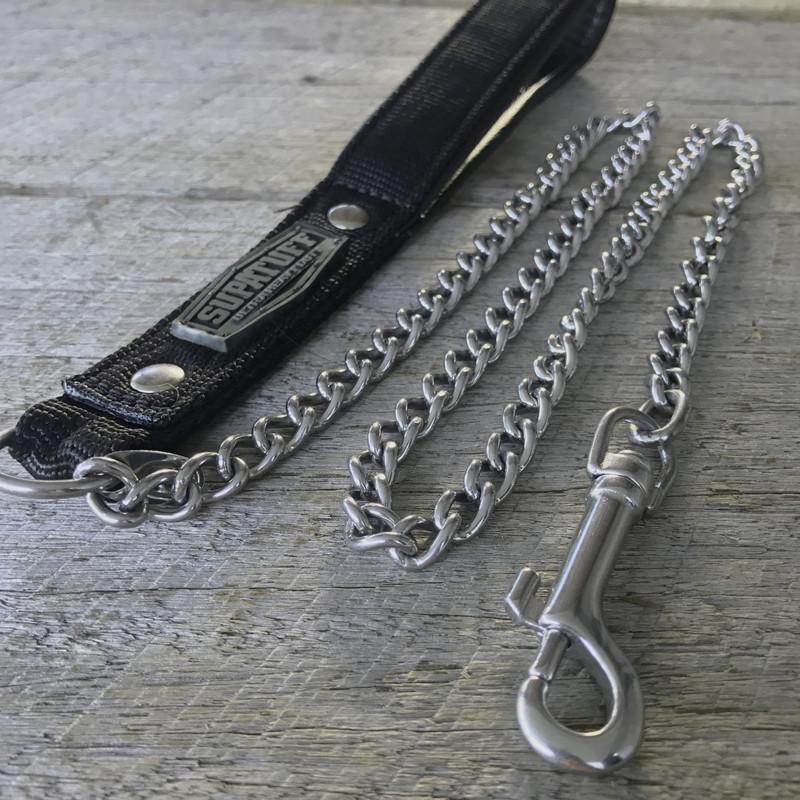
For walking harness options that complement the collar system, the SupaTuff slim fit harness provides a waterproof, all-stainless hardware option in a lightweight profile appropriate for Huskies in Australian summer conditions.
Flat Buckle vs Martingale: The Australian Decision
Both collar types have legitimate applications for Huskies, and the choice depends on the specific dog's escape behaviour and the Australian usage context.
Wide Flat Buckle Collar
A wide flat buckle collar at 4 to 5.5 centimetres, fitted correctly and worn at high-neck position, provides strong passive escape resistance without a tightening mechanism. It is the simpler construction of the two, with no secondary loop that can catch on surfaces or tighten unexpectedly. For Huskies that do not actively attempt collar escape during ID-wearing periods, the flat buckle provides appropriate security with less mechanical complexity. The flat buckle also has no tightening component that could create inadvertent pressure on the throat if the dog moves unexpectedly while tethered.
Martingale Collar
A martingale collar adds a tightening mechanism that closes the collar to skull circumference when tension is applied, preventing the collar from opening wide enough for slip-out regardless of neck-to-skull geometry. For confirmed escape artist Huskies that actively attempt to back out of collars during handling, the martingale's tightening mechanism adds a mechanical safety layer. The important caveat for Australian conditions is that the secondary loop must be managed appropriately during tethering to avoid the loop catching on fencing, vehicles, or furniture in the domestic environment.
Husky Collar Sizing for Australian Conditions
| Husky Profile | Typical Neck (skin level) | Collar Width | Recommended Size Range |
|---|---|---|---|
| Adult female, average build | 45 to 55 cm | 4 to 4.5 cm | Large (Rogue Royalty wide-fit) |
| Adult male, average build | 50 to 60 cm | 4.5 to 5.5 cm | Large to XL (Rogue Royalty wide-fit) |
| Adult male, heavier show/work build | 55 to 65 cm | 5 to 5.5 cm | XL to XXL (Rogue Royalty wide-fit) |
Measure through the coat to skin level at the base of the neck. The Husky's dense double coat can add 2 to 3 centimetres to an over-coat reading. After blowout, remeasure at the same point. Refit or readjust within the buckle range after each seasonal blowout.
Why Choose Rogue Royalty for Your Siberian Husky
The Rogue Royalty wide-fit leather collar range provides the 4 to 5.5 centimetre profile that gives Huskies meaningful skull-geometry escape resistance when combined with the high-neck positioning approach. The smooth napa calfskin inner reduces friction and coat matting at the collar contact line, which for a double-coated breed with a neck ruff accumulates into visible damage over time with rough-surfaced alternatives. All-metal hardware throughout handles the force generated by a large, strong breed during the moments when the collar is the active control or handling point.
The SupaTuff range provides the waterproof option for Huskies in coastal environments, active outdoor lifestyles, and Australian summer conditions where a quick-rinse collar after a water session is more practical than leather requiring conditioning and drying time. Both ranges are built to the same no-plastic hardware standard, which matters for a breed generating significant force at the D-ring and buckle during any sudden movement event.
The Rogue Royalty Collar Range for Siberian Huskies
Classic Wide Fit Leather Collar (Brown and Chrome)
For: companion Huskies in everyday suburban use where the collar serves ID and handling functions alongside harness-based walking
Full-grain bridle leather outer with smooth napa calfskin inner. The 4 to 5.5 cm wide profile provides skull-geometry escape resistance when worn at high-neck position. Solid non-rust metal hardware. Smooth napa inner reduces coat contact friction and matting at the collar ruff line. Available from Small through XXXL covering 33 to 74 cm neck circumference. 10-year craftsmanship warranty.
From $95.00 | View the Classic Wide Fit Leather Collar
SupaTuff Heavy Duty Collar
For: Huskies in coastal environments, active outdoor contexts, or Australian summer conditions requiring wash-and-go maintenance
Custom double-ply SupaTuff nylon, 40 to 48mm width. All-stainless steel hardware throughout, no plastic fittings. Waterproof, rot-resistant, UV-treated. Rinses clean after water sessions without conditioning. The lightweight profile and minimal thermal mass at the throat suits Australian summer conditions better than padded alternatives. Lifetime guarantee.
From $65.00 | View the SupaTuff Heavy Duty Collar
For leather collar maintenance, the All Natural Leather Balm keeps the bridle leather supple and the napa inner soft through Australian outdoor use, applied every six to eight weeks during regular wear.
4 to 5.5 cm wide-fit leather with napa inner for skull-geometry escape resistance. Lightweight SupaTuff for summer and coastal conditions. All-metal hardware. 10-year leather warranty and lifetime SupaTuff guarantee.
Browse the Wide Fit Collar Range →Collar Care for Siberian Huskies in Australian Conditions
The Husky's double coat creates a specific collar care consideration: coat fibres shed into the collar stitching and against the inner lining throughout blowout periods. During the heavy shedding weeks, removing the collar every few days and brushing any accumulated coat fibres from the stitching channels prevents the fibres from embedding in the leather or webbing where they trap moisture and accelerate material degradation.
For leather collars on Huskies in Australian summer conditions: avoid leaving a wet leather collar on the dog after a water session or heavy outdoor activity. The combination of sweat from the Husky's limited sweat glands at paw level and the ambient humidity under the dense double coat creates moisture accumulation at the collar line that, without regular drying and conditioning, accelerates leather degradation faster than dry-climate wear.
The full leather collar range covers all sizing from Medium through XXXL in the wide-fit profile appropriate for Huskies, and the wide-fit collar collection includes all colourway and hardware options available in the Husky-appropriate width range.
Frequently Asked Questions: Collars for Siberian Huskies in Australia
What size collar does a Siberian Husky need?
Most adult Huskies measure 45 to 60 cm at the base of the neck at skin level. Males typically measure 50 to 60 cm and females 45 to 55 cm. The dense double coat can add 2 to 3 cm to an over-coat reading, so measure at skin level through the parted coat. Choose the size where the measurement falls in the middle of the adjustment range and recheck after each seasonal blowout.
Why do Siberian Huskies escape collars so easily?
Two compounding factors: the neck-to-skull geometry allows collar slip-out when the dog applies backward pressure with the head dipped, and most owners wear the collar at the base of the neck where it has maximum travel distance over the skull. Repositioning the collar to high-neck position, just behind the ears, reduces escape distance to the skull and significantly improves passive escape resistance without any change to width or adjustment.
Should a Husky wear a martingale or flat buckle collar?
A correctly fitted wide flat buckle at 4 to 5.5 cm worn at high-neck position suits most Huskies for everyday ID wear. A martingale adds a mechanical tightening safety layer for confirmed escape artists that actively back out of collars. The flat buckle is preferred for simplicity and absence of a secondary loop that can tighten unexpectedly during tethering. The martingale is preferred when passive skull-geometry resistance is not sufficient for the specific dog.
What is the hot climate collar consideration for Huskies in Australia?
The Husky's cold-adapted double coat acts as bidirectional insulation. At collar contact points in Australian summer heat, the compressed coat creates a thermal insulation patch at the throat that reduces heat dissipation. A proportionally fitted collar without excessive coverage or padding minimises this effect. Heavily padded or unnecessarily wide collars add thermal mass at exactly the body point where heat management is most relevant for a breed managing Arctic insulation in Australian conditions.
Why is the harness more important than the collar for a Siberian Husky?
Huskies were bred specifically to pull in harness. Their chest and shoulder anatomy is optimised for harness-based force generation. Walking on a collar concentrates all pulling force at the trachea, thyroid, and cervical spine. The harness distributes the same force across the chest and shoulders as the breed's anatomy was designed for. The collar's role for a Husky is ID-carrying, legal compliance, and close-range handling, not walking control. Harness for walks, collar for ID, is the correct equipment combination for this breed.
How does the seasonal coat blowout affect Husky collar fit in Australia?
Huskies blow coat twice yearly on day-length triggers, not temperature triggers, so the blowout happens in Australia regardless of the mild winters. After each blowout, the neck ruff volume reduces by 1 to 2 cm at the collar contact point without any change in actual neck size. A collar fitted at peak coat can be effectively too loose after blowout. Recheck both the two-finger test and the high-neck skull clearance test after each seasonal blowout.
What Rogue Royalty collars suit Siberian Huskies?
The wide-fit leather collar in full-grain bridle leather with napa inner for everyday suburban companion Huskies where the collar serves ID and handling functions. The 4 to 5.5 cm width provides skull-geometry escape resistance at high-neck position. The SupaTuff Heavy Duty Collar for coastal environments, active outdoor contexts, and Australian summer use where wash-and-go maintenance and minimal thermal mass are priorities. Both in all-metal hardware, no plastic fittings.

