





A dog leash is the piece of equipment that gets the least thought and causes the most problems. Most Australian dog owners buy whatever is on the shelf at the closest pet store, attach it to the collar, and discover six months later that the clip is corroding, the stitching is fraying at the handle, or the whole thing breaks during a sudden lunge on a morning walk. At 6am on a busy road, that is not the moment to find out your leash hardware was undersized for your dog.
After building and testing leashes for K9 units and working dog handlers since 2009, we know exactly what fails and why. This guide covers every leash type available in Australia, how to match length to the activity, what materials and hardware actually hold up in coastal and high-UV Australian conditions, and the one type of leash most experts recommend against entirely.
Every Dog Leash Type Available in Australia
The Australian market offers six distinct leash types, each suited to a different use case. Understanding what each one does physically determines which one your dog actually needs.
Standard Fixed-Length Leash
The baseline. A fixed strap with a clip at one end and a loop handle at the other. Available in lengths from 90cm to 1.8 metres for everyday use, and in materials from budget nylon through to full-grain leather. For most Australian dog owners walking on footpaths, through parks, and along shared paths, a 1.2 to 1.5 metre fixed leash provides the right combination of control and natural walking freedom.
Width should match the dog's size and strength. A 12mm strap suits toy breeds and dogs under 10kg. A 20mm strap works for medium breeds. A 25mm or wider strap is appropriate for large breeds that generate significant leash force. Matching strap width to the dog is not just a comfort consideration; a narrow strap on a large dog concentrates leash force in a way that is uncomfortable to hold and wears the stitching at stress points faster.
Traffic Lead or Short Control Lead
A very short lead of 30 to 60cm used for close control in busy environments. Traffic leads are used at pedestrian crossings, near car parks, in vet waiting rooms, at outdoor markets, and any other situation where you need your dog directly at your side with zero slack. Some owners use a traffic lead as their only leash; most professional handlers use it as a secondary attachment that clips to the harness while the main leash stays on the collar, giving dual-connection handling and immediate short-range control.
Long Line Recall Leash
A fixed-length line of 5 to 15 metres used for distance recall training and controlled exploration in open spaces. A long line is not a walking leash. It is a training tool for the specific phase of a dog's development when recall is being established but cannot yet be trusted fully off-lead. The dog has the physical freedom to range and explore, but the handler maintains a physical connection that prevents the dog from disappearing or reaching a hazard before the recall cue works reliably.
In areas where off-leash exercise is not permitted by local council rules, a long line also allows a dog meaningful movement freedom while keeping the owner legally compliant. Running a 5 or 10 metre long line at a park oval gives a dog more effective exercise freedom than a 1.5 metre everyday leash, even if both are technically on-leash by the council's definition.
Long line management requires attention. The handler needs to keep the line from piling under the dog's feet, and must not let it wrap around their own hands or wrists. Hold the line at the handle end, let it flow naturally to the ground, and move to take up slack rather than letting the dog drag excess rope.
Slip Lead
A combined collar and leash in one piece. The loop at the business end forms around the dog's neck and tightens when tension is applied, releasing when tension stops. Slip leads are the fastest leash to put on and take off, which is why they are used in veterinary clinics, rescue kennels, and catch-and-release situations where speed matters. For training use, the same principles apply as a slip collar: the slip must sit high on the neck just behind the ears, not at the shoulder, and the handler must apply and release tension with precise timing. A slip lead sitting low and held with sustained tension becomes a choke lead.
Multifunction Dog Leash
A leash built with multiple clip points and adjustable loops that reconfigures between formats. A quality multifunction leash covers standard walking length, a short traffic-lead configuration, hands-free cross-body attachment for jogging, two-dog walking capability, and simultaneous attachment to both collar and harness. Police handlers, protection sport competitors, and working dog trainers use multifunction leashes as their primary everyday lead because one piece of equipment covers every situation without needing to swap gear.
Our SupaTuff 6-in-1 multifunction leash ($99) and the handmade leather multifunction leash ($84) are both built to this standard. The leather version is hand-crafted from premium bridle leather with solid brass hardware and is trusted by police and military handlers worldwide.
Chain Leash
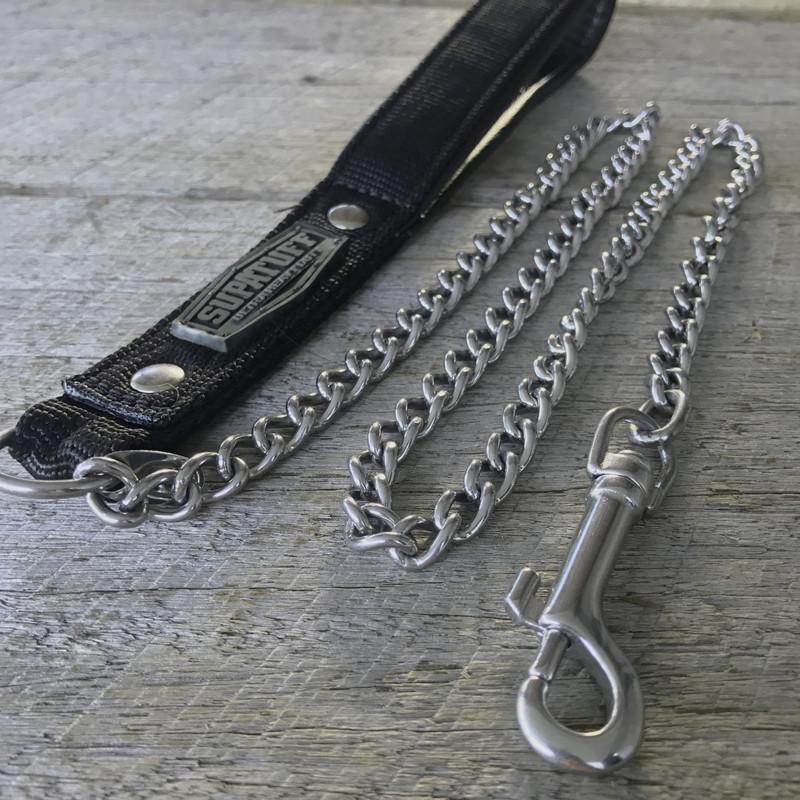
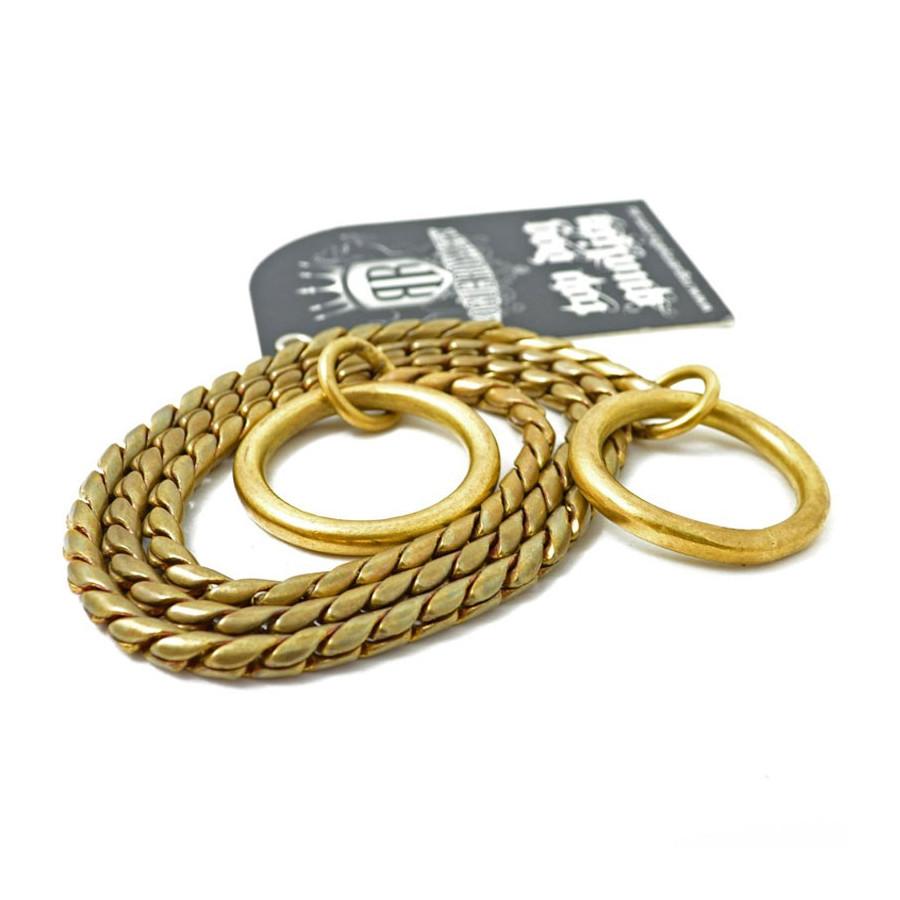
Steel or brass chain used primarily as a style statement and as a chew-deterrent for dogs that mouth their leads. Chain leashes are significantly heavier than nylon or leather equivalents of the same length, which creates downward pull on the collar or harness hardware attachment point. For dogs under 20kg, a 15mm or 20mm chain leash is proportionate. For small dogs, chain leashes are often too heavy to be practical. The chrome chain leash at 20mm and the gold chain leash at 15mm and 20mm in the Rogue Royalty range are both built with proper swivel hardware to reduce tangling under movement.
How to Choose the Right Leash Length for Every Situation
Length selection is driven by the activity and environment, not by habit or what came in the box. The same dog that needs a 1.2 metre leash on a busy footpath needs a 9.5 metre long line in a recall training session at an open oval.
| Situation | Recommended Length | Why |
|---|---|---|
| Busy footpaths, roads nearby | 1.2m | Close control, fast correction distance, legal compliance in tight spaces |
| General suburban walking | 1.2–1.5m | Natural walking slack without giving the dog too much range |
| Open park walking, relaxed pace | 1.5–1.8m | Allows the dog to range slightly and sniff without the lead going taut |
| Café strips, markets, vet clinics | Traffic lead, 30–60cm | Dog stays at side, no slack for approaching other dogs or people |
| Recall training, off-lead transition | 5m, 9.5m, or 10m long line | Distance freedom while maintaining physical connection and legal compliance |
| Obedience training, heel work | 1.2–1.5m leather or 5ft training leash | Consistent feedback, classic competition length for most obedience disciplines |
| Jogging or hands-free use | Multifunction, cross-body configuration | Frees hands, distributes leash force across the body rather than one wrist |
Dog Leash Materials: What Holds Up in Australian Conditions
Australian conditions stress leash materials harder than most Northern Hemisphere environments. Salt air near the coast accelerates metal corrosion and degrades synthetic fibres. Summer UV weakens nylon stitching and causes certain plastics to become brittle. Red dust packs into webbing and affects clip mechanisms. Rain and mud followed by rapid drying is hard on untreated leather. The material choice needs to match the conditions the dog is actually walked in.
Full-Grain Bridle Leather
The top layer of the hide, dense and strong, improves with conditioning over time. A well-maintained leather leash becomes more comfortable to hold as the leather softens and the surface develops natural grip. Leather provides better hand traction than slick nylon in wet conditions because the surface texture increases rather than decreases when damp. The tradeoff is maintenance: leather needs conditioning every one to three months and should not be repeatedly soaked in salt water without being dried and conditioned afterward.
Every Rogue Royalty leather leash uses full-grain bridle leather with bevelled and wax-sealed edges, wax-sealed stitching, solid brass or stainless steel hardware, and napa leather reinforcement at joins and the handle. The leather multifunction training lead has been used by police, military, and competition handlers worldwide and comes with a 100% money-back guarantee on quality.
Heavy-Duty Nylon Webbing
Practical for dogs that swim frequently, beach dogs, and owners who want low-maintenance gear. Quality nylon with solid metal hardware handles salt, sand, and repeated wetting better than leather for daily beach use. The critical variable is hardware quality, not the webbing itself. A heavy-duty nylon leash with zinc alloy clips is an inferior product to a quality nylon leash with stainless steel hardware, and the hardware difference shows within a year of regular coastal use.
Our SupaTuff leash range uses heavy-duty nylon webbing with solid stainless steel or solid brass snaps and no plastic fittings anywhere on the leash. The 9.5 metre recall training leash uses soft-ply nylon webbing specifically designed to prevent hand burn during long-line management, with leather-reinforced joins at the handle, head-latch, and connection points.
Chain
Solid brass or stainless steel chain for owners who want the aesthetic or need a chew-resistant lead. Chain leashes are heavy relative to their length, which matters for small breeds. Solid brass chain does not rust. Plated or zinc chain looks similar initially and corrodes noticeably within one to two years of coastal use. The Titan Heavy Chain lead at 60cm and the chrome chain lead at 20mm width are the working-dog options in the Rogue Royalty range; the gold chain leashes at 15mm and 20mm cover the statement end of the market.
Leash Clip Hardware: The Detail That Determines Safety
Most leash guides mention clip quality briefly and move on. For large, powerful, or reactive dogs, the clip is the most important component on the leash. It is the point where the full force of a sudden lunge concentrates, and it is the component that fails first when hardware is undersized or made from inferior material.
Clip Types and When Each One Works
Bolt snaps are the most common clip type. A spring-loaded button releases the gate. They are compact, quick to clip, and adequate for dogs up to approximately 25kg in everyday conditions. The weakness is that the spring mechanism can weaken over time, and a dog shaking their head vigorously can sometimes apply enough lateral force to release a bolt snap accidentally.
Trigger snaps use a lever mechanism that the thumb presses inward to open. This design resists accidental opening more reliably than a bolt snap because the lever retracts inward and requires deliberate thumb pressure to actuate. For dogs over 25kg, for reactive dogs, and for any working or sport context, a trigger snap is the safer choice.
The material the clip is made from determines how long it holds up in Australian conditions. Zinc alloy clips (often sold as "metal" without further specification) are adequate for mild conditions and light dogs. Solid brass is corrosion-resistant and appropriate for most dogs and environments. Marine-grade stainless steel (grade 316) is the highest-performance option for coastal environments, salt water exposure, and large powerful dogs. It maintains structural integrity in conditions that corrode brass over years.
Clip Size Must Match the Dog's Hardware
A common mistake is buying a leash with a clip sized for a different breed than the one it is being used on. A large, heavy clip on a small dog creates unnecessary downward pull on the collar D-ring and can irritate the neck over long walks. A small, lightweight clip on a large dog may not properly seat over a large D-ring and can release under lateral force. Match the clip diameter to the D-ring diameter on the collar or harness, with the clip large enough to open and close easily but no larger than necessary for the dog's hardware.
Australian Dog Leash Laws: What Every Owner Needs to Know
Leash laws in Australia are state-based and council-enforced. The consistent national requirement is that dogs must be on a leash in public places unless they are in a council-designated off-leash area. Beyond that, specific rules vary meaningfully by state.
| State | Key Leash Requirements | Off-Lead Rules |
|---|---|---|
| NSW | On-leash in all public areas. Maximum 4 dogs per walker. Councils must provide at least one off-leash area. | Council-designated areas only. Dog must be under effective control. |
| VIC | On-leash in public. Owners must carry a leash of max 3m. Within 5m of shared paths and 20m of playgrounds. | Designated off-leash reserves only. Effective control still applies. |
| QLD | On-leash in public. Council fines around $252 for off-leash violations in on-leash areas. | Council-designated areas only. |
| SA | On-leash in public. Maximum 2m lead length in on-leash areas. Retractable leads must not exceed 2m. | Designated areas only. Effective control standard applies. |
| TAS | Leash required on roads and footpaths. Lead must not exceed 2m. Maximum 2 dogs on one footpath per walker. | Off-lead areas only. Must remain responsive to commands. |
| WA | On-leash in public. Greyhounds must be leashed and muzzled in all public areas. Fines $1,000 to $4,000 for dangerous dogs. | Designated off-leash areas only. |
The phrase "effective control" in Australian dog law means more than physical attachment. In off-leash areas, owners are required to maintain effective control, meaning the dog responds to verbal commands and does not approach or harass people, other dogs, or wildlife. A dog that is physically off-leash but ignores its owner is legally not under effective control in most Australian jurisdictions, even in a designated off-leash area.
Always check the current rules with your local council. Councils update off-leash zone designations regularly, particularly in growing suburban areas.
The Rogue Royalty Dog Leash Range
Our gear range covers 73 leash products across leather, heavy-duty nylon, and chain in lengths from 60cm to 10 metres. Every leash in the range uses solid metal hardware. No plastic fittings anywhere across any configuration.
Soft Grip Recall Training Leash 9.5m
Made from soft-ply nylon webbing specifically to prevent hand burn during long-line management. Solid stainless steel snap. Leather-reinforced joins at the handle, head-latch, and all connection points. No plastic fittings. 3cm wide. For recall training, distance work, and any environment where the dog needs significant movement freedom while remaining on lead.
$64.99 | View the recall training leash
SupaTuff 6-in-1 Multifunction Leash
Reconfigures between standard walking, short control, hands-free cross-body, two-dog walking, and dual harness-and-collar attachment. Heavy-duty SupaTuff nylon with all-metal hardware throughout. Trusted by professional handlers. One leash that replaces four.
Leather Multifunction Training Lead
Hand-crafted from premium bridle leather with solid brass hardware. The same 6-in-1 configuration as the SupaTuff version. Specially cured and stitched for durability, softens and improves with use. Used by police, security, and military handlers. Comes with a 100% money-back guarantee.
Leather 5ft Training Leash
Premium bridle leather, 2cm wide, 155cm long. Solid stainless steel snap. Classic obedience and training length used in competition and everyday handling. Ages beautifully, softening with use. Suitable for puppies through to large breeds.
Pairing a Leash with the Right Collar or Harness
A leash and collar or harness work as a system. The leash clip attaches to the D-ring on the collar or harness, which means the load capacity of the clip must match or exceed the load capacity of the D-ring, and the D-ring must be rated for the force the dog can generate. An expensive leash attached to a collar with a stamped open-loop D-ring is only as strong as that D-ring.
For training walks where control is the priority, attaching the leash to a front-clip harness redirects a pulling dog and reduces the pulling force reaching the handler's hands. For working and protection sport contexts, a dual-attachment using both collar and harness gives redundant safety in case one attachment point fails. Rogue Royalty designs the harness range and the collar range with matching D-ring specifications so hardware compatibility is built in across the product line.
Maintaining Your Dog Leash in Australian Conditions
Leather leashes need conditioning every one to three months. After beach use, rinse the leather with fresh water, dry it away from direct sun and heat, and condition with a leather balm before storing. Direct sun drying shrinks and stiffens leather. Heat sources crack it at flex points. Applied every one to three months, the All Natural Leather Balm keeps bridle leather supple through Australian conditions.
Nylon leashes need less care but still benefit from rinsing after salt water exposure. Salt crystals left in the weave abrade the fibres from the inside as the leash flexes during walks. Check all metal hardware after every coastal use for early signs of surface corrosion. A clip showing pitting should be replaced before it fails, regardless of whether the leash itself is still in good condition.
Inspect every leash at least monthly regardless of material. Look for fraying at the handle loop, wear at the clip attachment loop where the hardware sits against the webbing, and any sign that the clip spring is losing tension or that the gate does not close firmly. A compromised leash on a large dog near a road is a serious safety risk. Replace before it fails, not after.
73 leashes across leather, SupaTuff nylon, and chain. Every clip is solid metal. Long lines, multifunction leads, training leashes, chain leads, and everyday walking leashes for every breed and activity level.
View All Dog Leashes →Frequently Asked Questions About Dog Leashes in Australia
What is the best leash length for everyday walking in Australia?
For everyday suburban walking, 1.2 to 1.5 metres is the practical range. This allows enough slack for a dog to walk naturally without pulling tight, while keeping the dog close enough to manage roads, cyclists, and other dogs quickly. In tight urban areas and near roads, 1.2 metres gives better control. In more relaxed park environments, 1.5 to 1.8 metres works well.
What is a long line dog leash used for?
A long line of 5 to 10 metres is a recall training tool that allows a dog to range and practice responding to recall cues while remaining physically connected to the handler. It is also used in areas where off-leash exercise is not permitted, giving the dog more movement freedom while the owner stays legally compliant. A 9.5 metre soft grip recall leash and a 10 metre recall leash are both available in the range.
Why are retractable leashes considered dangerous in Australia?
Retractable leashes create rope burn, laceration, and degloving injuries when the thin cord wraps around skin at speed. The locking mechanism jams in sand and dirt. The extended length allows dogs to reach roads and hazards before the owner can respond. Australian animal behaviour experts and councils including South Australia's City of Charles Sturt have specifically advised against them. A fixed-length lead or a long line in open environments provides better control and fewer injury risks.
What makes a good leash clip for a large or strong dog?
Trigger snap clips resist accidental opening more reliably than bolt snaps for large dogs. Material matters significantly: solid brass or marine-grade stainless steel (grade 316) outlasts zinc alloy and chrome-plated steel in coastal Australian conditions by years. For dogs over 30kg, look for clips with a rated break strength of at least 250kg. Every Rogue Royalty leash uses solid stainless steel or solid brass clips with no plastic fittings.
Are leather dog leashes better than nylon for Australian conditions?
Leather provides a better grip over time, softens with use, and handles everyday suburban and park conditions well. Nylon with solid metal hardware is more practical for dogs that swim daily or live near the beach. Both are solid choices when hardware quality is consistent. Rogue Royalty produces both in configurations that cover the full range of Australian environments and use cases.
What is a multifunction dog leash?
A multifunction leash reconfigures between standard walking length, short traffic-lead control, hands-free cross-body wear for jogging, two-dog walking, and dual harness-and-collar attachment. Police, security, and competition handlers use multifunction leashes as their primary everyday lead. Both the SupaTuff 6-in-1 and the leather multifunction lead cover all these configurations in one piece of gear.
What are Australian leash laws and do they vary by state?
Dogs must be on a leash in all public areas unless in a council-designated off-leash zone. Specific rules vary by state: Victoria requires owners to carry a leash of maximum 3 metres. South Australia and Tasmania require leads no longer than 2 metres in on-leash areas. Western Australia requires Greyhounds to be leashed and muzzled in all public areas. All states apply an effective control standard meaning the dog must respond to commands even in off-leash areas. Check your local council website for specific rules.

