





A muzzle is a safety tool. Used correctly and introduced with patience, it allows dogs to participate in situations they cannot yet safely manage on their own: vet visits, grooming appointments, encounters with other dogs during behaviour modification, public transport, and environments where an unexpected reaction could hurt someone. A muzzle is not a punishment. It is not a solution to behaviour problems on its own. And it is not interchangeable between types, because the wrong muzzle in Australian heat can create a medical emergency within minutes.
This guide covers every muzzle type available in Australia, exactly how to measure a dog for a correct fit, which dogs are legally required to wear a muzzle under Australian state legislation, why leather outperforms metal and plastic in Australian climate conditions, and the Rogue Royalty leather basket muzzle range including the specifically designed short-nose version for brachycephalic and bully breeds. Every product URL in this guide was verified live before publication.
Basket Muzzle vs Soft Muzzle: The Distinction That Matters in Australian Heat
There are two functional categories of dog muzzle and they serve completely different purposes. Understanding which is which prevents the most common and dangerous muzzle mistake Australian dog owners make.
Basket Muzzles
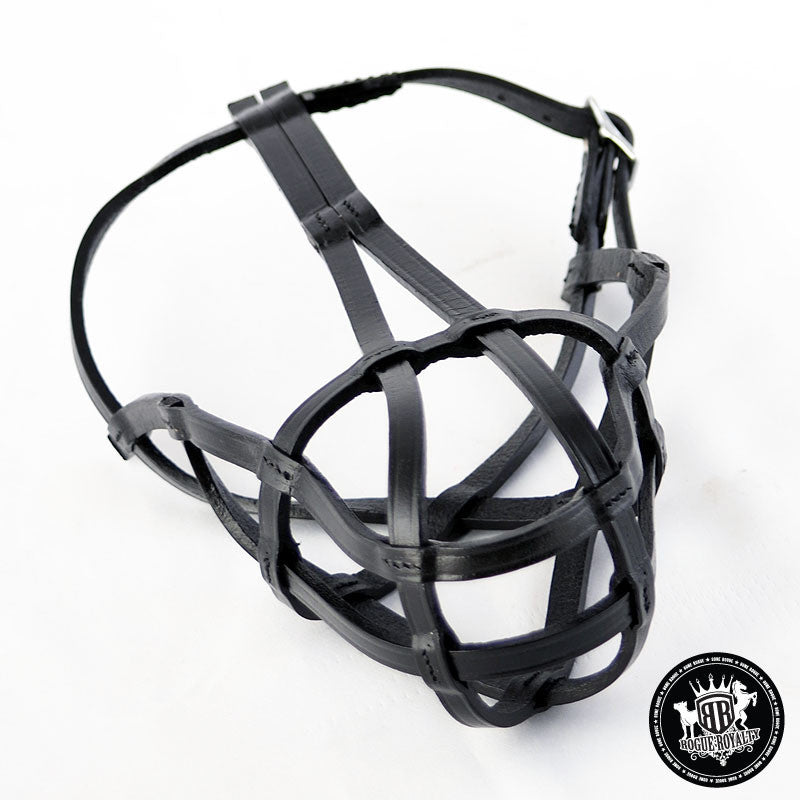
A basket muzzle has an open cage structure around the snout. The dog's mouth can open inside the basket, which means the dog can pant normally, drink water, and accept treats through the gaps in the basket. This is the muzzle type appropriate for any use lasting more than a few minutes.
The open design serves two functions. First, it allows full thermoregulation. Dogs cool themselves through panting, and any restriction on panting in Australian summer temperatures creates heat stress risk within minutes of moderate exercise. Second, it allows the dog to take treats during training, which is critical for positive reinforcement-based muzzle introduction and any behaviour modification work done while muzzled.
Basket muzzles are made from wire, thermoplastic, hard plastic, or leather. Wire and hard plastic are durable and appropriate for high-intensity protection and working dog applications. Leather is the best choice for everyday wear in Australian conditions for reasons covered in detail below.
Soft Muzzles
A soft muzzle wraps around the snout and holds the mouth mostly or fully closed. The dog cannot open their mouth to pant, cannot drink, and cannot accept treats. These muzzles are appropriate only for very brief, supervised procedures: a vet examination that takes a few minutes, a nail clip, or a wound check on a dog in pain who might bite reflexively.
| Feature | Basket Muzzle | Soft Muzzle |
|---|---|---|
| Dog can pant | Yes, fully | No (or severely restricted) |
| Dog can drink water | Yes, through the basket | No |
| Dog can take treats | Yes, through the basket gaps | No |
| Safe for walks and exercise | Yes | No, heat stress risk |
| Safe for extended wear | Yes, with correct fit | No, 10 minutes maximum |
| Suitable for training work | Yes | No |
| Best use case | All situations beyond brief procedures | Brief supervised vet or grooming procedures only |
When a Muzzle Is Appropriate and When It Is Not
Using a muzzle correctly means understanding both when it helps and what it cannot do on its own.
Situations Where a Muzzle Is Appropriate
Vet visits and grooming are the most common and most justified use for any dog. Dogs in pain bite reflexively, regardless of their normal temperament. A basket muzzle on an injured or examined dog is a welfare measure for both the dog and the handler. Most veterinary practices in Australia use muzzles routinely during examinations, particularly for animals in acute pain.
Behaviour modification work with reactive or aggressive dogs requires the handler to manage risk while the dog is in situations that currently trigger a reaction. A basket muzzle allows the dog to participate in the training environment safely while the behaviour modification progresses over weeks and months. Crucially, the muzzle reduces the consequence of an event while training reduces the likelihood of an event. Both are needed.
Legal compliance for declared dangerous dogs and restricted breed dogs in Australia requires muzzling in public spaces under state legislation. Owners of these dogs need a muzzle that can be worn for the full duration of a walk and provides reliable bite prevention while allowing normal thermoregulation.
Emergency situations including injury, unfamiliar handling by non-owners, and veterinary triage are contexts where any dog might bite from pain or fear. A muzzle trained in advance and associated with positive outcomes is significantly more useful than one that is introduced during a crisis.
Situations Where a Muzzle Is Not Appropriate
A muzzle is never appropriate as a solution to barking or destructive behaviour in an unsupervised dog. This creates fear, distress, and prevents normal self-regulation without addressing the cause of the behaviour. A muzzle cannot be left on an unsupervised dog for extended periods. A muzzle is not a substitute for behaviour modification. If a dog's behaviour requires a muzzle for safety in every interaction, the muzzle manages the risk while professional training addresses the cause. It does not replace that training.
How to Measure Your Dog for a Muzzle
An incorrectly sized muzzle fails in one of two ways. Too small and the dog cannot open their mouth to pant, which is dangerous. Too large and the muzzle moves, rubs, or is pawable, making it ineffective. Three measurements determine the correct size.
The Three Measurements You Need
Measurement A - Snout length: From the tip of the nose to approximately 1 to 2cm below the eyes, measured along the top of the nose. This determines how long the muzzle basket needs to be. The muzzle should not be longer than this measurement or it will obstruct the dog's line of vision. It should not be shorter or the basket will press the nose.
Measurement B - Snout circumference: Around the snout at the widest point, with the dog's mouth closed. This is the most critical measurement. The muzzle's internal circumference must be 2 to 4cm larger than this measurement to allow the mouth to open for panting. If the muzzle circumference equals the dog's snout circumference, the mouth cannot open.
Measurement C - Head circumference: Around the widest point of the skull across the cheekbones and under the throat. This determines the rear strap adjustment range. The strap must be able to sit comfortably behind the ears without being so loose that the dog can paw the muzzle forward and off.
Rogue Royalty Leather Basket Muzzle Sizing Chart
| Size | Nose to Top of Head (A) | Snout Circumference Fits Up To (B) | Head Circumference Range (C) | Typical Breed Fit |
|---|---|---|---|---|
| 1 | 15cm | 18cm | 30cm to 35cm | Small breeds, Toy Poodle, Miniature Schnauzer |
| 2 | 18cm | 19cm | 33cm to 38cm | Beagle, Cocker Spaniel, small Kelpie |
| 3 | 19cm | 20cm | 35cm to 40cm | Border Collie, Whippet, medium Kelpie |
| 4 | 20cm | 21cm | 37cm to 42cm | Labrador (female), Australian Shepherd |
| 5 | 21cm | 22cm | 39cm to 44cm | Labrador (male), Golden Retriever |
| 6 | 23cm | 23cm | 41cm to 47cm | Large German Shepherd, Malinois |
| 7 | 24cm | 25cm | 43cm to 48cm | Large Malinois, Dobermann |
| 8 | 27cm | 27cm | 44cm to 51cm | Large German Shepherd, Rottweiler (female) |
| 9 | 28cm | 30cm | 49cm to 52cm | Rottweiler (male), large Shepherd |
| 10 | 30cm | 32cm | 55cm to 58cm | Great Dane, Saint Bernard, large Mastiff |
| 11 | 31cm | 34cm | 53cm to 60cm | XL breeds, Irish Wolfhound |
| 12 | 34cm | 36cm | 60cm to 66cm | Giant breeds |
| 13 | 36cm | 40cm | 62cm to 69cm | Giant breeds, very large Mastiff |
The Rogue Royalty Leather Basket Muzzle Range
Both muzzles in the Rogue Royalty muzzle range are handmade from natural leather with an open basket design that allows full panting, drinking, and treat delivery. Natural leather was chosen over metal and plastic for specific reasons relevant to Australian conditions.
Metal muzzles absorb and retain heat against the dog's skin in direct sun. In Australian summer, metal contact against a dog's nose and face during a long walk becomes uncomfortable within 15 to 20 minutes in full sun. In winter, cold metal can cause the muzzle to stick uncomfortably to the skin. Natural leather does not absorb heat the way metal does and remains skin-temperature-neutral across a wider range of conditions.
Leather also softens over time, which means the muzzle becomes more comfortable the longer it is used. A new leather muzzle in week one is firmer at the contact points than the same muzzle in month six, which has conformed to the dog's face shape and softened at all pressure areas. No plastic or thermoplastic muzzle replicates this quality.
Dog Muzzle - Leather Basket (Standard)
For: standard-snouted dogs, working dogs, everyday wear, vet visits, training, legal compliance for declared dogs
Handmade natural leather basket muzzle with an open design for superior ventilation. Sized from small breeds (Size 1) through giants (Size 13) with a three-measurement sizing system. Full head strap prevents the dog from pawing the muzzle forward and off. Leather softens progressively for increasing comfort with wear. Suitable for hot and cold Australian climates. Used by protection, security, and police handlers. Meets the requirements of dangerous dog declarations in Australia.
From $55.00 | View the Leather Basket Muzzle
Short-Nose Muzzle - Leather Basket (Brachycephalic and Bully Breeds)
For: Staffies, Bulldogs, Boxers, French Bulldogs, Pugs, and any breed with a wide skull, short muzzle, heavy jowls, or loose facial skin
Designed specifically for flat-faced and bully breed anatomy after nearly a year of prototyping and testing across multiple breeds. Standard muzzles built for long-snouted dogs press against the nose, ride up into the eyes, and cannot secure around the wide skull geometry of brachycephalic breeds. This muzzle uses a shorter basket structure and wider rear geometry that accommodates brachycephalic anatomy correctly. Handmade natural leather, open basket for full ventilation and panting, progressive softening with wear. Sized using three measurements: nose length, muzzle circumference, and head/neck circumference.
$65.00 | View the Short-Nose Leather Muzzle
Why Leather Outperforms Metal and Plastic in Australian Conditions
Most international muzzle guides recommend thermoplastic basket muzzles as the primary choice. That recommendation is valid in temperate Northern Hemisphere climates. In Australia, the specific demands of summer heat, UV intensity, and the working and outdoor conditions under which many Australian dogs are muzzled favour leather for most applications.
Wire basket muzzles provide excellent ventilation and are appropriate for protection sport and high-intensity working applications. They are the right choice when physical impact resistance during bite work is required. For everyday use, vet visits, walks, and training sessions, the wire contact against the dog's nose during normal movement creates unnecessary friction that leather eliminates.
For beach and outdoor environments specifically, leather maintains a stable surface temperature that does not spike in direct sun the way wire and plastic do. Leather can be conditioned after salt water exposure and will maintain its integrity through the combination of UV, salt, and heat that Australian outdoor conditions regularly deliver. A quality leather muzzle properly conditioned with the Rogue Royalty All Natural Leather Balm after salt water or prolonged sun exposure will outlast cheaper plastic alternatives significantly.
Dog Muzzle Laws in Australia by State
Australian muzzle legislation is state-based and covers two categories of dogs: declared dangerous dogs (based on individual behaviour) and restricted breed dogs (based on breed regardless of individual behaviour).
| State | Muzzle Required For | Key Requirement |
|---|---|---|
| NSW | Restricted breeds (Pit Bull Terrier, Dogo Argentino, Fila Brasileiro, Presa Canario, Japanese Tosa) and declared dangerous dogs | Must be muzzled in all public places. Fines up to $77,000 for non-compliance with dangerous dog provisions. |
| VIC | Declared dangerous dogs and restricted breed dogs; declared menacing dogs | Domestic Animals Act: must be muzzled and on a lead outside the owner's dwelling and enclosure. Restricted breeds include the same five breeds as NSW. |
| QLD | Restricted breeds and declared dangerous dogs | Must wear a muzzle in public. Greyhound muzzling: exemption pathway exists via temperament assessment in some councils. |
| SA | Restricted breeds and declared dangerous dogs | Greyhound muzzling: exemption available after accreditation assessment. |
| WA | Declared dangerous dogs and restricted breed dogs | Greyhounds: compulsory muzzling requirement has been lifted for pet Greyhounds in WA. |
| TAS | Declared dangerous dogs and restricted breed dogs | Dog Control Act: must be muzzled on a lead no longer than 2 metres, handled by a person over 18. Greyhounds: muzzling requirement lifted for pet Greyhounds. |
Greyhound muzzling requirements deserve specific mention because they vary significantly by state and have changed in recent years. NSW, Victoria, WA, and Tasmania have lifted the compulsory muzzling requirement for pet Greyhounds. Queensland and SA retain requirements with an exemption pathway once a Greyhound undergoes a temperament assessment, usually resulting in a green collar designation that allows off-muzzle time. The RSPCA and Australian Veterinary Association both oppose compulsory pet Greyhound muzzling as breed-specific legislation unsupported by evidence of elevated risk.
Always check with your specific local council, as council-level rules can apply additional requirements beyond state minimums.
How to Introduce a Muzzle to Your Dog
A muzzle introduced through force or urgency creates a negative association that makes every future muzzling harder and more stressful. A muzzle introduced through positive reinforcement becomes neutral to positive within two to three weeks for most dogs.
Begin by placing a treat inside the basket and holding the muzzle in front of the dog without any pressure to engage. Let the dog sniff and investigate. The moment they push their nose toward the basket to reach the treat, mark and reward. Repeat this 10 to 15 times in the first session without ever touching the straps.
In subsequent sessions, hold the straps loosely while the dog's nose is in the basket and the dog is focused on treats. Do not clip the straps. When the dog is comfortable with the straps being held, begin clipping for a single second, then unclip and deliver treats. Gradually extend the clipped duration while continuously delivering treats through the basket.
Build up wear time in low-distraction environments at home before moving to outdoor environments. A dog that is comfortable wearing a muzzle at home for 10 minutes while receiving treats will transfer that comfort to more demanding environments far faster than one whose first real muzzle experience was a stressful vet visit.
The animal behaviour team at ACES Australia specifically notes that in hot Australian conditions, muzzle training sessions should be kept short, scheduled during cool parts of the day, and paired with access to water that the dog can lap through the basket gaps. Never rush the training timeline to meet a deadline. A muzzle trained over two weeks is far more useful than one rushed into use in three days.
Handmade natural leather, open basket design for full panting and ventilation. Standard range from Size 1 to 13 covering small breeds through giants. Short-nose version specifically built for brachycephalic and bully breeds. Trusted by protection handlers, K9 security units, and everyday dog owners across Australia.
View the Muzzle Range →Pairing a Muzzle with the Right Collar and Harness
A muzzle works as part of a complete handling system. The rear head strap on any basket muzzle secures around the skull behind the ears and anchors to the collar or sits independently. For dogs on a standard collar, the muzzle strap should be checked to confirm it does not place pressure on the collar buckle hardware. For dogs on a harness, the muzzle operates independently of the harness connection points.
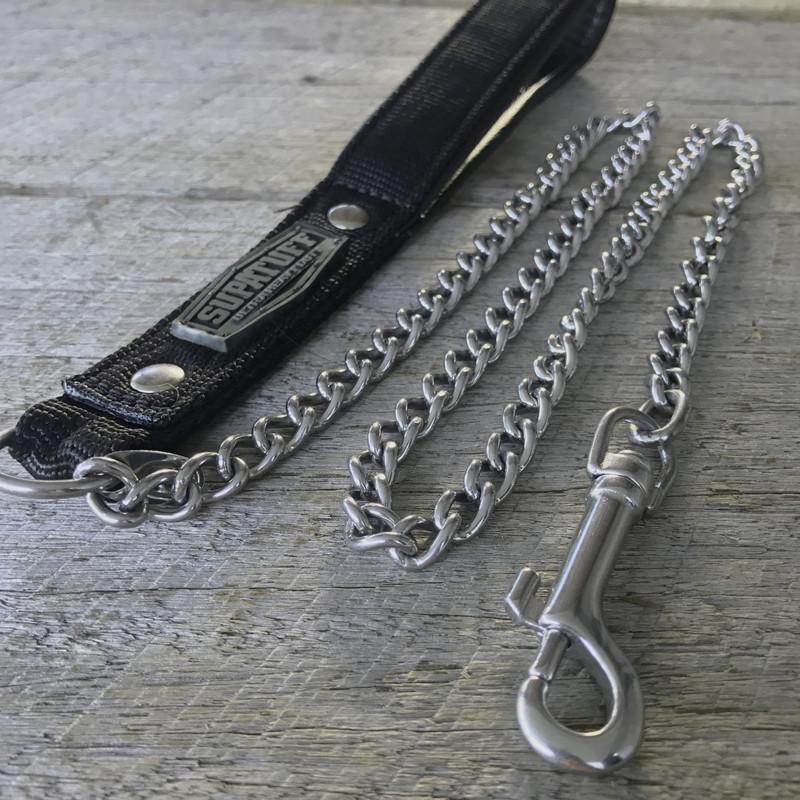
Dogs that require a muzzle for behaviour reasons during training often also benefit from a well-fitted training harness that gives the handler additional control during the behaviour modification process. The SUPATUFF Heavy Duty harness pairs with the leather muzzle for large, powerful, or reactive breeds where both tools are part of the management approach. The harness provides the handler with body control through the shoulder and chest structure, while the muzzle prevents bite risk during the training progression.
For dogs on a leather collar, the collar sits behind the muzzle strap. Confirm the collar buckle hardware does not sit directly under the muzzle rear strap, as hardware contact under strap pressure creates a pressure point that can cause discomfort over long wear.
Frequently Asked Questions About Dog Muzzles in Australia
What is the difference between a basket muzzle and a soft muzzle?
A basket muzzle has an open cage structure that allows the dog to pant, drink, and take treats. It is appropriate for all uses beyond a brief supervised procedure. A soft muzzle wraps the snout closed and restricts panting. It is only appropriate for very brief vet or grooming procedures under direct supervision. In Australian summer heat, a soft muzzle creates heat stress risk within minutes of moderate activity. For any use lasting more than ten minutes or involving physical activity, a basket muzzle is the only safe choice.
How do I measure my dog for a muzzle?
Three measurements: snout length (nose tip to 1 to 2cm below the eyes), snout circumference at the widest point with mouth closed, and head circumference across the cheekbones. When selecting a basket muzzle size, the muzzle's internal circumference must be at least 4cm larger than the dog's measured snout circumference to allow the jaw to open enough for panting. If uncertain between two sizes, always size up on circumference.
Are dog muzzles cruel?
A well-fitted basket muzzle introduced through positive reinforcement is not cruel. It allows the dog to pant, drink, take treats, and engage normally with its environment. Australian animal behaviour professionals consistently describe basket muzzles as safety and training tools. A muzzle becomes a welfare concern when it is the wrong type for extended use, fits incorrectly and causes rubbing, or is used as a substitute for behaviour modification rather than alongside it.
Which dogs are legally required to wear a muzzle in Australia?
Declared dangerous dogs and restricted breed dogs must be muzzled off the owner's premises under legislation in all states. Restricted breeds covered in multiple states include American Pit Bull Terriers, Dogo Argentino, Fila Brasileiro, Perro de Presa Canario, and Japanese Tosa. Greyhound muzzling requirements have been lifted for pet Greyhounds in NSW, Victoria, WA, and Tasmania. QLD and SA retain requirements with exemption pathways. Check your local council for specific requirements.
Why can't I fit a standard muzzle on my Staffy or Bulldog?
Staffies, Bulldogs, Boxers, and other brachycephalic breeds have wide skulls, short muzzles, heavy jowls, and loose facial skin that standard muzzles were not designed for. Standard muzzles press against the nose, ride up into the eyes, or cannot secure around the wide skull geometry. The Rogue Royalty Short-Nose Leather Basket Muzzle was developed specifically for this anatomy after nearly a year of prototyping and testing across bully and flat-faced breeds.
Why is leather better than metal or plastic for dog muzzles in Australian conditions?
Metal absorbs and retains heat in direct sun, becoming uncomfortable against the dog's face during extended outdoor use. In cold conditions, metal can stick to skin. Natural leather remains temperature-neutral across a wider range of conditions, softens progressively with wear to conform to the dog's face, and does not create the friction points that wire contact against the nose causes during normal movement. Properly conditioned leather also handles the salt, UV, and heat combination that Australian outdoor environments regularly deliver.
How do I introduce a muzzle to my dog?
Place a treat inside the basket and let the dog push their nose in voluntarily. Repeat many times without clipping the straps. Once the dog is confident pushing their nose into the basket, hold the straps loosely while delivering treats through the basket. Gradually introduce clipping the straps for a second at a time, extending duration while continuously rewarding. Build up wear time in low-distraction home environments before using in public. Most dogs accept a basket muzzle within two to three weeks of this approach.

