





Choosing a german shepherd collar involves more specific decisions than a generic large-dog collar guide covers. The GSD's neck anatomy, double coat, and in many cases working drive create collar requirements that differ meaningfully from other large breeds of similar weight. Getting the width, material, and hardware right means the collar is comfortable for the many hours a day a German Shepherd wears it, holds up under the forces the breed generates, and fits correctly across the seasonal coat changes an Australian GSD goes through.
This guide covers the GSD's specific anatomy and how it affects collar selection, why working line and show line Shepherds have different requirements, how the double coat changes sizing across Australian seasons, what hardware grade is appropriate, and how the Rogue Royalty collar range maps to German Shepherd use at every level from companion pet to working patrol dog.
What Makes the German Shepherd Collar Requirement Different from Other Large Breeds
Most large-dog collar guides treat all breeds in the 30 to 50kg range similarly. For German Shepherds, this approach misses the specific features of the breed's anatomy that affect collar selection.
The German Shepherd's neck is proportionally longer and more elegant relative to overall body size than other large breeds commonly used as comparators. A Rottweiler or Bull Arab of similar weight has a shorter, more muscular neck with a broader base. The GSD's longer neck means that collar positioning, strap width, and the angle at which any leash force is applied to the neck are all slightly different from how those variables work on stockier breeds.
The double coat adds a layer of complexity that most guides acknowledge but few address practically. In Australian conditions, the seasonal coat change between summer's short undercoat and winter's fuller coat can shift the effective collar circumference by enough that a collar that fitted correctly in summer is noticeably tighter by mid-winter. This matters more for German Shepherds than for single-coated breeds because the coat change is more pronounced.
The German Shepherd also spans a wider range of drive levels and working histories than most other popular breeds. A companion GSD from show lines living in a Sydney suburb generates different leash forces and requires different hardware specifications than a working line GSD used for patrol or protection training. A single collar recommendation does not serve both dogs equally well.
German Shepherd Neck Measurement: How to Do It Correctly
Accurate neck measurement is the foundation of collar selection for any breed, but for German Shepherds it requires a specific approach because of the double coat and seasonal variation.
Use a soft tape measure and wrap it around the widest point of the neck at the base, where the collar will actually sit in use, not at the mid-neck where the neck is narrower. Measure with gentle contact against the coat surface rather than pulled tight against the skin. Read the circumference and add the width of two fingers to get the working fit measurement. This is the number to use when selecting the size range.
Perform this measurement at the end of winter, when the undercoat is at its fullest. This is the measurement that will determine fit during the tightest seasonal period. If the working fit measurement falls at the very top of a size range in winter, choose the next size up rather than the current range, as the tightest point in the seasonal cycle is the critical fit to prioritise.
After fitting the collar, apply the two-finger check at every adjustment point: two fingers should slide under the collar with gentle pressure. Check the fit again after the first 20-minute active wear session, as the collar settles into position under movement. Then check again at the start of winter as the undercoat grows in.
German Shepherd Collar Width: What the Breed Actually Needs
Collar width is the variable that most GSD owners underestimate. The instinct is to select a collar that looks proportional to the dog's body, but the function of collar width is pressure distribution rather than aesthetics.
Any leash force, whether a gentle pressure during heel work or a sudden reactive lunge in a public environment, is distributed across the contact area between the collar and the neck. A narrow collar concentrates this force across a small contact strip. A wider collar distributes the same force across a proportionally larger area, reducing peak pressure per unit area at any point on the neck during the event.
For German Shepherds, the recommended width range is 35mm to 48mm for adult dogs. Working line GSDs and high-drive individuals generate higher peak forces and benefit from the wider end of this range, 40mm to 48mm. Companion GSDs in everyday suburban use can use the narrower end, 35mm to 40mm, without meaningful compromise. Puppies and adolescents should be fitted with collars proportional to their current neck size and resized as they develop, rather than being put in adult-width collars that are too wide for their juvenile neck.
| GSD Age and Type | Typical Neck Circumference | Recommended Width | Notes |
|---|---|---|---|
| Puppy (8 to 16 weeks) | 25cm to 36cm | 15mm to 20mm | Measure frequently; puppies grow quickly through sizes |
| Adolescent (4 to 12 months) | 35cm to 50cm | 20mm to 30mm | Check fit monthly during the rapid growth phase |
| Adult female (show or companion line) | 45cm to 55cm | 35mm to 40mm | Measure at end of winter for winter-coat fit |
| Adult male (show or companion line) | 50cm to 60cm | 40mm to 48mm | Males tend toward the wider end of the size range |
| Working line GSD (either sex) | 48cm to 62cm | 40mm to 48mm | All-metal hardware required; working line GSDs generate higher peak forces |
Working Line vs Show Line German Shepherds: Different Collar Requirements
The German Shepherd exists in two meaningfully different population groups in Australia: working lines and show lines. The collar that suits one does not always suit the other equally well.
Working Line German Shepherds
Working line GSDs are bred for drive, athleticism, and working ability in police, military, search and rescue, and protection sport contexts. They are typically leaner, more muscular, and higher-drive than show line dogs, with higher reactive force during excited or stimulated moments. For working line GSDs, the collar is not just an ID tag holder. It is an operational piece of equipment that must hold up under the peak loads the dog generates without hardware failure.
All-metal hardware at the D-ring and buckle is a safety requirement for working line dogs, not a preference. Plastic hardware at any load-bearing connection point fails under the sudden peak forces that a highly driven GSD generates during a reactive event. The SupaTuff SECURITY collar with its double-pronged all-stainless buckle and welded stainless D-ring is built to this specification. The wide-fit leather collar range with solid brass hardware meets the same specification in a leather construction for dry-condition working use.
Show Line and Companion German Shepherds
Show line GSDs are typically calmer, broader in build, and lower in reactive drive than working line dogs. In everyday companion contexts, they generate lower peak leash forces and have different daily wear requirements. A show line GSD in a suburban environment benefits from the same wide-fit profile as a working line dog, but the hardware specification can be satisfied by the full leather collar range rather than requiring the heavy-duty waterproof SupaTuff construction.
For show line GSDs that attend obedience trials, conformation shows, or public events where the dog is on leash for extended periods, collar comfort across long wearing durations is a primary consideration. Full-grain bridle leather with a napa calfskin inner develops a conforming fit to the individual dog's neck over months of regular wear, becoming more comfortable rather than less as it breaks in.
Collar Material for German Shepherds in Australian Conditions
Australian conditions create specific material considerations that generic collar guides written for northern hemisphere markets do not address. The combination of UV intensity, temperature extremes, and seasonal variation affects both the collar material and the hardware in ways that matter for long-term durability.
Full-Grain Leather for Dry Everyday Use
Full-grain bridle leather is the appropriate choice for German Shepherds in everyday suburban and training use in dry Australian conditions. It handles the leash forces a GSD generates without fraying at D-ring attachment points as nylon alternatives do under sustained daily use. The leather softens and conforms to the dog's neck over time, producing comfort that improves with wear rather than degrading. Solid brass hardware matched to the leather construction resists the corrosion that chrome-plated alternatives develop under Australian UV and humidity.
For Australian summer conditions, leather requires conditioning two to three times a year to maintain suppleness and prevent surface cracking. A well-maintained leather collar for a German Shepherd can last eight to twelve years under daily active use, making the initial investment significantly more cost-effective than replacing nylon alternatives every one to two years.
SupaTuff Waterproof Nylon for Wet and Field Conditions
German Shepherds used in field work, patrol, beach environments, or any context involving regular water exposure need a waterproof collar that handles repeated wet and dry cycles without strap degradation. The SupaTuff double-ply waterproof nylon with all-stainless hardware is built for these conditions. It rinses clean, dries quickly, and does not develop the mildew or fibre softening that standard nylon collars develop under sustained wet use. The all-stainless hardware resists salt corrosion in coastal Australian environments where chrome-plated alternatives deteriorate rapidly.
Common Mistakes When Choosing a German Shepherd Collar
Selecting collar width by appearance rather than by function. A narrow collar looks proportional on a large dog but concentrates leash force at a small neck contact area. For a GSD that pulls, a 20mm narrow collar concentrates force in a way that is uncomfortable and potentially damaging over time. Width is a function specification, not an aesthetic one.
Not accounting for double coat thickness in sizing. A collar that fits correctly in Australian summer may be truly tight by mid-winter when the undercoat is fully grown. Measuring once in summer and never rechecking is the most common fit error for GSD owners in Australia.
Using plastic buckles on a working line or high-drive GSD. Plastic buckles fail suddenly at their rated load without warning. For a dog that generates the reactive forces a high-drive working line GSD does, this failure mode occurs at the worst possible moment. All-metal hardware is a safety specification for these dogs.
Fitting the collar too tight for the coat. Because GSD owners see the thick coat and assume the collar needs to be tighter to contact the skin, over-tightening is common. The two-finger check applies at the coat surface, not at the skin. Two fingers should slide under the collar at the coat level for correct fit.
Using a single collar for both ID wear and leash walking. For German Shepherds that pull significantly or are in active training, a collar used for ID and a harness used for leash attachment is a more appropriate setup than relying on the collar for active walking control. The collar remains as the ID and backup control point while the harness handles the primary leash force.
Why Choose Rogue Royalty for Your German Shepherd Collar
Rogue Royalty has been handcrafting dog gear in Australia since 2009, with over 30,000 customers using the collar and working dog range in daily active use. German Shepherds are among the most common breeds in the Rogue Royalty customer base, and the product range reflects the specific requirements of the breed: wide-fit leather collars for the GSD's proportionally longer neck, all-metal hardware at every connection point, and SupaTuff waterproof construction for working and active use in Australian conditions.
The range covers the full spectrum of GSD use from companion pet to working patrol dog, with leather and SupaTuff options at every size from the adolescent growth phase through to the large adult male working line GSD.
The Rogue Royalty German Shepherd Collar Range
Wide Fit Leather Collar Range
For: German Shepherds in everyday and training use in dry conditions; develops a conforming fit over time; correct width for pressure distribution on large breed necks
Full-grain bridle leather. Napa calfskin inner lining. Solid brass hardware. Available Small through XXXL, covering all GSD sizes from adolescent through to large adult males. 10-year craftsmanship warranty.
From $66.50 AUD | Browse the Wide Fit Leather Collar Range
SupaTuff Strong Dog Collar (Wide Fit)
For: German Shepherds in active outdoor, field, and patrol use; waterproof for beach, rain, and coastal Australian conditions; all-stainless hardware
Double-ply SupaTuff nylon. All-stainless hardware. No plastic. Wide-fit profile. Waterproof, UV-treated, rot-resistant. Suits working GSDs in all Australian outdoor conditions. Lifetime guarantee.
From $69.60 AUD | View the SupaTuff Wide Fit Collar
SupaTuff SECURITY Collar
For: working line and high-drive German Shepherds; the highest-specification collar in the range with double-pronged stainless buckle and welded stainless D-ring
Double-ply waterproof SupaTuff nylon. Double-pronged all-stainless buckle. Welded solid stainless D-ring. No plastic at any connection. 48mm wide-fit profile. Lifetime guarantee.
$76.00 AUD | View the SupaTuff SECURITY Collar
Active X Dog Harness
For: pairing with the collar for walk and training sessions; distributes leash force across chest and shoulders rather than the neck; recommended for GSDs that pull
Built for active, high-drive breeds. Full freedom of shoulder movement. Chest-distributed leash force. Solid metal hardware. Suited to the GSD's active working movement patterns.
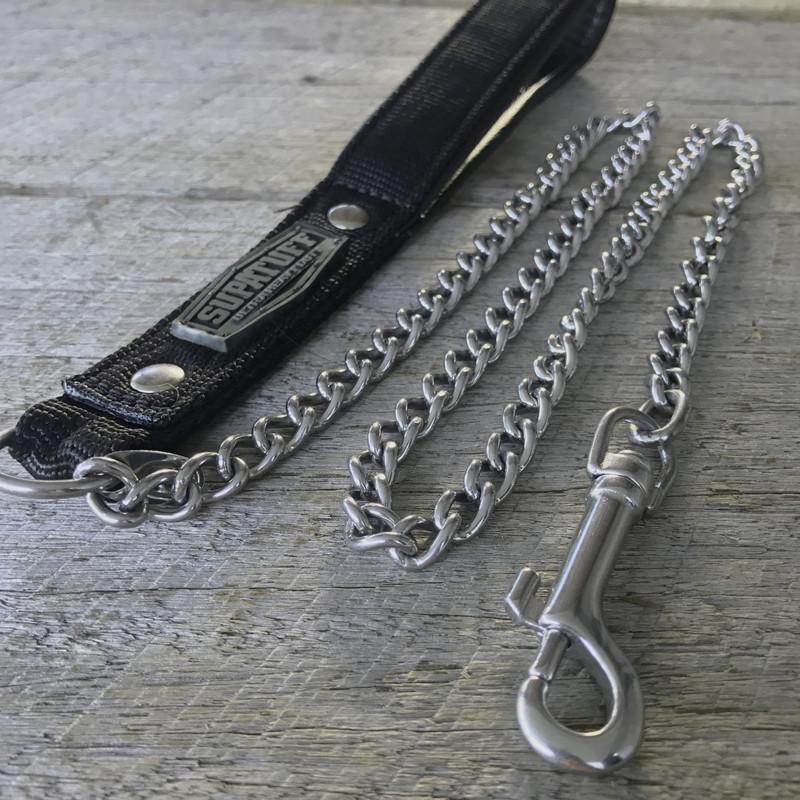
Complete the setup with a matched lead from the Rogue Royalty dog leash range in matched all-stainless or solid brass hardware for a complete collar and lead system without dissimilar metal contact at the snap clip.
Wide-fit leather collars from $66.50. SupaTuff waterproof from $69.60. SECURITY collar at $76.00. All-metal hardware. No plastic. Sized for German Shepherds.
Browse the Full Leather Collar Range →What Australian Dog Owners Say About Rogue Royalty
Thick, well made, durable and padded on the inside for comfort. Its such a beautiful collar! The leather is great for my dogs sensitive skin and she looks badass!
I absolutely love this colour on my girl and the quality is great ..ideal for a girl like mine who loves hanging off the back of the ute.
Love the quality, and the design, and our looks awesome, thanks
Amazing quality collars!
Great product and service
Frequently Asked Questions: German Shepherd Collar
What size collar does a German Shepherd need?
Most adult GSDs need a collar fitting a neck circumference of 45cm to 60cm, with males toward the upper end and females toward the lower end. Measure at the widest point of the neck at the base where the collar sits, add two finger-widths, and choose the size where this falls in the middle of the range. In Australia, measure at end of winter when the double coat is fullest.
What width collar does a German Shepherd need?
Adults need 35mm to 48mm width. Working line and high-drive GSDs suit the wider end (40mm to 48mm). Companion GSDs in everyday suburban use can use 35mm to 40mm. Width distributes leash force across more neck surface area: it is a function specification, not an aesthetic choice.
What is the best collar material for a German Shepherd?
Full-grain bridle leather with solid brass hardware for everyday dry-condition use. It conforms to the neck over time and lasts significantly longer than nylon under daily active use. SupaTuff waterproof nylon with all-stainless hardware for working, coastal, or wet-condition use. Both options provide all-metal hardware at every connection point.
Does the German Shepherd double coat affect collar sizing?
Yes. Seasonal coat changes can shift the effective collar circumference by one to two centimetres. Measure at end of winter when the coat is fullest and select a size where this measurement falls in the middle of the range. Check the two-finger clearance again at the start of each winter as the undercoat grows in.
What is the difference between working line and show line GSD collar requirements?
Working line GSDs are higher-drive and generate higher peak leash forces, making all-metal hardware at D-ring and buckle a safety requirement. The SupaTuff SECURITY collar or wide-fit leather with solid brass hardware suits them. Show line companion GSDs in suburban use can use the same range with slightly less concern about peak hardware load.
Should a German Shepherd wear a collar or harness?
Both. A collar for everyday ID tag attachment and short handling interactions. A harness for walks and training sessions where leash force is generated, as it distributes force across the chest rather than the neck. The collar and harness serve complementary functions for most GSD owners.
How do I fit a collar correctly on a German Shepherd?
Measure neck circumference at the base where the collar sits. Add two finger-widths for working fit. Select the size where this falls in the middle of the range. Apply the two-finger check under the collar at the coat surface after fitting. Recheck after the first 20-minute walk and again at the start of winter.

