





Most dog leash guides tell you to look for durable materials, strong hardware, and a comfortable grip. Those three categories are correct and entirely useless without the specific numbers and mechanisms behind them. A 15mm nylon leash with a zinc-plated snap clip is made of durable materials and has strong hardware compared to a cheap retractable. It will also fail on a 45-kilogram Rottweiler lunging at a skateboard.
This guide covers what actually determines whether a leash is appropriate for large, powerful dogs: the specific webbing width and why the number matters, how box-stitching at stress points changes the failure mode during sudden jerk forces, the bullsnap mechanism versus the trigger snap and what the difference means in practice, why leather-padded handles exist as a safety feature rather than a styling choice, and what hardware grade you need if your dog walks near salt water in Australia.
Webbing Width: The Number That Determines Load Distribution
Webbing width in millimetres is the single most specific and most useful specification to check on any leash marketed as heavy duty. It directly determines how the force from a sudden pull is distributed across the material and across the handler's palm.
At a given leash tension, the stress per unit area in the webbing is inversely proportional to the width. A 15mm leash at 100 kilograms of tension carries approximately double the stress per millimetre of webbing compared to a 30mm leash at the same tension. The thinner webbing reaches its material limit sooner, and it also creates a narrower contact line against the handler's palm, concentrating the friction and impact of a sudden pull into a smaller skin area.
| Webbing Width | Typical Use Case | Handle Contact | Suited To |
|---|---|---|---|
| 15 to 20mm | Small and toy breeds | Narrow strip against palm | Dogs under 15 kg with minimal pulling |
| 25mm | Medium breeds, moderate activity | Comfortable everyday grip | Medium breeds, moderate pullers |
| 30mm | Large breeds, strong pullers | Broad surface, distributes impact | Large and XL breeds, working dogs, strong pullers |
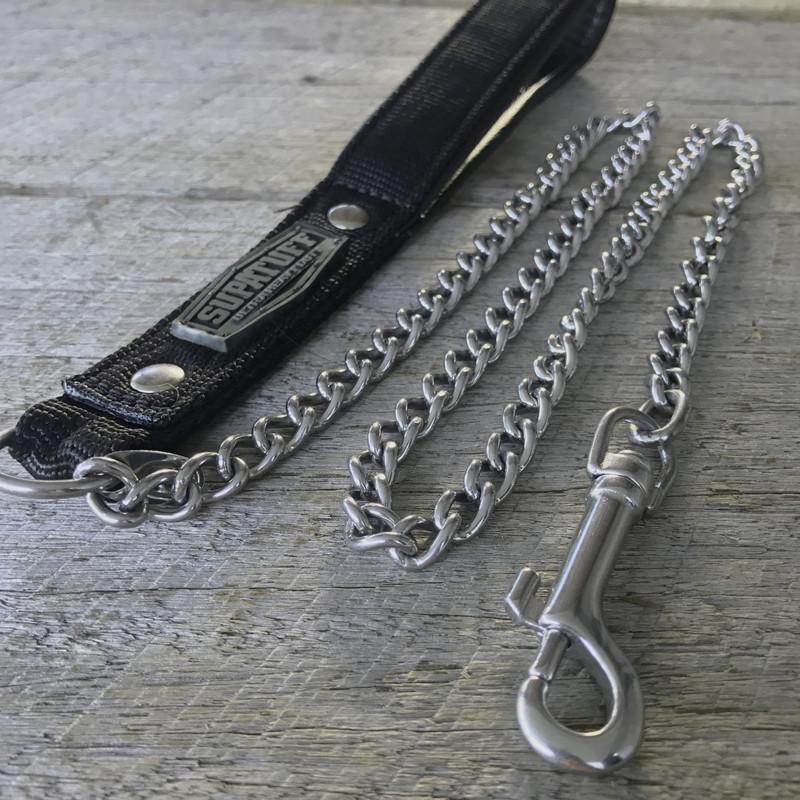
The 30mm custom SupaTuff webbing used in the Rogue Royalty heavy duty bullsnap leash is double-ply, meaning two layers of webbing are bonded together across the full length of the leash. Double-ply construction adds tensile strength while maintaining the flat profile that handles comfortably, compared to rope-style constructions that are narrow and create the rope-burn friction risk described later in this guide.
Box-Stitching at Stress Points: Why Stitching Location and Pattern Both Matter
This is the engineering detail most leash guides skip entirely and the one most likely to determine whether a leash holds during the specific moment it needs to most. A leash experiences its highest stress not during normal walking but during the sudden jerk at the moment a dog lunges at full acceleration from a stationary or near-stationary position. This jerk force is significantly higher than the sustained tension of a dog walking at the end of its lead.
The highest-stress points on any leash are the joins: where the webbing loops through the clip attachment, where the handle stitching closes on itself, and where any intermediate attachment point connects. These joins concentrate stress because the webbing changes direction at each point, creating a local stress concentration that exceeds the stress in the straight runs of webbing between them.
Bullsnap vs Trigger Snap: The Clip Mechanism Difference That Matters on Working Dogs
The clip connecting the leash to the collar or harness is the single highest-stress point in the leash system. A trigger snap uses a spring-loaded gate: pressing the trigger depresses a spring and opens the gate. When closed, the spring holds the gate shut. Under repeated high-tension loads from a large, powerful dog, the spring gate flexes with each pull and can progressively weaken, or in lower-quality versions, be forced open by a combination of downward and lateral force acting simultaneously on the gate.
A bullsnap uses a solid rotating barrel. The barrel must be physically rotated to open, which means the clip cannot be opened by leash tension in any direction or magnitude. The barrel mechanism engages positively when closed rather than being held shut by spring tension. The only way the bullsnap opens is by deliberate rotation, which means force on the clip during a sudden pull works against the closed barrel rather than against a spring mechanism.
This difference in failure mode is why bullsnap clips are standard on police, military, and protection sport working dog equipment. In those applications, clip failure during a working moment is not an acceptable risk outcome, and the bullsnap's positive-locking mechanism provides a fundamentally different safety guarantee than any spring-loaded trigger snap regardless of the trigger snap's rated strength.
Leather Padded Handles: Safety Feature, Not a Style Choice
Leash guides occasionally mention leather handles as a comfort or premium feature without explaining the specific safety mechanism behind them. The reason leather-padded handles exist on quality heavy-duty leashes is the rope-burn problem specific to bare nylon webbing under sudden high load.
When a large dog lunges suddenly at the end of a leash, the handler's instinct is to tighten the grip, which presses the webbing more firmly against the palm and fingers at exactly the moment the webbing is moving rapidly through the hand or snapping taut under load. The narrow, relatively stiff edge of bare nylon webbing in this situation creates a concentrated friction line against the skin surface. The combination of pressure and friction generates heat rapidly, producing rope burn that can range from mild friction redness to a genuine laceration in extreme cases with thin webbing and heavy dogs.
A leather padded handle provides a broader, softer contact surface against the palm. The leather distributes the same contact force across more skin area, and the natural give in quality leather absorbs some of the impact energy from a sudden jerk rather than transmitting it entirely to the handler's hand. The handle padding also provides better grip retention in wet conditions compared to smooth nylon, which is relevant for Australian coastal walks where the handle may be damp from sea spray or rain.
Hardware Grades and Australian Coastal Conditions
Australia's coastline and the high proportion of dog owners who walk near beaches, surf zones, and estuaries create a specific hardware durability requirement that most leash guides written for other markets don't address. Salt water attacks metal hardware through a specific electrochemical corrosion mechanism driven by chloride ions, and not all metals labelled as stainless steel are equally resistant to this attack.
Zinc-Plated Hardware
The most common hardware on budget and mid-range leashes. Zinc plating creates a silver-coloured surface that visually resembles stainless steel in product photography but is a fundamentally different material underneath. Zinc plating corrodes in salt water exposure within weeks to months of regular use, developing surface rust that stains the webbing and the dog's coat and progressively weakens the hardware. The corrosion accelerates at scratches or chip points in the plating where the base metal is exposed.
Standard Stainless Steel
Significantly more resistant to salt water than zinc plating, and appropriate for occasional coastal exposure. Standard stainless does not have the same level of chloride ion resistance as marine-grade stainless and can develop surface pitting under extended regular salt water immersion, particularly in warm water environments.
Marine-Grade Stainless Steel (316 Grade)
Contains molybdenum which blocks the chloride ion attack mechanism that degrades lower-grade stainless in salt water. This is the appropriate hardware specification for dog owners who walk near beaches or salt water regularly. The SupaTuff range uses stainless steel hardware with the intent of providing the salt-water resistance profile needed for coastal Australian use, which is why all hardware is specified as stainless throughout with no zinc-plated components.
Leash Length for Large Breed Walking and Training
Length is the practical daily-use variable that most large breed owners have the clearest opinion on, but it interacts with the other specifications in ways that affect both safety and training outcomes.
A 120cm leash is the standard everyday length for large breed walking in Australian suburban and urban environments. This gives the dog enough room to walk naturally beside the handler without creating a trailing excess that wraps around legs, poles, or other pedestrians on shared paths and narrow footpaths. For a large, powerful dog, a longer everyday leash also gives the dog more acceleration distance before reaching the end, which increases the peak force at the clip and handle during a sudden lunge.
A shorter 60cm or 30cm traffic lead is the appropriate tool for high-density environments, vet clinics, pet-friendly café strips, and any situation requiring the dog to be held close alongside the handler with minimal lead slack. Many quality heavy-duty leads include a second handle positioned 20 to 30cm from the clip specifically for this purpose, allowing the handler to shorten effective lead length instantly without changing equipment during a walk.
The Rogue Royalty Heavy Duty Leash Range
The full leash range at Rogue Royalty covers everyday walking, training, and working dog applications across several distinct builds, each with specific construction details matched to its intended use case.
SupaTuff Heavy Duty Bullsnap Lead (120cm)
For: large and powerful breeds, strong pullers, working dogs, coastal environments
Webbing: 30mm custom double-ply SupaTuff nylon | Hardware: stainless steel bullsnap clip, stainless D-ring, stainless keepers | Handle: leather-padded grip | Stitching: box-stitched and reinforced at handle, head-latch, and all joins | Plastic fittings: none | Length: 120cm | Guarantee: worldwide lifetime
From $64.00 | View the SupaTuff Bullsnap Lead
Steel Professional Adjustable Training Leash
For: working handlers, police and security, trainers needing multiple configurations in one lead
Material: full-grain bridle leather | Configuration: standard lead, hands-free waist lead, short traffic lead, double-attachment training lead | Hardware: stainless steel throughout | Plastic fittings: none | Used by: police, military, and security handlers worldwide
From $84.00 | View the Steel Professional Training Lead
Soft Grip Recall Training Long Line (9.5m)
For: recall training at distance, controlled freedom, long-distance socialisation
Webbing: soft-ply nylon specifically designed to prevent hand burn during long-line handling | Hardware: stainless steel snap hook, leather-reinforced joins at handle and head-latch | Width: 3cm | Length: 9.5m | Plastic fittings: none
$64.99 | View the Recall Training Long Line
Built for the specific load requirements of large, powerful dogs in Australian conditions. Worldwide lifetime guarantee on every SupaTuff lead.
Browse the Full Heavy Duty Lead Range →Matching the Lead to Your Dog's Profile and Walking Context
The right heavy-duty lead is determined by the combination of the dog's weight and pulling force, the environments you walk in, and the level of handling control you need across different daily situations.
For a large breed companion dog walked daily in suburban environments on shared paths, the 120cm SupaTuff bullsnap lead covers everyday walking with the hardware and stitching specification appropriate for a dog that may pull or react suddenly at any point during a normal walk. The leather-padded handle provides all-day comfort without the grip fatigue that bare nylon handles create over extended use.
For a working handler managing a dog across multiple daily contexts including training sessions, handler transitions, and varying levels of control requirement, the steel professional adjustable training leash provides the configuration flexibility that a fixed-length lead cannot match, in the full-grain leather build that working dog practitioners have standardised on for longevity and grip quality.
For recall training specifically, the 9.5m soft-grip long line addresses the hand-burn problem that affects handlers using standard webbing on a long line. During active recall training, the long line moves rapidly through the handler's hands, and the specific soft-ply construction of the recall lead is the detail that makes the difference between a training session that ends with rope-burned palms and one that ends when the handler decides to stop rather than when their hands give out.
The complete SupaTuff collection covers matching collars, leads, and harnesses in the same zero-plastic, all-stainless hardware specification, for owners who want consistent gear performance across their complete dog handling setup.
Leash Inspection and Maintenance for Australian Conditions
A heavy-duty leash is an investment that should outlast multiple cheaper replacements. The maintenance that protects that investment is minimal but needs to happen at specific points rather than only when a problem becomes visible.
What to Inspect After Every Coastal Outing
Rinse the entire leash with fresh water after any salt water exposure, including beach walks, estuary areas, and salt spray environments. Pay particular attention to the clip mechanism, flushing the barrel of the bullsnap or gate of the trigger snap with fresh water to remove salt crystal deposits that can cause the mechanism to seize or corrode from the inside before any visible surface rust appears. Dry naturally away from direct sun and heat sources, which degrade nylon webbing faster than normal UV exposure over time.
Stitching and Webbing Inspection Schedule
Inspect the stitching at the clip attachment, handle loop, and any midpoint joins every four to six weeks on a leash in regular daily use. Look for broken stitch threads, fraying of the webbing at bend points near hardware, and any separation between webbing layers at the double-ply construction points. Any visible stitching break at a load-bearing join is a replacement signal rather than a cosmetic issue to monitor. The join fails suddenly under load rather than progressively from stitching break to stitching break, which makes observing an early break the most important early warning available.
Hardware Function Check
Test the clip mechanism for smooth, positive operation monthly. A bullsnap that requires unusual force to open or does not seat completely when closing has likely accumulated salt crystal or grit deposits inside the barrel mechanism. Flush with fresh water and work the mechanism through several open-close cycles while wet to clear the deposits before they harden. A clip that remains stiff after thorough flushing and drying should be replaced rather than continued in service on a large, powerful dog where clip failure during a reactive moment is a serious safety risk.
Frequently Asked Questions About Heavy Duty Dog Leashes in Australia
What makes a dog leash heavy duty?
Four specific elements together: webbing width and ply count that distributes load across a broader material surface, box-stitch reinforcement at every stress point rather than single-pass seams, hardware rated for peak sudden-jerk force rather than sustained walking tension, and handle construction that protects the handler's palm during sudden load events. A leash marketed as heavy duty without specifying webbing width in millimetres, stitching reinforcement type, and hardware material type is making a claim without the specific details needed to evaluate it.
What is a bullsnap clip and why is it better for large dogs?
A bullsnap uses a solid rotating barrel that locks positively when closed and cannot be opened by tension in any direction. A trigger snap relies on a spring-loaded gate that can flex, weaken, or be forced open by combined directional forces under repeated high-tension loads. Bullsnap clips are the standard on working dog, police, and security handling equipment specifically because clip failure under load is not an acceptable outcome in those applications.
What leash width is recommended for large dogs?
25mm is appropriate for medium breeds and moderate pulling. 30mm is the recommended width for large, powerful breeds including Rottweilers, German Shepherds, Mastiffs, and Staffies. Width directly determines how load is distributed across both the webbing material and the handler's palm during a sudden pull, with wider webbing distributing the same force across more area and reducing both material stress and friction burn risk to the handler.
Does a leather handle on a dog leash make a real difference?
Yes. Bare nylon webbing under sudden high tension creates a concentrated friction line against the handler's palm, which is the mechanism that causes rope burn during a sudden lunge. A leather padded handle provides a broader, softer contact surface that distributes the same force across more skin area and absorbs some impact energy. For owners of large dogs that lunge reactively, this is a meaningful safety difference, not a cosmetic upgrade.
Why does coastal salt water affect leash hardware?
Salt water attacks metal hardware through chloride ion corrosion, which is far more aggressive than fresh water. Zinc-plated hardware develops visible rust within weeks to months of regular coastal exposure. Standard stainless steel resists this better but can still pit under extended regular salt water immersion. Marine-grade 316 stainless contains molybdenum that blocks the chloride attack mechanism, making it the appropriate hardware specification for Australian coastal dog walking.
What leash length is best for walking a large dog in Australia?
120cm is the standard for everyday suburban and urban walking. It gives adequate room for natural walking without creating excess lead that wraps around legs or infrastructure in shared path environments. A secondary 60cm or 30cm traffic lead, or a second handle positioned close to the clip, covers high-density environments where the dog needs to walk immediately beside the handler.
What heavy duty leashes does Rogue Royalty offer?
The SupaTuff Heavy Duty Bullsnap Lead at 120cm uses 30mm double-ply custom nylon, a stainless steel bullsnap clip, leather-padded handle, and box-stitched reinforcement at all stress points with no plastic fittings. The Steel Professional Adjustable Training Leash provides full-grain leather with multiple configurations for working handlers. The 9.5m Soft Grip Recall Long Line uses soft-ply nylon to prevent hand burn during active long-line recall training. All carry a worldwide lifetime guarantee.

