





Reviewed by Wendell Van Jour, Founder, Rogue Royalty. Hand-building leather dog gear since 2009. Supplier to protection K9 units, working handlers, and over 30,000 dog owners worldwide. Last reviewed May 2026.
Most "premium" leather dog leashes on the US market aren't what their listings claim. After sixteen years cutting hides and building canine equipment for working handlers, I can tell you the gap between a leash that lasts a decade and one that cracks in six months comes down to five specific details. Almost nobody checks them before buying. The good news: once you know what to look for, you can evaluate any leather leash in about thirty seconds. Here's what a high quality leather dog leash actually is, what separates real handcrafted gear from mass-produced look-alikes, and how to pick one that'll still be on your dog ten years from now.
What does "leather" actually mean on a product listing
The word covers a huge range. On one end, a single solid slice of full-thickness cowhide. On the other, shredded scraps glued together. The grade tells you which one you're getting.
Full-grain leather is the outermost layer of the hide with the natural grain intact. It's the strongest grade because the densely packed surface fibers haven't been sanded off. Full-grain develops a patina, softens with use, and is what any serious working leash should be cut from.
Top-grain leather is full-grain that's been sanded smooth and coated. It looks uniform. It's also weaker, because that sanding removes the toughest fibers. Fine for a small-dog fashion leash. Wrong choice for a 70-pound Labrador.
Genuine leather is marketing language. It usually means the lowest usable grade, a thin split layer of hide. If a listing says "genuine leather" without specifying full-grain or top-grain, assume bottom-shelf.
Bonded leather is shredded scraps mixed with adhesive. It cracks within months under any real load. Walk away.
Vegetable-tanned vs chrome-tanned: why it matters
How a hide is tanned determines how it ages. Vegetable tanning uses plant tannins from oak bark, chestnut, or mimosa over several weeks. The result is firmer, sturdier, and softens beautifully with handling. Latigo and English bridle leather are both vegetable-tanned variants, and they're the gold standard for working leashes.
Chrome tanning uses chromium salts. It's faster, cheaper, more uniform, and more flexible from day one. It also doesn't build the same character or strength over time. Most mass-produced "premium" leashes are chrome-tanned because the process scales.
If a seller can't tell you how their leather was tanned, that's your answer. We cover this in more detail in our guide to why leather collars and leashes outlast synthetic alternatives.
What separates a real premium leash from a cheap one
Five checks. After running a workshop that supplies handlers across four continents, these are what I look at on any leash before I'll call it premium.
1. Leather grade and thickness
A genuine high quality leather dog leash is cut from a full-grain, vegetable-tanned hide. The thickness should match the dog:
|
Dog size |
Leather thickness |
Equivalent in oz |
Width |
|
Small (under 25 lbs) |
3 mm |
7 to 8 oz |
1/2 inch |
|
Medium (25 to 60 lbs) |
4 mm |
9 to 10 oz |
3/4 inch |
|
Large (60 to 90 lbs) |
5 mm |
11 to 12 oz |
3/4 to 1 inch |
|
Working or protection dog |
6 mm or thicker |
13 to 14 oz |
1 inch |
Hold a leash up against a light. Translucent patches mean inconsistent grain or thinning. A proper leash is uniform end to end. If you need help sizing the rest of your dog's gear, our measuring guide walks you through it.
2. Stitching and joinery
The handle joint is where most cheap leashes fail. Single-row machine stitching with no rivet is the budget approach, and it always fails eventually. Double-row saddle stitching plus a rivet is mid-tier and dependable. Saddle stitching uses two needles working from opposite sides of the leather, so if one thread breaks, the seam holds.
Hand saddle-stitching with solid brass or copper rivets through every stress point, plus a folded leather loop at the snap end, is the top tier. That's what a ten-year leash looks like, and it's exactly how we build ours.
3. Hardware
Hardware is where quiet shortcuts happen. The photos look identical. The metallurgy isn't.
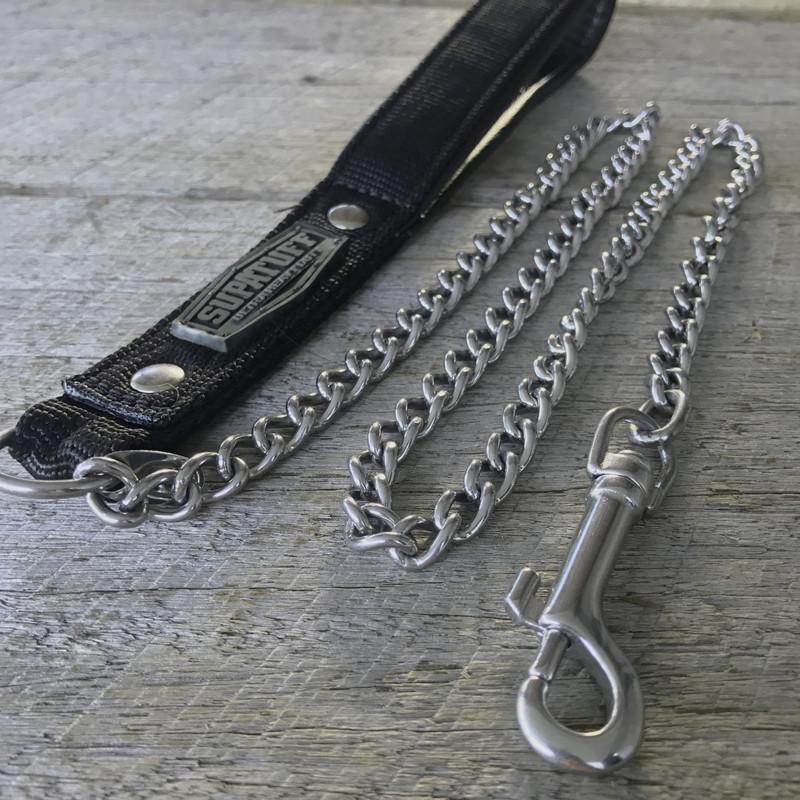
Look for solid brass or solid bronze bolt snaps with a load rating of 400 pounds or higher. They don't rust, don't bend, and the spring stays smooth. For working dogs, look for stainless steel bullsnaps, the heavy oblong snap with a thumb lever. They're used by police K9 and military working dog units, load-rated 500 to 600 pounds or more, and release cleanly under tension. Our Supatuff Bullsnap Leash is built around exactly this hardware specification.
Avoid plated zinc. It looks like brass for the first three weeks. Then the plating wears, the zinc oxidizes, and the spring fails. It's the fastest tell on a cheap leash.
4. Edge finishing
Run your thumb along the edge of any leash you're considering. A premium leash has burnished, beveled, often waxed edges. The fibers are sealed so they won't fray, and the edges are rounded so they don't saw at your palm during a sudden pull. A cheap leash has raw, square-cut edges that fray, soak up water, and turn uncomfortable within weeks.
5. The handle
A proper handle fits a closed fist with winter glove room. It's reinforced where it joins the body. Working and training leashes often include a traffic handle, a short secondary loop near the snap that lets you choke up on the dog in tight situations. It's worth having if you walk in cities, crowds, or vet waiting rooms. If you need more configurations from a single leash, our multifunction training leash was built for exactly that.
How long should a high quality leather dog leash last
With reasonable care, eight to twelve years. We've got customers still using leashes we built in 2011. The leather softens, the patina deepens, and the hardware keeps doing its job.
A cheap leash typically fails inside eighteen months. That's three or four replacements over the life of a single quality leash, plus the inconvenience and the risk of a snap breaking mid-walk. The premium leash is the cheaper option over time, often by a factor of three.
What length leash should you buy
The ASPCA recommends four to six feet for general walking. In practice:
Four feet is for training, traffic work, and busy urban walks where you need maximum control. Six feet is the standard everyday walking length and works for most owners. Anything longer, ten to fifteen feet or more, is for long-line work, recall training, and scent work in open environments. Our training leash range covers both ends. Most handlers benefit from owning both a four-foot and a six-foot leash.
Leather vs nylon: the honest comparison
Nylon wins on upfront price and continuous wet-weather use. It's lighter and more forgiving in rain. But it frays under UV exposure, burns your palms during hard pulls, and typically lasts one to three years before showing serious wear.
Leather wins on lifespan (eight to twelve years), comfort under load (it softens to your hand), strength when properly graded, and total cost over a decade. The patina that develops on a well-cared-for leather leash is something nylon can't replicate. If you walk in flood conditions every single day, get nylon. For everyone else, leather is the better long-term buy. For a broader breakdown across all leash types, see our guide to choosing the best dog leash.
Matching a leash to your dog's breed
A few notes from the workshop. Belgian Malinois, German Shepherd, and Doberman handlers should look at 1 inch wide, 6 mm thick, with a stainless bullsnap. These dogs hit hardware hard. Cane Corso, Rottweiler, and Mastiff owners want the same specs, often with a traffic handle for vet visits and crowd work. Our Supatuff leash collection is built around this use case.
Pit Bull and American Staffordshire Terrier owners do well with 3/4 to 1 inch width, 5 to 6 mm thickness, and a solid brass bolt snap as a minimum. A wide handle matters for grip during a sudden pull. Golden Retriever, Labrador, and Border Collie are the standard working dog configuration: 3/4 inch wide, 5 mm thick, solid brass bolt snap. French Bulldog, Boston Terrier, and Cocker Spaniel sit in the 1/2 to 3/4 inch range at 4 mm. Toy breeds work fine at 1/2 inch and 3 to 4 mm.
A matching handmade leather collar gives you a complete setup in the same grade of hide and hardware.
What we build at Rogue Royalty
We've been hand-cutting full-grain, vegetable-tanned hide in our Australian workshop since 2009. Hand saddle-stitching, solid brass and 316 stainless steel hardware, burnished and waxed edges, every leash inspected before it ships. We supply protection K9 units, working handlers, and serious dog owners across the United States, UK, Europe, and Australia.
Our Supatuff Bullsnap Leash is the heavy-duty workhorse, 120 cm long with a stainless bullsnap rated for any working dog. The standard leather leashes in our range cover everyday walking and training. Both ship internationally with our craftsmanship guarantee. We're not the cheapest option. We're built to be the last leash you buy.
How to keep a leather leash going for a decade
Three habits cover most of leather leash longevity.
Condition the leash quarterly. Apply a thin coat of neatsfoot oil, mink oil, or a dedicated leather conditioner. Let it absorb overnight, then wipe off the excess. This keeps the fibers supple and prevents cracking.
Air-dry only. If your leash gets caught in rain or your dog jumps in a creek, wipe it down with a dry cloth and hang it somewhere ventilated. Never on a radiator. Never in direct sun. Heat cracks leather.
Inspect quarterly. Check the stitching at the handle and the snap end. Replace before failure, not after. A sticky snap or a lifted thread is your early warning.
For the complete routine including the products we use ourselves, read our full leather leash care guide.
The bottom line
A high quality leather dog leash is full-grain, vegetable-tanned, four to six millimeters thick, with hand-stitched joinery, solid brass or stainless steel hardware, burnished edges, and a handle built for a fist rather than a photograph.
If a seller can't tell you the leather grade, the tanning method, the thickness, and the snap load rating, they probably don't know themselves.
For a leash that'll outlast every nylon one you've owned, see our leather leash range. For working dogs and serious pullers, the Supatuff Bullsnap Leash is what handlers actually use.
Loyalty deserves royalty. Buy the leash once.
Frequently asked questions
What's the best type of leather for a dog leash?
Full-grain, vegetable-tanned cowhide. Latigo and English bridle leather, both vegetable-tanned, are excellent variants for working leashes.
How thick should a high quality leather dog leash be?
3 mm for small dogs, 4 mm for medium, 5 to 6 mm for large breeds, 6 mm or thicker for working dogs and serious pullers.
Is leather better than nylon for a dog leash?
For longevity, comfort under load, and total cost over a decade, yes. Nylon wins on upfront price and continuous wet conditions.
How long should a leather dog leash last?
With proper conditioning and care, eight to twelve years. Cheap leashes typically fail inside eighteen months.
Can leather dog leashes get wet?
Briefly, yes. They handle rain and creek crossings fine. What kills leather is being stored wet, dried with heat, or repeatedly soaked without conditioning.
What's the best length for a leather dog leash?
Four to six feet for general walking. Four feet for traffic and training, six feet for everyday walks, longer for recall and scent work.
Are braided leather leashes stronger than flat ones?
Per gram of leather, yes. The handle joint and snap remain the failure points, so a well-built flat leash often outperforms a poorly built braided one.
How do I clean a leather dog leash?
Wipe with a damp cloth. Use saddle soap on stubborn marks. Air-dry. Apply leather conditioner. Never machine-wash leather.

