





The standard advice is stop-and-wait, use a front-clip harness, and be consistent. Most dog owners have tried all three and their dog still pulls. The reason isn't that the advice is wrong. The reason is that none of those guides explain the arousal threshold concept, the multi-person consistency trap, or the specific way leash length changes what the dog actually learns. Those are the gaps that explain why training works in the backyard and fails on the street.
This guide covers the stop-and-wait method and exactly when it stops working, the arousal threshold concept and how to train around it, why training fails when more than one person walks the dog, how leash length changes the behaviour you build, the sniff-permission release cue that makes walks sustainable, equipment that supports training rather than substituting for it, and the Rogue Royalty leash and harness range matched to each training phase.
Why Dogs Pull in the First Place
Pulling works. This is the complete explanation. A dog that pulls forward and reaches the interesting smell, the other dog, the gate, or the tree has been rewarded for pulling by the experience of arriving at the thing it wanted. Every walk where this happened reinforced pulling as the strategy that produces forward movement and access to interesting things.
Dogs are not pulling to dominate, be defiant, or ignore the owner. They are doing what has always worked. The training challenge is replacing a very well-established behaviour pattern that has been reinforced hundreds or thousands of times across every walk the dog has ever taken, with a new pattern where walking at a loose lead beside the handler becomes the more reliably rewarding option.
The Stop-and-Wait Method: How It Works and When It Fails
Stop-and-wait, sometimes called red-light green-light, is the most widely recommended and most widely used loose-lead training method. The handler stops the moment the leash goes taut, stands still without speaking, and only begins walking again when the dog voluntarily releases tension. The dog learns that tension stops forward movement and slack restarts it.
This method works, but only below the dog's arousal threshold. A dog that is mildly interested in the environment, alert but calm, can process the cause-and-effect message of stop-and-wait. A dog already over-threshold, meaning its arousal level is high enough that the prefrontal cortex has essentially stepped back and the limbic system is running the show, cannot process that message. The dog at high arousal is not ignoring training. The dog at high arousal is neurologically in a state where learning is not occurring.
Arousal Threshold Training: The Concept Most Guides Skip
Every dog has an arousal threshold, the level of environmental stimulation above which the dog's behaviour becomes reactive, impulsive, and difficult to train. Below threshold, the dog can think, make choices, learn from consequences, and respond to cues. Above threshold, the dog is in a state of high arousal where impulse control is essentially unavailable.
The most common training mistake for pulling dogs is running all training sessions in a low-distraction environment, building good behaviour in that environment, then taking the dog directly into a high-distraction environment that pushes them over threshold immediately. The dog appears to forget all training on the first step out the front gate because the street immediately exceeds their threshold in a way the training environment never did.
The solution is systematic threshold training. This means identifying the exact point at which the dog's arousal rises above where it can learn, and conducting all initial training sessions just below that point. As the dog develops reliable behaviour at each threshold level, the next slightly higher stimulation level is introduced. Progress looks like this: backyard first, then quiet street at low-traffic time, then same street at slightly higher traffic, then a street with more dog activity, and so on, in increments small enough to keep the dog trainable throughout.
| Dog State | Signs | Trainable? | Right Action |
|---|---|---|---|
| Below threshold | Alert, engaged, can look at handler, takes treats | Yes | Continue training session |
| At threshold edge | Treats taken more slowly, focus drifting, mild pulling | Partially | Use higher-value treats, reduce distraction level |
| Over threshold | Ignores treats entirely, fixed on stimulus, hard pulling, barking | No | Increase distance from stimulus, let arousal drop before continuing |
The Multi-Person Household Problem
This is the training failure point that no loose-lead walking guide covers adequately and that most dog owners with a pulling problem have experienced without recognising it as the cause. Dogs do not generalise learned behaviour automatically to all handlers. They learn rules in the context they were built, including which person applies those rules.
If one person in the household has trained stop-and-wait consistently for weeks, the dog may walk perfectly with that person. The same dog walks with a different household member and pulls immediately, because that second person has never enforced the stop-and-wait rule. The dog is not being selectively disobedient. It has learned two different sets of rules for two different handlers, and is applying each set correctly.
Resolving this requires every person who walks the dog to apply identical criteria: the same leash length, the same stopping point when tension occurs, the same reward position, the same timing of reinforcement. This sounds simple and is practically difficult because adults in a household have different walking speeds, different tolerances for the dog getting ahead, and different tendencies to let small amounts of pulling continue rather than stopping. One person allowing even minor pulling for several minutes of a thirty-minute walk is enough to maintain the pulling behaviour against weeks of careful work by another person.
Leash Length Is a Training Variable, Not Just a Preference
Most loose-lead guides recommend a 1.2 to 1.5 metre leash for training and stop there. The reason leash length matters as a training variable, not just a safety consideration, is that it changes the physical space the dog has to develop acceleration before the end of the leash is reached, and changes the position habit the dog builds.
A 1.2 metre leash gives the dog approximately 80 centimetres of range in front of the handler before tension occurs. This places the dog approximately 80 centimetres in front of the handler as the habitual walking position. A 1.8 metre leash gives the dog considerably more range, and the position habit built at 1.8 metres places the dog noticeably further ahead in the dog's learned sense of where loose-lead position actually is.
For initial training stages, a shorter fixed leash produces a stronger position habit closer to the handler. Once that habit is reliable at short range, the same behaviour can transfer to longer leash lengths naturally. Using a long line for formal loose-lead training produces a dog that walks loosely at 5 metres from the handler, which is not the same skill as walking loosely beside the handler at 1.5 metres.
The Sniff-Permission Release Cue: Making Walks Sustainable
A walk that requires the dog to walk in a perfect position beside the handler for the entire duration, never stopping, never sniffing independently, is not a sustainable or enriching walk for the dog. Sniffing is the primary way dogs process environmental information, and suppressing it for an entire walk creates frustration that often emerges as pulling toward interesting smells specifically.
Building a release cue into structured walks, a phrase like "go sniff" or "free time" that explicitly gives the dog permission to range more freely and follow its nose for a period, makes the walk functionally richer for the dog and paradoxically reduces pulling. Over time, the dog internalises that the structured walking period is finite and followed by free sniffing time, which reduces the urgency of trying to reach every smell immediately during the structured section.
The release cue works both directions. "Go sniff" gives permission and "with me" or "let's go" signals the return to structured walking beside the handler. Switching between modes on cue becomes reliable with practice, giving the handler control over walk structure while giving the dog genuine environmental engagement throughout.
Breed-Specific Pulling Tendencies and What They Mean for Training Approach
Pulling is a universal dog behaviour, but the reason a specific breed pulls and the level of arousal that drives that pulling varies by breeding purpose in ways that change which approach works best. Treating every pulling dog identically misses the breed-specific motivation that determines both the difficulty of the training and the most effective intervention.
Working and Sled Breeds: Huskies, Malamutes, and Similar
These breeds were selectively bred over generations specifically to pull against resistance as their primary function. Pulling is not just a learned habit for a Husky; it is deeply embedded behaviour that feels inherently rewarding to the dog in a way that goes beyond ordinary operant conditioning. Stop-and-wait training works more slowly for these breeds than for dogs where pulling is purely learned rather than bred-in, and owners frequently need to accept a longer timeline and more consistent application before reliable loose-lead behaviour emerges. A front-clip harness is particularly useful as a management tool for this group during the training period because it makes the behaviour physically less effective even as it is being trained out.
Scent Hounds: Beagles, Basset Hounds, and Similar
Scent hounds pull toward smells with a specific intensity that can override other training cues because the olfactory drive in these breeds is exceptionally strong. A Beagle that has locked onto a scent trail is in a state where the smell is effectively overriding almost everything else including normal training consequences. Training approaches that work with the dog's nose rather than against it produce better results: the sniff-permission release cue described earlier in this guide is particularly valuable for scent hounds, because it channels the sniffing drive into permitted structured periods rather than attempting to suppress it completely.
High-Energy Herding Breeds: Border Collies, Kelpies, Australian Shepherds
Herding breeds typically pull from over-excitement about the environment rather than from a drive to physically pull or sniff. Their arousal threshold is often lower relative to environmental stimulation than many other breeds, meaning they cross into over-threshold states more easily in stimulating walking environments. The key adjustment for these breeds is shorter, more frequent training sessions in progressively more stimulating environments rather than attempting long walks in busy areas early in the training process. Their intelligence means they typically learn the training rules quickly, but generalising that learning across arousal levels requires more systematic work than with lower-drive breeds.
When to Involve a Professional Trainer
Several situations should prompt seeking help from a qualified professional trainer rather than continuing to manage independently. A dog that has seriously injured a handler through pulling, a reactive dog that becomes aggressive or effectively unmanageable around triggers during walks, a dog that has been through multiple training attempts without improvement, and a multi-dog household where pulling has become a complex social dynamic all benefit from a trainer's direct assessment of what is specifically happening and why standard approaches are not producing the expected results.
Equipment That Supports Training, Not Substitutes for It
No piece of equipment teaches a dog not to pull. Equipment is a management and training support tool. The right equipment makes the training process more effective and the interim period before reliable training is established safer and more comfortable. The wrong equipment, specifically retractable leashes, actively undermines the training process.
Retractable Leashes
Retractable leashes maintain constant low-level tension against the cord throughout the walk, which means the dog never experiences what genuine slack feels like. The dog cannot build a sense of the difference between taut and loose lead because the mechanism prevents the lead from being truly loose. Additionally, when the dog pulls and the cord extends, forward movement is rewarded, which is the exact opposite of what loose-lead training requires. Retractable leashes are incompatible with leash training for any dog at any stage.
Front-Clip Harness
A front-clip harness redirects the dog sideways when it pulls, reducing the effectiveness of pulling as a locomotive strategy without applying neck pressure. This makes pulling physically less rewarding and makes the training period safer and more manageable, particularly for large, powerful dogs. It does not teach the dog not to pull and should be combined with training, not used as the only intervention.
The Rogue Royalty Training Leash Range
The training leash collection at Rogue Royalty covers each phase of loose-lead training with the right leash for that stage.
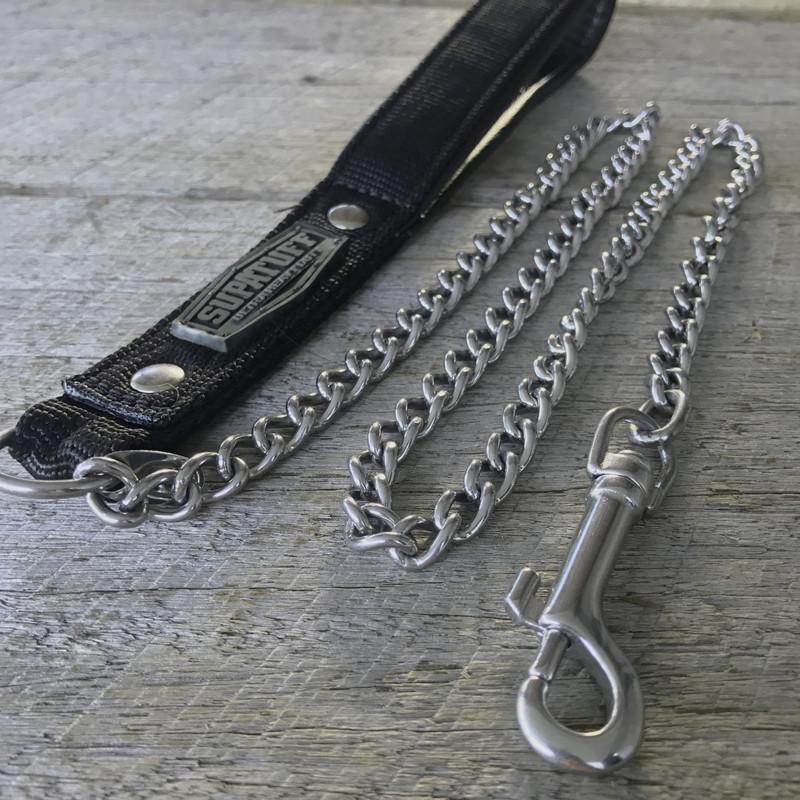
SupaTuff Bullsnap Leash (120 cm)
For: formal loose-lead training sessions; the correct length for building position habits
30mm double-ply SupaTuff webbing with stainless steel bull snap clip. Leather-padded handle. No plastic fittings. The 120cm length is specifically calibrated for loose-lead training, giving the dog enough range to walk naturally without the excess that builds a looser position habit. Lifetime guarantee.
From $64.00 | View the SupaTuff Bullsnap Leash
Steel Professional Adjustable Multifunction Leash
For: handlers who need variable length across different training contexts in one piece of equipment
Full-grain bridle leather with multiple attachment points. Configures as a standard fixed-length lead, shortened to a traffic lead for close control, or extended for different applications. Used by professional handlers and trainers for its configuration flexibility without needing multiple separate leashes.
From $84.00 | View the Adjustable Training Leash
Soft Grip Recall Training Long Line (9.5 m)
For: recall training and controlled freedom once loose-lead position work is established
Unique soft-ply nylon designed specifically to prevent hand burn during active long-line handling. Stainless steel snap hook, leather-reinforced joins. 9.5 metres by 3 cm width. Use this for recall distance training, not as a substitute for fixed-length loose-lead training.
$64.99 | View the Recall Training Leash
Fixed-length training leads, adjustable multifunction leads, and recall long-lines, all with stainless steel hardware and no plastic fittings.
Browse the Full Leash Range →Supporting Equipment: Slim-Fit Harness for Smaller Dogs
For small and medium breed dogs where the body proportions make a front-clip harness the preferred option during the training period, the SupaTuff slim-fit harness provides four-point adjustment and all-stainless hardware in a 25mm profile sized for lighter frames. The four-point adjustment covers the varying proportions common in mixed-breed and small-breed dogs, and the all-stainless build means no plastic buckles that can fail on a dog making sudden movements during a training session.
Frequently Asked Questions About Stopping Dog Pulling on the Leash
Why does my dog keep pulling on the leash even after training?
The most common reason is that training sessions run below the dog's arousal threshold but actual walks happen above it. A dog can walk loose-lead in the backyard and immediately pull on a busy street because the arousal state is fundamentally different. Training hasn't transferred because the behaviour was built in a different brain state. Fix this through systematic threshold training: exposing the dog to progressively higher distraction levels in increments small enough to keep the dog trainable throughout.
What is the stop-and-wait method for leash pulling?
The handler stops completely every time the leash goes taut, stands still without speaking, and only walks again once the dog releases tension voluntarily. The dog learns that tension stops movement and slack allows it. This works well below the dog's arousal threshold but becomes ineffective or counterproductive for dogs already over-aroused, because a dog in a high-arousal state cannot process the cause-and-effect relationship the method relies on.
Does a front-clip harness stop a dog from pulling?
A front-clip harness reduces the physical impact of pulling by redirecting the dog sideways rather than allowing it to power straight forward. It does not teach the dog not to pull and should not substitute for training. The harness is a management tool that makes training safer and more comfortable while the behaviour is being addressed through consistent training.
What leash length is best for training a dog not to pull?
A fixed-length leash of 1.2 to 1.5 metres for formal loose-lead training. This length limits the scope for the dog to accelerate before hitting tension and builds a position habit closer to the handler than a longer leash would. Retractable leashes are actively harmful to leash training because they maintain constant low-level tension and prevent the dog from feeling what genuine slack means.
Why does my dog walk well for one person but pull for another?
Dogs generalise learned behaviour to the handler who trained it, not to all handlers automatically. If one person has trained stop-and-wait consistently and another has allowed pulling, the dog has learned two different rule sets and applies each correctly. Every household member must apply identical criteria: same leash length, same stopping point, same reward timing, for training to hold across all walkers.
Should I use a long-line lead for training loose-lead walking?
No. A long-line is the right tool for recall training and controlled freedom, not for teaching the dog to walk beside you. Using a long line for loose-lead training produces a dog that walks loosely at 5 metres from the handler, not beside the handler at 1.5 metres. Keep training tools matched to the specific skill being built.
What equipment does Rogue Royalty offer for leash training?
The training range includes a 120cm SupaTuff bullsnap leash for formal training sessions, a steel professional adjustable multifunction leash for variable-length applications, and a 9.5 metre soft-grip recall long-line for recall work. All hardware is stainless steel with no plastic fittings. The slim-fit SupaTuff harness is available for small to medium dogs needing a front-clip option during training.

