





Walking a reactive dog in Australia's busy parks, coastal paths, and suburban streets is one of the most stressful experiences in dog ownership. The dog lunges, barks, and pulls. Other people stare. The handler tightens the lead. The dog escalates. Nothing seems to change between one walk and the next, and many owners begin to dread the daily outing that most people consider a simple pleasure.
The reason most owners stay stuck is that they are managing the reaction rather than changing the underlying emotional state that produces it. This guide covers the threshold concept, why trigger stacking makes some walks dramatically worse than others, the counter-conditioning protocol that actually changes reactivity over time, why retractable leads specifically make the problem worse rather than better, what the sniff reset does at a physiological level, and how to match your equipment to the specific stage of training you are working through.
What Reactivity Actually Is and Why It Matters for How You Handle It
Reactivity is not the same as aggression, although the two can look similar from a distance. A reactive dog is one that responds to specific triggers with behaviour that is out of proportion to the actual threat those triggers represent. The trigger sets off a physiological stress response that the dog cannot easily regulate, and the barking, lunging, or pulling is the outward expression of that stress response rather than a deliberate choice to attack.
Most reactive dogs are experiencing some combination of fear, frustration, or over-arousal. Fear-based reactivity tends to include body language indicating the dog wants distance: a hard stare, hackles up, body tense, and barking or lunging directed at moving the trigger away. Frustration-based reactivity, often called barrier frustration, is common in dogs that are highly social but have learned they cannot reach other dogs on leash, and the behaviour can look aggressive while the dog's actual intent is to make contact.
Understanding which of these is driving the behaviour changes the training approach. Both resolve through counter-conditioning, but the specific protocol elements differ, and punishment-based approaches that aim to suppress the reaction in the moment make both types significantly worse over time by adding an additional layer of aversive experience to the already stressful trigger encounter.
The Threshold: The Single Most Important Concept for Reactive Dog Walks
Every reactive dog has a threshold distance for each of its triggers. Below threshold, the dog notices the trigger and can still function, eat treats, respond to cues, and look back at the handler. Above threshold, the dog's arousal has exceeded the level where learning can occur and the reactive behaviour takes over.
The threshold distance is not fixed. It varies by trigger type, the dog's baseline stress level on that day, how many other stressful events have occurred earlier in the walk, the time of day, and environmental factors like heat, which itself raises baseline arousal. A dog that handles other dogs at 10 metres on a quiet Tuesday morning may need 25 metres on a Saturday afternoon after a stressful car journey.
Trigger Stacking: Why the Same Walk Is Sometimes Far Worse
This is the concept most reactive dog guides mention briefly and none of them explain fully. Trigger stacking is the cumulative effect of multiple stressors on the dog's arousal level within a single walk or across a single day. Each trigger encounter raises the arousal level, and the arousal does not return to baseline instantly when the trigger passes. It returns gradually, over minutes to hours depending on the individual dog's stress regulation capacity.
The practical consequence is that a dog that would handle a cyclist calmly at the start of a walk may react violently to the same cyclist at the same distance 20 minutes into a walk that has already involved two other dog sightings and a shouting child. The cyclist did not change. The dog's available threshold buffer was used up earlier in the walk.
Trigger stacking also explains why some days seem to produce unexpected setbacks even when training progress has been strong. Dogs that have experienced a stressful event before the walk, such as a vet visit, an argument in the household, or a particularly loud delivery van, begins the walk with a raised arousal baseline and will reach its threshold earlier in any trigger encounter than it would on a calm day.
Counter-Conditioning and Desensitisation: The Evidence-Based Training Approach
Counter-conditioning is the process of changing the dog's emotional response to a trigger from negative to neutral or positive through repeated pairing of the trigger with something the dog values highly, typically high-value food. Desensitisation is the process of gradually reducing the dog's reactivity to a trigger by presenting it repeatedly at a non-reactive level until that presentation level no longer produces a stress response.
The two methods work together: desensitisation controls the distance and intensity of trigger exposure to keep the dog below threshold, and counter-conditioning delivers the positive association at each exposure that gradually changes the underlying emotional response. Used together systematically, they produce lasting change in reactivity rather than the temporary suppression that punishment-based approaches create.
The Look At That Protocol
The most practical applied version of counter-conditioning for reactive dogs is the Look At That (LAT) protocol. The sequence is simple but requires consistency. When a trigger appears, as soon as the dog notices it, mark the moment with a soft marker word or click, then immediately deliver a high-value treat. The treat delivery is contingent on the dog noticing the trigger, not on the dog ignoring it or looking away, because the goal is to change the emotional meaning of the trigger rather than to suppress the looking behaviour.
Over many repetitions below threshold, the dog learns a new association: trigger appears, then something excellent happens. The dog begins to look at the trigger and then look back at the handler in anticipation of the treat. When the look-back behaviour appears without cueing, the emotional response is changing. The trigger is beginning to predict good things rather than threat or frustration.
Session Structure for Progress
Training sessions for reactivity should be short, typically 5 to 10 minutes of active below-threshold work. The goal per session is to accumulate repetitions of the trigger-appears, mark-and-treat sequence while the dog remains below threshold throughout. If the dog reacts at any point, the session is over and the next session will begin at a greater distance from that trigger. Progress is not measured by how close the dog can get to a trigger in any single session. It is measured by how consistently the dog remains below threshold and by the gradual reduction in threshold distance over weeks and months of work.
Why Retractable Leads Specifically Make Reactivity Worse
Retractable leads are the most consistently recommended against piece of equipment for reactive dog management, and most guides say so without fully explaining the specific mechanisms that make them actively harmful rather than merely suboptimal.
The first problem is acceleration distance. A reactive dog on a retractable lead can travel several metres toward a trigger before the handler can engage the lock. A dog that would have been at its working threshold distance at 10 metres has now closed to 6 metres under full acceleration before any response is possible. At 6 metres it may be above threshold and already in the middle of a reactive episode that the handler had no time to prevent.
The second problem is constant low-level tension. Retractable leads maintain a light resistance against the cord throughout the walk, which keeps the dog in a mild state of arousal rather than the relaxed state of walking on a loose lead. This constant tension primes the dog for escalation when a trigger appears, because it is never truly in a relaxed state during the walk.
The third problem is communication. A fixed-length lead transmits information through tension and release between handler and dog. The thin cord of a retractable lead has poor tactile feedback in both directions, making subtle handler communication through lead pressure essentially impossible. For a reactive dog, this means the handler has less ability to communicate calmly before a reaction escalates.
The Sniff Reset: Why Your Dog Needs It After Every Reaction
Most reactive dog guides mention allowing the dog to sniff after a reaction as a decompression strategy. Very few explain why sniffing works at a physiological level, which is the information that makes the practice feel worth prioritising rather than optional.
A reactive episode activates the dog's sympathetic nervous system: cortisol and adrenaline are released, heart rate and breathing increase, and the dog's body is in a state of high arousal. The cortisol from a reactive episode remains elevated in the bloodstream for a significant period after the episode itself ends, typically between 20 and 60 minutes in dogs with established stress responses.
Ground sniffing activates the parasympathetic nervous system by requiring the dog to slow its breathing and pace, lower its head, and process olfactory information at a rate that is incompatible with high arousal. The specific mechanics of deep nasal breathing during sniffing trigger a physiological calming response through vagal nerve activation. This is not a metaphorical calming effect. It is a measurable shift in the dog's autonomic nervous system state.
The practical implication is that the 3 to 5 minutes of sniffing you allow your dog after a reactive episode is not wasted walk time. It is the fastest route to reducing the dog's elevated cortisol and preventing trigger stacking effects from that episode from affecting every subsequent trigger encounter on the same walk.
Equipment Matched to Training Stage
Reactive dog management involves different equipment needs at different stages of the training process, and using the wrong equipment for the wrong stage can either limit effectiveness or create unnecessary risk.
| Training Stage | Primary Challenge | Recommended Equipment | Why |
|---|---|---|---|
| Early management (pre-training) | Physical control during reactive moments; preventing practice of the reactive pattern | Front-clip harness + 120cm fixed lead | Front clip redirects lunge; fixed length prevents acceleration distance problem of retractables |
| Active counter-conditioning | Maintaining working threshold distance in open spaces | Front-clip harness + 9.5m long line in open areas | Long line allows threshold distance while keeping dog safely connected during training |
| Busy urban environments | Close control in narrow spaces, queues, vet visits | Front-clip harness + 120cm fixed lead with second handle for short-lead positioning | Second handle allows instant shortening without equipment change |
| Maintenance (established training) | Maintaining progress during normal daily walks | Any quality fixed lead 120 to 150cm; harness or collar per dog preference | Continued loose-lead walking with ongoing reinforcement of calm responses |
The Rogue Royalty Gear Range for Reactive Dog Management
The training leash collection and harness range at Rogue Royalty cover each of the equipment stages described above.
SupaTuff Slim Fit Harness (Front-Clip Management Harness)
For: early management phase and active counter-conditioning; front-clip attachment for lunging control
25mm custom double-ply SupaTuff nylon, four-point independent adjustment, all stainless steel hardware, no plastic fittings. Lightweight profile that does not restrict shoulder movement during the lateral redirection that the front-clip attachment creates. Waterproof and UV-treated. Lifetime guarantee.
From $52.00 | View the SupaTuff Slim Fit Harness
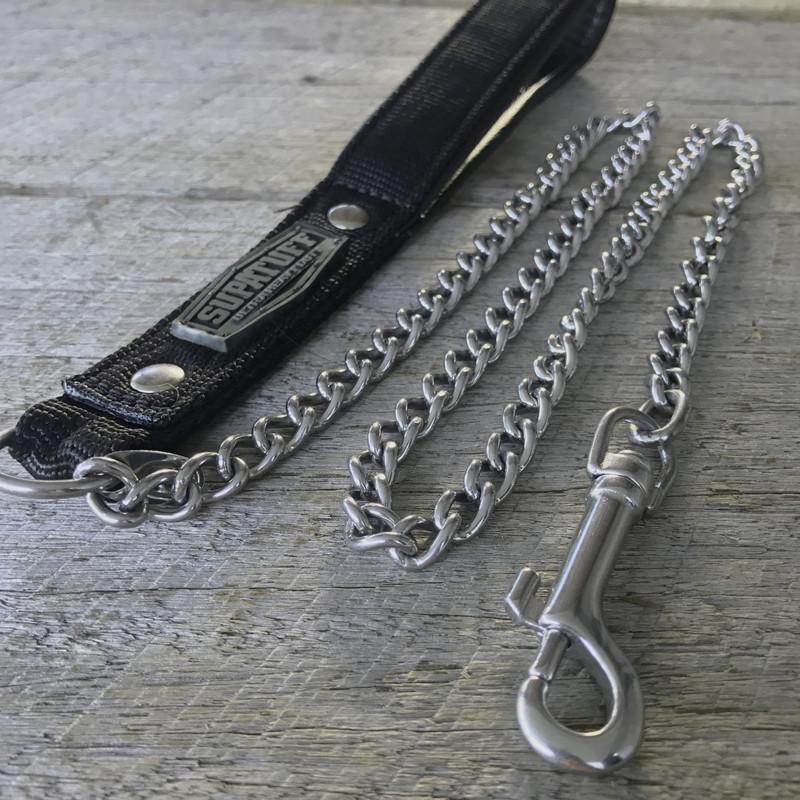
SupaTuff Heavy Duty Bullsnap Lead (120cm)
For: urban reactive dog walking; immediate handler response capability; no acceleration distance
30mm double-ply custom nylon, stainless steel bullsnap clip, leather-padded handle, box-stitched reinforcement at all stress points. No plastic fittings. The 120cm fixed length maintains the predictable distance essential for reactive dog management. The bullsnap clip locks positively and cannot be opened by leash force in any direction. Lifetime guarantee.
From $64.00 | View the SupaTuff Bullsnap Lead
Soft Grip Recall Training Long Line (9.5m)
For: active counter-conditioning in parks and open spaces; working at threshold distance safely
Soft-ply nylon webbing specifically designed to prevent hand burn during active long-line handling. 9.5 metres of working distance while maintaining safety connection. Stainless steel snap hook, leather-reinforced joins. No plastic fittings. The correct tool for below-threshold training in open environments where the dog needs distance to remain workable.
$64.99 | View the Recall Training Long Line
Front-clip harnesses, fixed-length bullsnap leads, and soft-grip long lines, all with stainless steel hardware and no plastic fittings. Built for the specific demands of reactive dog management.
Browse the Training Leash Range →When to Involve a Professional Trainer
Counter-conditioning and desensitisation are evidence-based approaches that many owners can apply successfully with consistent effort and good information. Some situations warrant professional support alongside owner-led training, and identifying them early prevents months of ineffective work.
Any dog with a history of biting, a bite that has broken skin, or bite behaviour that has escalated in intensity over time needs professional behavioural assessment before any systematic training programme begins. One whose reactivity is increasing despite months of consistent owner-led work, or a dog whose threshold distance is so large it cannot be managed safely in any practical public setting, benefits from an experienced trainer who can assess what specific protocol adjustments would help.
Any dog whose reactivity appears to be worsening with age rather than remaining stable may have an underlying medical component contributing to the behaviour, and a veterinary assessment before or alongside behavioural work is appropriate. Thyroid dysfunction, pain, and certain neurological conditions can all lower a dog's stress threshold and increase reactive behaviour in ways that training alone cannot resolve.
The full harness range covers every breed size from small reactive dogs through to large powerful dogs in both management and working configurations, matched to the specific handling requirements of each training stage.
Frequently Asked Questions About Walking a Reactive Dog in Australia
What is a reactive dog?
A reactive dog responds to specific triggers such as other dogs, cyclists, or strangers with behaviour disproportionate to the actual threat, most commonly barking, lunging, or pulling. Most reactive dogs are experiencing fear, frustration, or over-arousal rather than predatory aggression. The training approach focuses on changing the dog's emotional response to triggers rather than suppressing the behaviour through punishment.
What is the threshold distance and why does it matter?
The threshold distance is the distance from a trigger at which your dog can notice it without reacting. Below threshold the dog can eat treats, respond to cues, and disengage. Above threshold the reactive behaviour takes over and learning is not possible. All effective reactive dog training happens below threshold, and finding the individual dog's threshold distance for each trigger is the foundation of any systematic training programme.
What is trigger stacking and why does it make some walks worse?
Trigger stacking is the cumulative effect of multiple stressors within a single walk. Each trigger encounter raises arousal and the arousal does not return to baseline instantly. A dog that handles cyclists calmly at the start of a walk may react to the same cyclist at the same distance 20 minutes in if two other dogs and a skateboarder have already pushed its arousal level toward the threshold. Keeping walks short enough to prevent arousal buildup is the most practical management strategy.
Why do retractable leads make leash reactivity worse?
Retractable leads allow the dog to travel several metres toward a trigger before the lock engages, eliminating the handler's ability to intervene before the dog reaches or passes its threshold. They also maintain constant low-level tension that primes the dog for arousal throughout the walk, and provide poor tactile communication compared to a fixed lead. Fixed-length leads of 120 to 150cm are consistently recommended for reactive dog management for all three of these reasons.
What does a front-clip harness do for a reactive dog?
A front-clip harness attaches the lead at the chest, which means when the dog lunges toward a trigger, the connection redirects the dog's body sideways rather than allowing forward momentum. This makes lunging less effective, gives the handler more steering control, and removes neck pressure. It is a management tool that makes reactive dog walking safer during the training period, not a substitute for counter-conditioning training.
What is the sniff reset and why does a dog need it after a reaction?
The sniff reset is a period of unstructured ground sniffing immediately after a reactive episode. Sniffing activates the parasympathetic nervous system through deep nasal breathing and vagal nerve stimulation, working against the elevated cortisol and adrenaline from the reaction. This lowers the dog's arousal baseline and prevents the cortisol from that episode from reducing the threshold for every subsequent trigger encounter on the same walk.
What equipment does Rogue Royalty recommend for walking a reactive dog?
For early management: SupaTuff slim-fit front-clip harness paired with 120cm bullsnap fixed lead. For threshold training in open spaces: the same harness with a 9.5m soft-grip long line to maintain safe connection at working distances. For urban close-control situations: 120cm bullsnap lead with a second handle for instant length shortening. All in stainless steel hardware with no plastic fittings.

