





Most dog gear marketing reaches for words like "tactical" and "K9" without explaining what those words actually mean mechanically. An agitation or handle collar is a specific, purpose-built tool with a real engineering reason behind its width, and that reason has nothing to do with looking serious. It has to do with what happens to a dog's airway when a powerful animal hits the end of a leash hard, repeatedly, during real handling and control work.
This guide covers exactly what an agitation collar does and why the width is the entire functional point, what a built-in handle is actually for in practical handling situations, how collar and harness work together as a dual safety setup for serious working contexts, correct width selection by dog size, how to match leash hardware and length to the handling task at hand, and the Rogue Royalty gear that has been field-tested by an anti-poaching K9 unit operating in demanding South African bush conditions.
The Dual Function That Defines an Agitation Collar
An agitation collar exists to solve a specific problem: a dog under high drive, pulling hard or hitting the end of a line repeatedly during training, control work, or genuine restraint, generates concentrated pressure on the neck that a standard collar simply isn't built to handle safely. The agitation collar's wide design serves two functions simultaneously. It restrains the dog effectively, and it allows the dog to keep breathing while pulling, by spreading that pulling force across a much wider area of the neck than a narrow collar would.
This is a real working tool rather than a styling choice. Industry guidance on this equipment category describes the agitation collar as one of the most used pieces of gear for law enforcement and military K9 handlers, used almost daily during controlled training work, and frequently deployed as the dog's everyday collar precisely because of this pressure-distribution function. Some handlers pair the agitation collar with a separate correction tool such as a prong or e-collar, since the wide agitation collar itself is specifically not designed to deliver corrections; its job is safe restraint and breathing, not behavioural correction.
What the Built-In Handle Is Actually For
A built-in handle gives the handler an immediate, dedicated grip point for close-quarters control, something a plain collar edge doesn't provide safely or comfortably. This matters in specific, recurring situations: managing a strong dog through a crowded space, maintaining instant control during a vet visit or unexpected encounter with another dog, or any moment where the handler needs to physically guide or restrain the dog without time to clip and adjust a leash.
For owners of large or powerful breeds who aren't working dog professionals but still need reliable close-range control, this same handle function applies directly to everyday situations: a dog that lunges at the front door, pulls hard near a road, or needs to be moved quickly through a busy environment. The handle isn't exclusive to formal K9 work; it's a practical control feature that benefits any handler managing a strong, high-drive dog in real-world settings.
Collar Width by Dog Size and Workload
Working dog industry standards for agitation collar width typically run from around 3cm up to 5cm, with the wider end of that range reserved for large, powerful working breeds and the narrower end suited to average and smaller working dogs.
| Dog Size and Type | Typical Agitation/Handle Collar Width |
|---|---|
| Average to smaller working breeds | Approximately 3cm to 4cm |
| Large, powerful working breeds (Malinois, German Shepherd, similar builds) | Approximately 4.5cm to 5.5cm |
| Very large or exceptionally muscular breeds | Upper end of the range, sometimes beyond, depending on the specific dog |
The practical fit check used across professional handling contexts is simple: the collar should sit snugly enough to stay secure under tension, while the handler should still be able to comfortably grip the collar with a full hand, palm up or down. This hands-on check matters more than relying purely on a neck circumference measurement in isolation, since it confirms the collar actually functions as a usable handle under real conditions, not just that it fits the dog's measurements on paper.
Why Serious Handlers Use a Dual Attachment Setup
For working or protection-context dogs specifically, attaching the leash to both the collar and a harness simultaneously is standard professional practice, not an unusual precaution. The logic is plain redundancy: if one attachment point fails, the dog backs out of one piece of equipment, or hardware on one item gives way under sudden force, the second attachment point keeps the dog secured.
A wide handle or agitation collar gives the handler head control that a harness cannot replicate, since a harness manages the body rather than the head and neck specifically. This head control matters directly in scenarios requiring precise close-quarters direction, not just general restraint. A harness, meanwhile, redirects leash force away from the neck during general walking and sustained pulling, reducing overall strain during everyday handling. Used together, the two pieces of equipment cover different functional gaps rather than duplicating the same job.
The Rogue Royalty Working Dog Collar Range
Two products in the Rogue Royalty training and handling range are built specifically around the wide, restraint-and-control function covered in this guide.
Handle Collar (Wide Fit)
For: close-quarters control, strong or high-drive dogs, handlers needing instant grip access
Handmade from full-grain bridle leather with a built-in grip handle for instant close-range control. Wide padded design distributes pressure across the neck for strong dogs and dogs that pull. Solid metal buckles and keepers, soft napa leather lining. Sized from M (33cm to 42cm neck, 4.5cm width) through XXL (53cm to 64cm neck, 5.5cm width).
From $89.25 | View the Handle Collar
SupaTuff SECURITY Collar (Wide Fit)
For: working dogs, protection training, dogs needing maximum hardware strength
Heavy-duty SupaTuff webbing at 4.8cm width across the full size range. Stainless steel fittings throughout, zero plastic components. Sized from S (36cm to 45cm neck) through XXL (60cm to 69cm neck). Backed by a 100% lifetime guarantee, built for working dogs and protection training contexts that demand serious hardware reliability.
From $80.75 | View the SupaTuff SECURITY Collar
Field-Tested in Genuine Working Conditions: The Pit-Track Partnership
Most working dog gear claims are self-reported. This one has independent, public confirmation from the field. Rogue Royalty has supplied SupaTuff heavy-duty collars, leashes, and harnesses, along with natural grooming products including the Spray Away Ear Guard, to Pit-Track, a registered non-profit anti-poaching K9 unit operating in South Africa. Pit-Track's dogs work in demanding bush conditions protecting endangered Southern White Rhinoceros populations from poachers, a working environment that puts genuine sustained stress on equipment far beyond what most consumer testing replicates.
This kind of field validation, from an independent operator using the gear under actually demanding daily conditions rather than a controlled product review, is a meaningfully different category of evidence than marketing copy. Pit-Track's team has also specifically credited the natural grooming range, noting the Spray Away Ear Guard as the most effective pest repellent they've used at their K9 base camp and training facility, for keeping their working dogs protected during extended field deployments.
Choosing Between the Handle Collar and the SECURITY Collar
The choice between these two products generally comes down to material preference and hardware philosophy rather than one being objectively superior for working contexts. The leather Handle Collar offers superior comfort against the neck through its padded napa leather lining, ages and softens with wear, and provides the dedicated grip handle as its primary functional feature beyond width-based pressure distribution. The SupaTuff SECURITY Collar prioritises maximum hardware durability and weather resistance through its stainless steel fittings and heavy-duty webbing construction, suited to dogs working in wet, muddy, or otherwise harsh outdoor conditions where leather maintenance becomes impractical.
For handlers wanting both functions, pairing the leather Handle Collar for everyday control and close-quarters handling with the SupaTuff range for harder, dirtier working conditions covers both use cases without compromising either one. The full leather collar range and the SupaTuff line share the same hardware quality standard, so the decision between them comes down to material and context rather than a tradeoff in build quality.
The same SupaTuff hardware supplied to an anti-poaching K9 unit working in South African bush conditions daily. Wide agitation and handle collars built for real control, not just the look of it.
Browse Training and Handling Gear →For working and handling dogs specifically, visible identification matters as much as it does for any companion dog, particularly given how much time these dogs spend in public-facing or operational environments away from home base. A solid metal dog tag attached to whichever collar serves as the dog's primary everyday wear, whether that's the handle collar or the SECURITY collar, ensures the dog can be identified quickly if separated from the handler during an operation or training exercise.
Matching the Right Leash to Handling Gear
A wide handle or agitation collar is only as effective as the leash and clip working with it, since the leash is the actual point of contact transferring force between handler and dog during every control moment. For working contexts specifically, the leash needs to match the collar's purpose: stable hardware that won't fail under sudden tension, a length appropriate to the work being done, and a grip that holds up to repeated, sustained use rather than occasional casual walking.
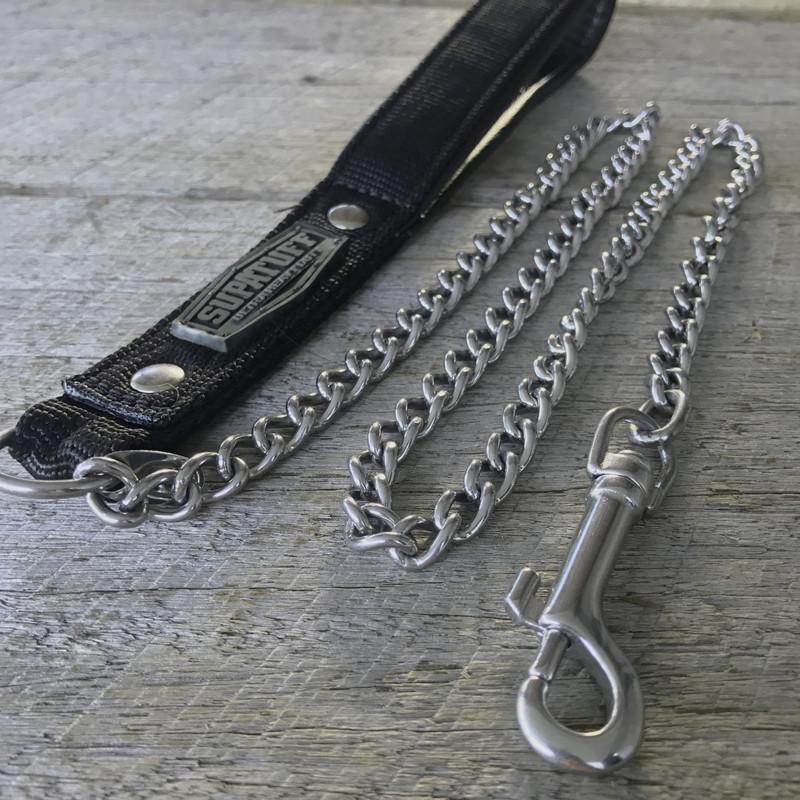
The steel professional adjustable training leash in the Rogue Royalty range is built specifically around this requirement, used by police, security, military, and competition handlers who need a leash that performs consistently across multiple contexts rather than a single-purpose lead. The multifunction design allows attachment at multiple points, which matters directly for the dual-attachment safety setup covered earlier in this guide: a handler can connect simultaneously to both the collar and a harness using the same piece of equipment, rather than needing two separate leads for a single dog during serious working or control situations.
Solid brass hardware throughout this leash matters for the same reason solid hardware matters on the collar itself: working equipment fails at its weakest point under sudden load, and that weak point is almost always the hardware rather than the webbing or leather body of the product. A leash with a premium leather body and a cheap, unrated clip is not meaningfully stronger than the clip alone, since that clip determines the actual load the entire system can handle before failure.
Leash Length for Different Handling Contexts
Different handling situations call for different leash lengths, and using the wrong length undermines even the best collar and leash hardware. A short lead, typically under a metre, gives the handler maximum close-quarters control and is appropriate for crowded environments, vet visits, or any situation requiring the dog to stay tight against the handler's side. A standard working length, generally in the 1.2 to 1.8 metre range, suits everyday handling and most training contexts where the dog needs some natural movement room without losing immediate control.
For tracking, scent work, or controlled distance training specifically, a longer line gives the dog room to work while keeping the handler connected, though this is a different equipment category from the close-control leash used during agitation or restraint work. Matching leash length to the specific task at hand, rather than using one all-purpose length for every context, is part of what separates deliberate professional handling from improvised equipment use.
When a Collar Alone Isn't Enough
For dogs in genuine working roles, whether protection, security, conservation, or detection contexts, the collar is one component of a broader equipment system rather than a complete solution on its own. Handlers managing dogs in these roles typically build out a full kit: the wide handling collar for close control and breathing safety, a harness for body management and load distribution during sustained work, appropriate leash hardware matched to the specific task, and reliable identification in case the dog becomes separated during an operation or training exercise in unfamiliar terrain.
This systems-based approach to equipment reflects how working dog professionals actually think about gear: not as individual purchases evaluated in isolation, but as a coordinated kit where each piece needs to perform reliably alongside the others under the same demanding conditions. A collar that performs perfectly but pairs with mismatched, lower-quality leash hardware creates a weak point in the system regardless of how well the collar itself was built, which is why handlers serious about working dog gear tend to standardise on a single trusted supplier across collar, leash, and harness rather than mixing brands and hardware standards across the kit.
Maintaining Handling Gear Under Heavy Use
Gear used daily for serious handling work sees far more cumulative stress than an everyday companion dog's collar, which makes regular inspection a genuine safety practice rather than routine maintenance. Check stitching at the D-ring attachment point and handle junction specifically, since these are the highest-stress points on any handle or agitation collar under repeated hard use. For leather products, conditioning every one to three months keeps the hide supple and prevents the cracking that eventually compromises stitched and riveted hardware points. For the SupaTuff stainless steel range, a freshwater rinse after exposure to mud, salt, or harsh outdoor conditions prevents grit buildup at the moving joints of the buckle and D-ring.
Establishing a fixed inspection schedule, rather than only checking gear when something already feels wrong, catches early wear before it becomes a failure point during an actual handling situation. A monthly visual and hands-on check, run through every piece in the kit, takes a few minutes and is the same standard of care professional handlers apply to gear that simply cannot be allowed to fail mid-task. For owners and handlers managing equipment across multiple dogs or a larger working program, keeping a simple written log of when each piece was last inspected and conditioned helps maintain this discipline consistently rather than relying on memory alone, particularly across a team where different handlers may use the same shared equipment on different days.
Frequently Asked Questions About Agitation and Handle Collars
What is an agitation collar and what is it actually used for?
A wide leather or webbing collar designed to restrain a dog while allowing it to breathe under pulling tension, by distributing pressure across a wider neck area than a standard narrow collar. Used in controlled aggression work, decoy training, and daily handling by law enforcement and working dog professionals, sometimes as the dog's everyday collar specifically for this pressure-distribution benefit.
Why does collar width matter so much for working and powerful dogs?
Width determines how force distributes across the neck. A narrow collar concentrates force into a small area, increasing pressure on the trachea and soft tissue. A wider collar spreads identical force across more surface area, reducing pressure intensity and helping the collar stay flat and stable under load. For powerful breeds generating substantial force, this is a functional requirement, not a styling choice.
What is a built-in handle on a dog collar actually for?
It gives the handler immediate, close-range control without grabbing the collar edge or the dog's neck directly. Useful in high-traffic environments, vet visits, or any moment requiring instant close-quarters control of a large or powerful dog. Handlers managing strong dogs in public settings frequently cite the built-in handle as the most used feature of this collar style.
Should I use a collar or a harness for handling a powerful working dog?
Many handlers use both together. A wide handle or agitation collar gives superior head control a harness cannot replicate. A harness redirects leash force away from the neck during general walking. For serious working dogs, attaching the leash to both simultaneously is a standard dual-point safety setup, so if one attachment fails, the second remains secure.
What does it mean when working dog gear is described as field-tested?
It means the gear has been used in genuine working conditions by professional handlers, with prolonged real-world use, direct operator feedback, and wear patterns identified through actual deployment rather than laboratory testing alone. Gear tested by working K9 units operating in harsh daily conditions has faced sustained stress most consumer testing never replicates.
What is the correct width for an agitation or handle collar based on dog size?
Industry standard widths typically run from 3cm to 5cm, with the wider end reserved for large, powerful breeds and the narrower end for average to smaller working breeds. The collar should fit snugly under tension while still allowing the handler to comfortably grip it with a full hand, which is the practical fit check used across professional handling contexts.
Does Rogue Royalty supply gear to working K9 units?
Yes. Rogue Royalty has supplied SupaTuff heavy-duty collars and natural grooming products to Pit-Track, an anti-poaching K9 unit in South Africa protecting endangered Southern White Rhinoceros populations using trained dogs in demanding bush conditions. Pit-Track's director has publicly described the gear holding up to extended field use without failure, representing genuine third-party field validation under sustained working conditions.

