




The short answer is that both materials can be excellent or terrible depending entirely on the quality grade of the specific product, not the material category itself. A full-grain bridle leather collar with brass hardware will outlast most nylon collars by years. A bonded leather or PU leather collar sold as leather will peel and fail within twelve months. A custom-specification SupaTuff nylon collar with stainless steel hardware throughout is a serious lifetime product. A budget nylon collar with plastic buckles can fail suddenly under one hard pull from a large dog.
This guide compares the two materials honestly across durability, waterproofing, skin contact, hardware quality, maintenance, and the Australian-specific conditions that change which is the more practical choice. It also covers the critical distinction most leather collar guides skip: the difference between genuine full-grain leather and PU leather, which changes every durability claim in the comparison.
What Genuine Leather Actually Means (and What It Doesn't)
The word leather on a product label covers a wide range of actual materials, from the highest-grade full-grain bridle leather to bonded leather made from compressed leather scraps, to PU leather which is polyurethane-coated fabric with no animal material at all. Any durability comparison between leather and nylon is meaningless without specifying which grade of leather is being discussed, because the performance difference between full-grain bridle leather and PU leather is larger than the difference between quality leather and quality nylon.
Full-Grain Bridle Leather
Full-grain leather retains the complete outer surface of the hide, the densest and strongest layer of the material. Bridle leather specifically is tanned and treated with oils and waxes that give it exceptional density, water resistance relative to other leather grades, and the capacity to soften and mold to a specific shape under repeated use and pressure. A bridle leather collar worn daily for months develops a set that follows the exact contours of the individual dog's neck, which is why it becomes more comfortable with time rather than wearing down. This is the material used in Rogue Royalty's handmade leather collar range.
PU Leather and What Happens When It Fails
PU leather, described variously as faux leather, vegan leather, synthetic leather, or simply "leather" in many product listings, is a polyester or polyurethane base coated with plastic to approximate the appearance of genuine leather. PU leather does not develop patina and does not mold to the dog's neck over time. The plastic surface layer begins to crack, peel, or flake within 12 to 24 months of normal daily use, at which point both the cosmetic appearance and the structural integrity of the collar degrade simultaneously. Many budget and mid-range collars sold as leather at under approximately $30 AUD are PU leather products.
What Custom-Grade Nylon Actually Means
The same distinction applies to nylon. Standard commercial nylon webbing used in most budget collar products differs significantly from custom-specification double-ply nylon webbing manufactured for specific load requirements. Budget nylon starts losing tensile strength from UV exposure and repeated wet-dry cycling from around 12 months, frays at stress points over time, and typically uses plastic buckles that introduce a separate failure point independent of the webbing material itself.
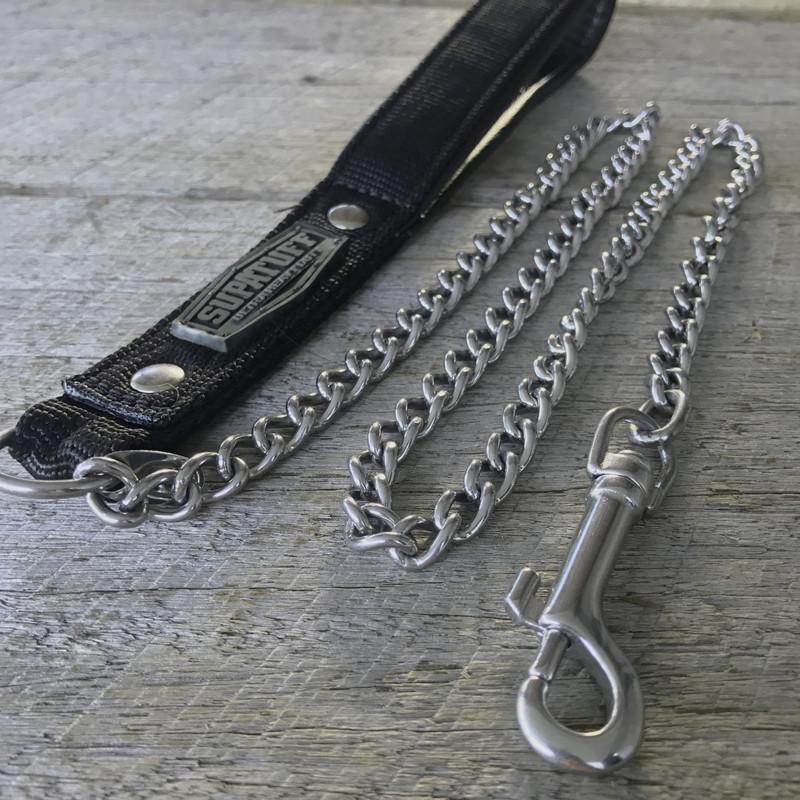
SupaTuff nylon, the webbing grade used in Rogue Royalty's heavy-duty collar range, is custom-manufactured to specific specifications including double-ply construction, UV treatment, colour stability, rot resistance, and weatherproofing. The collar system uses stainless steel hardware throughout with no plastic fittings at any point, which eliminates the plastic failure mode entirely. This is a different product category from standard commercial nylon, not a marketing claim applied to the same material.
The Seven-Factor Comparison
| Factor | Full-Grain Bridle Leather | SupaTuff Custom Nylon |
|---|---|---|
| Lifespan | 8 to 15 years with maintenance | Lifetime guaranteed with stainless hardware |
| Waterproofing | Absorbs water; handles rain, not regular swimming | Fully waterproof, rot-resistant |
| Skin contact | Molds to neck; napa inner; very low irritation risk | Smooth-finish webbing; comfortable from day one |
| Break-in | 1 to 2 weeks; improves significantly with wear | No break-in needed |
| Maintenance | Conditioning every 3 months | Rinse clean; no conditioning needed |
| Hardware | Solid brass or stainless steel throughout | All stainless steel, no plastic fittings |
| Best conditions | Urban daily walking; moderate weather | All weather; swimming; working dogs; wet environments |
Durability: Which One Actually Outlasts the Other
Full-grain bridle leather collars, properly maintained, are routinely used daily for 8 to 15 years. The leather deepens in colour over time, develops a patina specific to how that individual collar has been used, and becomes more comfortable with each passing month as it conforms to the dog's neck shape. This improvement-with-age characteristic is unique to genuine leather and has no equivalent in synthetic materials.
High-quality custom nylon with stainless hardware is rated for lifetime use. It doesn't improve with age in the same tactile way leather does, but it also doesn't require the same maintenance to achieve that lifespan and doesn't have the waterproofing limitation leather carries.
The practical durability conclusion is this: both Rogue Royalty leather and SupaTuff nylon are lifetime collar investments at the quality level they're built to. The choice between them is about lifestyle fit, not which material wins a durability race, because in this quality bracket both materials outlast the useful comparison period considerably.
Waterproofing: The Area Where Nylon Wins Clearly
Leather absorbs water. Full-grain bridle leather handles ordinary rain, damp grass, and brief wet exposure without significant long-term damage, particularly when dried naturally and conditioned regularly. What it doesn't handle well is repeated full immersion, such as a dog that swims in a river, ocean, or pool multiple times per week throughout the year.
Repeated soaking and drying cycles accelerate the drying out of natural oils in leather, making it progressively stiffer and more prone to surface cracking unless conditioning frequency increases to match. In Australian coastal or humid tropical environments where a dog is frequently in water regularly, SupaTuff nylon is the clearly more practical daily choice, and using a leather collar on the same dog for drier outings is a reasonable dual-collar approach.
Skin Contact and Irritation Risk
This is where leather holds a specific advantage that most nylon collar guides don't discuss. Standard commercial nylon is typically treated with synthetic dyes and chemical finishes during manufacture. In dogs with contact skin sensitivities, these dye compounds are a more common irritation source than the nylon fibre itself. Collar rash, presenting as redness, hair loss around the collar line, or persistent scratching, is more common on budget nylon collars with aggressive dye treatments than on natural leather with a napa inner.
Full-grain bridle leather, particularly with a soft napa leather lining at the contact surface, presents a natural, breathable material against the skin rather than a synthetic one. The natural oils in the leather also contribute a degree of moisture management that helps reduce the build-up of heat and sweat under the collar during active walks.
Hardware Quality: The Factor That Actually Determines Safety
The leash connects to the collar at the D-ring. The collar stays on the dog via the buckle. Both are single points where the entire connection chain either holds or fails. The collar material, leather or nylon, rarely fails first on a quality product. The hardware fails first on most collars.
Plastic buckles are the most common failure point across both material categories. They fail in cold weather by becoming brittle. They fail under sudden high-force loading by cracking rather than deforming. They show no visible warning before failure because plastic fracture is sudden rather than progressive. Both quality leather and quality nylon collar ranges at Rogue Royalty use solid brass or stainless steel hardware throughout, which changes the failure mode entirely: metal hardware under overload deforms visibly before it fails, giving the handler an observable warning sign rather than a sudden separation.
Maintenance: What Each Material Actually Requires
Leather conditioning every three months is the main maintenance requirement for bridle leather collars. Rogue Royalty's All Natural Leather Balm restores the natural oils and waxes in the leather that daily use gradually depletes, keeping the material supple and preventing the cracking that dried-out leather develops over time. Beyond conditioning, drying leather naturally away from direct heat sources after wet exposure and storing it away from sustained direct sunlight covers the realistic maintenance for most Australian owners.
SupaTuff nylon requires no conditioning. A rinse with water cleans it after muddy or wet outings. It can be hosed down. It does not absorb or retain odours the way standard nylon does, and it doesn't require any product-based maintenance beyond keeping it physically clean.
Tanning Methods: Why Not All Leather Behaves the Same
This is the depth of detail that separates a genuine product specialist from a general guide. Most leather collar comparisons treat leather as a single material, but the tanning method used to process the hide significantly affects the collar's durability, water resistance, flexibility, and ageing characteristics. Two leather collars can have identical construction and hardware and very different long-term performance based on this one variable.
Vegetable Tanning
Vegetable tanning uses plant-based tannins, historically from oak bark and similar sources, to transform raw hide into leather. The process is slow, typically weeks or months, and produces leather with high density, firmness on first wear, and the capacity for genuine patina development over time. Vegetable-tanned leather is typically a warm brown tone that deepens and develops character with use and age. It is the most traditional form of leather tanning and produces the material most commonly used in quality equestrian and saddlery work, including bridle leather. It handles compression and tension well without deforming permanently, which is why it develops a set around the dog's neck contours rather than simply stretching.
Chrome Tanning
Chrome tanning uses chromium salts and takes hours rather than weeks. It produces a softer, more uniformly flexible leather that is easier to dye in a wide range of colours. Most commercial leather goods, including most standard leather dog collars on the market, use chrome-tanned leather because the process is significantly cheaper and faster. Chrome-tanned leather typically has less body and density than vegetable-tanned leather, doesn't develop the same depth of patina, and may have a slightly more plastic-like feel at similar thicknesses. It is still genuine leather, but it ages differently and the long-term durability profile differs from vegetable-tanned material in ways that matter for a product worn daily for years.
The Collar Width Factor That Changes the Leather Versus Nylon Calculation
Width affects both materials differently, and the difference matters more than most comparisons acknowledge. A narrow leather collar on a large, powerful dog concentrates pulling force into a small area of both the material and the dog's neck. The mechanical stress is higher per unit of material, and the contact pressure on the neck is higher per unit of surface area. A wide leather collar on the same dog distributes that same force across more material and more neck surface, both reducing per-unit stress on the collar and reducing pressure on the dog's neck simultaneously.
This matters for the leather versus nylon comparison because a narrow nylon collar with stainless steel hardware on a large dog may be more durable and more comfortable than a narrow leather collar with equivalent hardware, simply because the narrower profile concentrates force in a way that tests the leather more severely. Moving up to a wide-fit leather collar at the same quality grade reverses that calculation for most dogs, because the distributed force profile is within the comfortable operating range of quality bridle leather at that width.
For dogs under approximately 15 kilograms that don't pull hard, this distinction is largely academic. For dogs over 30 kilograms that pull actively during walks, collar width and collar material interact in ways that affect both equipment durability and the dog's neck comfort in a meaningful practical sense.
The Rogue Royalty Range Across Both Materials
Rogue Royalty produces both materials at the quality end of each category, specifically so owners can choose based on their dog's lifestyle rather than being forced into a compromise.
The leather collar range covers slim, regular, and wide fit profiles across multiple styles from the classic everyday Rogue Classic through to the bold studded RuffNeck, all in full-grain bridle leather with a napa inner and solid brass or stainless steel hardware. A 10-year craftsmanship warranty covers the workmanship on every leather collar in the range.
The SupaTuff range uses custom double-ply webbing, all stainless steel hardware, and carries a lifetime guarantee. The SupaTuff heavy-duty collar is the working dog and strong puller option in the nylon category, built specifically for conditions where leather's waterproofing limitation makes it impractical.
The wide fit collection includes both leather and SupaTuff options for muscular, broad-necked breeds, and the regular fit range covers the middle ground across both materials for dogs at standard proportions.
Not a compromise between two mediocre options. Two serious products, each the right choice for different lifestyles and conditions.
Browse the Full Collar Range →Frequently Asked Questions: Leather vs Nylon Dog Collars
Does a leather dog collar last longer than a nylon collar?
Full-grain bridle leather, maintained with periodic conditioning, consistently outlasts standard nylon by years. Quality leather collars are routinely used daily for 8 to 15 years. Standard nylon shows meaningful degradation within 1 to 2 years. However, at the SupaTuff quality grade with all-stainless hardware and custom double-ply webbing, nylon carries a lifetime guarantee, so the durability comparison depends heavily on the quality grade of each specific product rather than the material alone.
Can a dog wear a leather collar in water or rain?
Occasional rain and wet grass do not significantly damage quality bridle leather, particularly when dried naturally and conditioned periodically. But for dogs that swim several times a week or live in consistently wet conditions, waterproof nylon is the more practical daily choice. Leather is better suited to drier walking conditions; SupaTuff nylon handles full-immersion environments comfortably.
What is the difference between genuine leather and PU leather in dog collars?
Genuine full-grain leather is actual animal hide, dense, moldable, and durable. PU leather is polyurethane-coated polyester fabric with no animal material, sold under names including faux leather, vegan leather, or synthetic leather. PU leather typically peels, cracks, or flakes within 12 to 24 months of daily use. It does not mold to the dog's neck, develop patina, or improve with wear the way genuine leather does.
Is nylon safe for dogs with skin sensitivities?
Standard nylon is treated with synthetic dyes that can cause contact irritation in sensitive dogs. Genuine leather, particularly with a napa inner lining, presents a more natural material at the contact surface and is generally lower-irritation for sensitive dogs. Hair loss appearing as a consistent band at the collar line without redness can indicate material sensitivity rather than a fit issue.
Does nylon fray and become unsafe over time?
Yes. Nylon frays at stress points, most commonly near buckle holes and D-ring attachment points. Unlike leather which shows surface cracking as a warning, fraying nylon can look acceptable while structural integrity has been significantly reduced. A nylon collar showing any fraying near hardware points should be replaced immediately rather than judged safe by appearance alone.
What makes SupaTuff nylon different from standard nylon dog collars?
SupaTuff uses custom-specification double-ply webbing manufactured to Rogue Royalty's own requirements: weatherproof, rot-resistant, colourfast, UV-treated. Critically, all hardware is stainless steel with no plastic fittings at any point. This eliminates plastic buckle failure as a risk mode entirely. Under overload stress, stainless hardware deforms visibly before failing, rather than snapping suddenly.
Which is better for a large, powerful dog: leather or nylon?
Both can be appropriate at the right quality grade. The determining factor is hardware quality, not collar material. Full-grain leather with solid brass or stainless steel hardware is a strong, reliable everyday choice. SupaTuff nylon with stainless steel throughout is appropriate for working, protection, or very wet conditions. The collar that fails on a large dog is almost always one with plastic fittings, regardless of whether the strap itself is leather or nylon.

