




Leather dog collars Australia-wide range from $15 mass-produced strips of bonded leather to handcrafted full-grain bridle pieces built to last a decade. The gap between them is not primarily about price. It is about material grade, construction method, inner lining quality, hardware specification, and how the collar performs under the specific Australian conditions that most collar guides written for northern hemisphere markets completely fail to address.
Australia is one of the most demanding environments on earth for leather gear. High UV intensity, coastal salt exposure, extreme heat-to-cool temperature cycling between outdoor conditions and air conditioning, subtropical humidity in Queensland and northern New South Wales, and the active year-round outdoor lifestyle that Australian dog owners maintain all place stresses on a collar that mild-climate guides don't account for. A collar that lasts five years in Scotland may crack within eighteen months in Brisbane without the right material and maintenance approach.
This guide covers what separates full-grain bridle leather from cheap alternatives under Australian conditions, why the inner lining is the most overlooked variable in collar quality, how salt water damages hardware and which component fails first, Australian council ID tag compliance and what it requires from your collar, the sizing framework for wide-fit and slim-fit leather collars across Australia's most popular breeds, and the care routine that extends leather collar life through Australian summers.
What Full-Grain Bridle Leather Is and Why It Behaves Differently in Australian Conditions
Walk into any chain pet store in Australia and pick up a collar labelled "genuine leather." That label confirms the product is made from animal hide. It tells you nothing about which part of the hide, how it was tanned, or whether it will hold up under the conditions your dog actually lives in.
Leather quality is determined by four variables: which layer of the hide was used, the tanning process, the finishing, and the thickness. Most cheap leather collars use split grain or bonded leather: either a lower layer of the hide with weaker fibre structure, or reconstituted leather scraps pressed together with adhesives. These materials look similar to full-grain in a product photograph and fail within months of regular outdoor use.
Full-Grain Leather
Full-grain leather uses the outermost layer of the hide, where the fibre structure is tightest and strongest. The natural grain surface is retained rather than sanded away to remove marks, which preserves the leather's structural integrity. A collar made from full-grain leather flexes without cracking, develops a patina from use rather than surface peeling, and maintains its shape under the leash forces generated by an active dog.
Bridle Leather
Bridle leather is a specific grade of full-grain leather originally developed for saddlery and horse equipment. During the tanning and finishing process, tallow and waxes are worked deep into the hide fibres, giving the leather inherent water resistance rather than a surface coating that wears away. In Australian conditions, this distinction is significant. A surface-treated leather collar looks water-resistant when new and becomes progressively less so as the surface finish wears off with daily use. A bridle leather collar has water resistance built into the fibre structure itself, which persists throughout the collar's life with correct conditioning maintenance.
Why the Inner Lining Is the Most Important Variable Nobody Talks About
Every leather collar buying guide discusses the outer material. Very few discuss what sits against the dog's skin and coat, which is the surface that determines the collar's daily comfort and its long-term effect on coat health.
The inner contact surface creates friction against the coat at every movement the dog makes. Over weeks of daily wear, this friction accumulates. A rough or textured inner surface bends and catches individual hairs thousands of times per day, eventually causing them to interlock and form matting at the two parallel lines where the top and bottom edges of the collar strap contact the coat. This matting is particularly visible and problematic in long-coated and double-coated breeds.
Napa Calfskin Inner Lining
Napa calfskin is a soft, smooth full-grain leather with an exceptionally tight grain structure. Used as the inner lining of a collar, it creates a near-frictionless contact surface that slides against coat fibres rather than catching on them. The practical result is that a collar with a napa inner produces no coat matting at contact points regardless of the dog's coat length or texture, because the friction that causes matting is not present.
For short-coated breeds, the napa inner contacts skin directly and provides a smooth surface that does not cause friction sores or skin irritation at the collar line. For long-coated and double-coated breeds common across Australia, including Border Collies, Golden Retrievers, Siberian Huskies, and rough-coated Kelpies, it eliminates the collar-line coat damage that builds invisibly over months until the owner notices a parted, matted strip under the collar strap.
How Salt Water Damages Leather Collars and Which Hardware Component Fails First
Coastal living is a central part of Australian dog ownership. Beach outings, ocean swimming, and salt air exposure are daily realities for millions of Australian dogs and their collars. Most guides address this with "rinse after beach use." Understanding why the rinse matters, and what happens when it doesn't happen, helps owners make better collar decisions and catch wear before it becomes failure.
Salt water damages leather collars through two separate mechanisms that happen simultaneously. In the leather, salt penetrates the fibre structure during immersion and then draws moisture out of the hide as it dries. The fibres that were saturated during the swim become progressively drier as the salt concentration pulls their remaining moisture outward. Over repeated wetting and drying cycles without proper rinsing, this produces hardening and cracking from within the leather layers rather than from the surface, which is the reason "rinse before conditioning" rather than "just condition" is the correct post-beach care sequence.
In the hardware, salt water accelerates corrosion through a process where salt deposits in the micro-gaps between metal surfaces. The buckle mechanism fails before the D-ring in most cases because the buckle has a moving prong that sweeps through a slot, and salt deposits in this gap create friction, stiffness, and eventually corrosion that prevents the buckle from seating correctly. A D-ring, being a simple loop without moving parts, accumulates less salt and fails later. This is the specific reason all-stainless hardware, which resists chloride corrosion significantly better than chrome-plated alternatives, matters more for coastal Australian dogs than for inland dogs.
Australian Council ID Compliance and What It Means for Your Collar Choice
Every Australian state and territory requires dogs to wear a collar with an identification tag when in a public place. This is a legal requirement under local government companion animal legislation across all jurisdictions. The collar is not optional for outdoor use, and the ID tag must be attached to it.
This legal requirement creates a specific functional specification for the collar's D-ring. The D-ring must be solid enough to hold the tag securely under the weight of the tag and the occasional snagging of the tag on vegetation or furniture. It must be positioned correctly at the centre top of the collar so the tag hangs freely where it can be read without flipping underneath or rotating to the side. And it must be corrosion-resistant enough to remain structurally sound after the regular wet-and-dry cycling that an outdoor Australian dog's collar experiences.
A D-ring made from solid brass or stainless steel satisfies these requirements across a decade of regular use. A D-ring made from chrome-plated zinc alloy, which is the most common D-ring material in budget and mid-market collars, typically shows surface corrosion within 18 to 24 months of coastal or wet-condition use, with visible pitting and rust streaking that contaminates the tag surface and eventually compromises the ring's structural integrity.
Sizing Leather Dog Collars Across Australian Breeds
Correct collar sizing involves two variables: the neck circumference measurement and the appropriate collar width for the dog's size and breed type. Both matter. A collar sized correctly by circumference but at the wrong width for the dog's build is either too bulky and heavy for a small dog, or too narrow to distribute leash tension appropriately for a large one.
| Dog Profile | Common Australian Breeds | Typical Neck Range | Appropriate Width |
|---|---|---|---|
| Small breeds | Chihuahua, Maltese, Toy Poodle, Dachshund | 18 to 30 cm | 15 to 20 mm (slim-fit) |
| Medium breeds | Border Collie, Kelpie, Staffy, Beagle | 30 to 45 cm | 25 to 32 mm |
| Large breeds | Labrador, German Shepherd, Golden Retriever, Boxer | 42 to 58 cm | 35 to 48 mm (wide-fit) |
| Extra-large breeds | Rottweiler, Mastiff, Great Dane, Bull Arab | 52 to 74 cm | 48 to 55 mm (wide-fit) |
Measure at the base of the neck where the collar will sit, at skin level rather than over the coat. For thick-coated breeds, the dense coat can add 1 to 2 centimetres to an over-coat reading, which affects the sizing choice. Choose the size where the measurement falls in the middle of the adjustment range, not at the extremes.
How to Care for Leather Dog Collars in Australian Conditions
Leather collar care in Australia requires more attention than most northern hemisphere guides suggest because the environmental stresses are higher. High UV intensity, summer temperatures above 30 degrees Celsius, humidity variations, and salt exposure in coastal regions all accelerate the drying and degradation processes that conditioning is designed to counteract.
The Core Maintenance Sequence
After any wet exposure, allow the leather to dry naturally at room temperature away from direct sun and away from heat sources. Direct sun and heat sources cause rapid moisture loss that stiffens and cracks the fibres before the natural oils can redistribute. Once fully dry, apply a small amount of leather conditioner working into the grain with a clean cloth.
Every six to eight weeks during regular outdoor use, apply leather conditioner regardless of whether the collar has been wet recently. In high-UV conditions across northern and central Australia, apply every four to six weeks. The Rogue Royalty All Natural Leather Balm is specifically formulated for the leather grades used in the collar range and maintains the napa inner's soft contact surface alongside the bridle leather's outer suppleness.
Monthly Hardware Check
Run the D-ring freely to confirm it moves without friction or roughness. Check the buckle prong for any signs of corrosion at the pivot point. Inspect the stitching at the D-ring and buckle joins for any fraying or loosening. For coastal dogs, run this check every two weeks rather than monthly.
Why Choose Rogue Royalty for Leather Dog Collars in Australia
Rogue Royalty has been building handmade leather dog gear in Australia since 2009, supplying over 30,000 customers across the country with collars built to the standards that daily Australian use demands. Every collar in the leather range uses full-grain bridle leather selected for its suitability under Australian UV, heat, and coastal conditions.
The napa calfskin inner lining on every leather collar is not a marketing feature. It is the specific construction detail that prevents coat damage at contact points over months and years of daily wear, and it is the most meaningful differentiator between collars that are comfortable for the dog's coat and those that are not. Solid brass hardware at every D-ring and buckle, with no plated components at any load-bearing connection point, handles the salt and humidity exposure of coastal Australian dog life without the corrosion timeline that affects chrome-plated alternatives.
The 10-year craftsmanship warranty on every leather collar reflects the build standard that backs these claims across years of active use rather than months. A correctly maintained Rogue Royalty leather collar will outlast multiple rounds of budget collar replacements, arriving at the end of its first decade looking better than most $40 collars look at the end of their first year.
The Rogue Royalty Leather Collar Range
Classic Wide Fit Leather Collar (Brown and Chrome)
For: medium to extra-large breeds needing a wide-fit profile; everyday suburban use; ID tag carrying; the leather component of a dual-collar system for coastal dogs
Full-grain bridle leather outer with smooth napa calfskin inner at every contact point. Double-pin roller buckle. Solid non-rust metal hardware throughout. Available Small through XXXL covering 33 to 74 cm neck circumference. 10-year craftsmanship warranty.
From $95.00 | View the Classic Wide Fit Leather Collar
Wide Fit Leather Collar Range
For: large and extra-large breeds; dogs needing the escape-resistance and pressure-distribution advantages of a wider collar profile
Full range of wide-fit leather collar designs in bridle leather with napa inner lining. Solid brass and chrome hardware options. All-metal construction, no plastic fittings. Available from Small through XXXL. 10-year craftsmanship warranty across the range.
From $95.00 | Browse the Wide Fit Leather Collar Range
Slim Fit Leather Collar Range
For: small and medium breeds; proportional lightweight profiles for dogs where a wide collar would be disproportionately heavy or bulky
Full-grain bridle leather in a slim-fit profile with napa calfskin inner. All-metal hardware. Available from XXXS neck sizes upward covering the full range of small and medium breed neck circumferences. 10-year craftsmanship warranty.
From $55.00 | Browse the Slim Fit Leather Collar Range
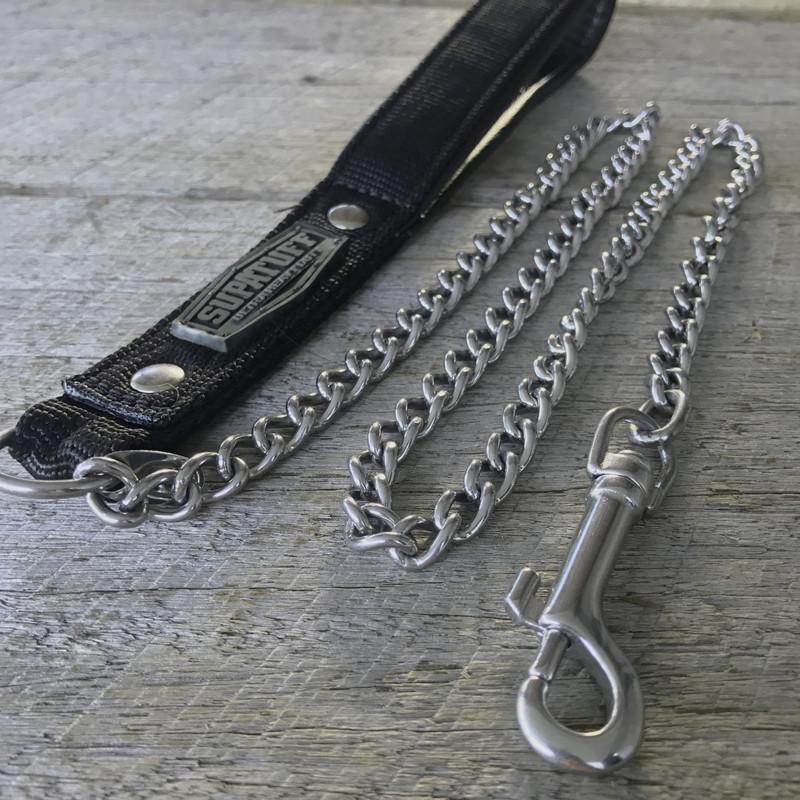
For the waterproof component of a dual-collar system, the SupaTuff Heavy Duty Collar provides waterproof double-ply nylon with all-stainless hardware and a lifetime guarantee for beach, river, and field conditions.
For leather collar maintenance in Australian conditions, the All Natural Leather Balm maintains both the bridle leather outer and the napa calfskin inner, applied every six to eight weeks during regular outdoor use.
What Australian Dog Owners Say About Rogue Royalty
Thick, well made, durable and padded on the inside for comfort. Its such a beautiful collar! The leather is great for my dogs sensitive skin and she looks badass!
I absolutely love this colour on my girl and the quality is great ..ideal for a girl like mine who loves hanging off the back of the ute.
Love the quality, and the design, and our looks awesome, thanks
Amazing quality collars!
Great product and service
Full-grain bridle leather. Napa calfskin inner. Solid brass and stainless hardware. Built for Australian conditions from small to XXXL.
Browse All Leather Dog Collars →Common Mistakes When Buying Leather Dog Collars in Australia
Buying by price alone. The $15 to $40 leather collar bracket is almost entirely bonded leather, split grain, or chrome-tanned strip leather with minimal fibre integrity. The price difference between a $15 collar that lasts 12 months and a $95 collar that lasts 10 years favours the quality purchase significantly over any dog's lifetime.
Ignoring the inner lining. Most buyers examine the outer surface of a leather collar and never look at what sits against the dog. Turn any collar over before buying. A rough, unfinished, or textured inner surface will cause coat damage within weeks on any medium to long-coated breed. A smooth napa inner will not.
Not maintaining leather after wet exposure. Leaving a leather collar unconditioned after repeated wet-and-dry cycling in Australian conditions is the most common cause of premature cracking. The leather dries out from the inside as residual moisture is drawn out, and without conditioning to replenish the oils, the fibres become brittle.
Choosing the wrong width for the dog's build. A narrow collar on a large, strong breed concentrates leash tension on a small contact area and can cause discomfort and coat damage at that point. A wide collar on a small, fine-necked breed adds unnecessary weight and can sit awkwardly across the neck. Match the width to the dog's neck size, not to personal preference for a particular look.
Frequently Asked Questions: Leather Dog Collars Australia
How long do leather dog collars last in Australia?
A quality full-grain bridle leather collar with solid metal hardware, correctly maintained, lasts 5 to 15 years in Australian conditions. A cheap genuine leather collar using bonded or split-grain leather typically fails within 12 to 18 months under regular outdoor use. The variance is almost entirely explained by the leather grade and whether the collar is conditioned regularly and rinsed after salt water exposure.
What is the best leather for dog collars in Australian conditions?
Full-grain bridle leather. Its wax and tallow impregnation provides inherent water resistance built into the fibre structure rather than a surface coating that wears off. Under Australian UV, salt, and heat, bridle leather maintains structural integrity better than lighter vegetable-tanned or chrome-tanned alternatives and develops a patina rather than cracking with age.
Do leather dog collars need to come off before swimming?
Yes. Salt water penetrates leather fibres and draws moisture out as it dries, causing progressive cracking from within. At the hardware, salt deposits in the buckle mechanism create corrosion that stiffens and eventually prevents correct operation. The buckle fails before the D-ring. For regular swimmers, use a waterproof collar for water outings and leather for dry everyday use.
What does a napa lining do that a regular leather inner doesn't?
Napa calfskin creates a smooth, low-friction contact surface that slides against coat fibres rather than catching on them. Over weeks of daily wear, a rough inner surface causes hairs to interlock and form matting at collar contact lines. A napa inner eliminates this friction entirely, leaving no coat damage at contact points even after months of daily wear on long or double-coated breeds.
What collar width is right for my dog?
15 to 20mm slim-fit for small breeds under 10kg. 25 to 32mm for medium breeds 10 to 25kg. 35 to 48mm wide-fit for large breeds 25 to 45kg. 48 to 55mm wide-fit for extra-large breeds over 45kg. Match width to neck size for proportional fit and appropriate pressure distribution, not to visual preference alone.
Are leather dog collars legal for ID compliance in Australia?
Yes. All Australian councils require a collar with an ID tag when a dog is in a public place. A leather collar with a solid D-ring at the centre top meets this requirement in every Australian jurisdiction. The D-ring must be solid metal, correctly positioned, and corrosion-resistant enough to remain structurally sound through regular outdoor use.
How often should I condition a leather dog collar in Australia?
Every six to eight weeks during regular active use, and after any significant wet exposure once fully dry. In high-UV conditions across Queensland, Northern NSW, and Western Australia, condition every four to six weeks. After beach outings, rinse with fresh water first, allow to dry fully in shade, then condition before next use. Never condition a still-damp collar.

