





Search for a long line for recall training and the length advice is everywhere, somewhere between two metres and thirty metres depending on which particular guide you happen to land on during your search. What's missing from almost all of it is the actual logic connecting length to training stage and environment, plus the injury risk that actually matters and gets buried under generic safety bullet points most owners skim past quickly. A long line is not one tool with one correct length. It's a category that changes function depending on how long it is and how it's used.
This guide covers exactly which length suits which training stage and environment, the documented hand and wrist injury risk from incorrect handling technique that most product listings never mention, why harness attachment matters more for long line work specifically than for everyday walking, realistic recall training timelines, the training mistake that quietly undermines recall reliability regardless of which line is used, and the Rogue Royalty recall leash range covering the full length progression most dogs actually need.
Length by Purpose, Not Just by Preference
The single biggest mistake in long line selection is treating length as a purely personal preference rather than a functional choice tied directly to the dog's current training stage and the specific environment being used. Different lengths serve meaningfully different purposes, and using the wrong one for the situation either limits training effectiveness or creates unnecessary handling difficulty for the person holding the other end.
| Length | Best Suited For |
|---|---|
| 5 metres | Structured recall practice in smaller or partially enclosed spaces, early-stage training, dogs newer to recall work |
| 9.5 to 10 metres | Advanced recall work in open spaces, decompression walks allowing extended sniffing and exploration, dogs with established baseline recall reliability |
The progression itself matters just as much as the individual length choice made at any single point. Starting recall training on a shorter line in a controlled environment, then moving to a longer line as the dog demonstrates consistent response over time, follows the same incremental logic used across most structured dog training methods generally, rather than introducing maximum distance and distraction from day one. A dog that hasn't yet shown reliable recall at five metres in a quiet space is not ready for ten metres in an open, distraction-heavy environment, regardless of how much extra freedom that length would offer in theory.
The Hand and Wrist Injury Risk Most Listings Don't Mention
This is the detail almost every long line product page skips entirely, focusing instead on material and length specs while leaving out the actual handling technique that determines whether the tool is safe to use. Orthopaedic guidance on dog walking injuries is specific and consistent on this point: never wrap a leash or long line around your fingers, hand, or wrist, even though doing so can feel like it offers more secure control.
The mechanism is basic physics rather than an abstract caution. When a dog reaches the end of a long line at speed, the line has accumulated real kinetic energy that needs to go somewhere the instant the line goes taut. A hand holding the line loosely in an open palm can absorb that force by adjusting grip or releasing slightly. A hand or wrist with the line wrapped around it has no give at all, meaning the full force transfers directly into the joint and surrounding tissue. Documented injuries from this exact mechanism include fractures, dislocations, and tendon or ligament damage, serious outcomes from what feels like a minor handling choice in the moment.
Why Harness Attachment Matters More for Long Lines Specifically
The case for harness attachment over collar attachment is stronger for long line work than it is for everyday short-lead walking, and the reason comes back to the same force transfer principle covered above. A standard walk involves gradual, predictable pressure on the leash. Long line work, by design, involves the possibility of a dog running the full length of the line and hitting the end of it at speed, particularly during recall training when distractions are intentionally introduced.
A long line attached to a flat collar transmits that sudden stopping force directly into the neck and trachea in a sharp, concentrated jolt, a meaningfully different force profile than the gradual pressure of normal walking that a flat collar handles without issue. A harness distributes that same sudden force across the chest and shoulders instead, removing the concentrated neck pressure risk entirely. For dogs still building recall reliability specifically, where an unpredictable bolt toward a squirrel, another dog, or an interesting scent is a realistic and expected scenario during training, harness attachment removes a real injury risk that collar attachment carries.
Realistic Recall Training Timelines
Recall training timelines vary considerably by individual dog, but commonly cited ranges across dog training guidance span roughly two to twelve weeks of consistent practice before a dog demonstrates consistently reliable recall in moderate distraction environments. Naturally independent breeds, or dogs with strong prey drive, may take longer than this range suggests, and that's a normal reflection of temperament rather than a training failure.
Progress through this period is rarely a straight line. A dog responding reliably in a quiet backyard can regress noticeably the first time a truly exciting new distraction appears, another dog, wildlife scent, or an unfamiliar person, and this regression is an expected part of generalising the skill across different environments rather than a sign the earlier training didn't work. Consistent, short, frequent practice sessions tend to produce more reliable long-term results than occasional longer sessions, since frequency builds the habit more effectively than session length alone.
Council Leash Rules and Long Line Use in Public Spaces
Long line use in public areas sits in a genuine grey zone that varies considerably by local council across the country. Some local government areas enforce specific maximum lead length restrictions in particular public spaces, and a long line trailing loosely behind a dog, even when not actively held taut by the handler at that exact moment, may not satisfy a specific council requirement for the dog to be under direct, immediate leash control, depending on exactly how that particular council's bylaw happens to be worded.
Rather than assuming consistent national rules apply everywhere, checking the current requirements for the specific local council area before using a long line in a public space, particularly a designated on-leash area, avoids an entirely avoidable compliance issue or fine down the track. Designated off-leash areas typically don't carry the same restriction, making them the more practical environment for long line recall work where local off-leash zones are available and appropriate for the training stage.
The Training Mistake That Undermines Every Long Line Session
A long line is only as effective as the training approach behind it, and the single most common mistake that quietly undermines recall reliability has nothing to do with line length or hardware quality. Dog behaviour professionals describe this as poisoning the recall cue: the word "come" stops carrying a reliable positive meaning because it has, at some point, been followed by something the dog experiences as unpleasant.
This happens in two common and easy-to-miss ways. The first is calling a dog only to immediately end something enjoyable, clipping the lead back on at the end of an off-leash session, or ending a play session the moment the dog arrives. The dog learns the recall cue reliably predicts fun ending, which is a logical reason to delay or avoid responding even though the dog isn't being deliberately defiant. The second is any frustration, scolding, or physical correction directed at the dog after it finally does respond, even a late or reluctant return. From the dog's perspective, the sequence is simple: respond to the cue, then experience something unpleasant. The behavioural lesson learned is the opposite of what the handler intended.
This matters directly for long line work specifically because the entire tool exists to safely test recall at increasing distance and distraction without genuine risk of losing the dog. If the recall cue itself has been compromised through inconsistent consequences, no amount of line length or correct attachment point will produce reliable results, since the dog's hesitation isn't a handling or equipment problem in this scenario. It's a learned association problem that needs addressing before progressing to longer distances or higher distraction environments makes any practical sense.
Keeping a Long Line in Good Working Condition
A long line sees considerably more ground contact than a standard short lead, dragging through grass, mud, sand, and water during normal recall training sessions. This added exposure means a long line needs more regular attention than everyday walking gear to stay in safe working condition, since a compromised line is precisely the wrong failure point during a recall exercise specifically designed to test distance and reliability.
Rinse the line with fresh water after any session involving mud, salt water, or heavy sand contact, then allow it to dry fully before the next use rather than coiling it away damp. Nylon webbing that's stored wet, particularly when bundled tightly in a bag or vehicle boot, can develop mildew or odour over time, and trapped grit between fibres gradually works as an abrasive against the material itself during normal flexing and handling. A quick check of the stitching at the handle and the snap hook attachment point before each session, the same routine recommended for any leash hardware, catches early wear before it becomes a failure point during an actual training exercise rather than after.
For lines used frequently in wet or muddy conditions specifically, inspecting the snap hook mechanism for smooth operation matters more than it does on a standard leash used mainly for short, dry walks. A snap that sticks or doesn't close fully due to accumulated grit creates a genuine connection point failure risk precisely during the kind of high-tension moment, a dog hitting the end of the line at speed during recall practice, when secure hardware matters most. This is a small, quick check that takes seconds but directly protects against the exact failure mode a long line session is most likely to test.
The Rogue Royalty Recall Leash Range
The Rogue Royalty training leash range covers the length progression most dogs actually need, from structured shorter-distance work through to advanced open-space recall.
5 Metre Black Nylon Leash
For: structured recall practice in smaller or partially enclosed spaces, dogs newer to long line training
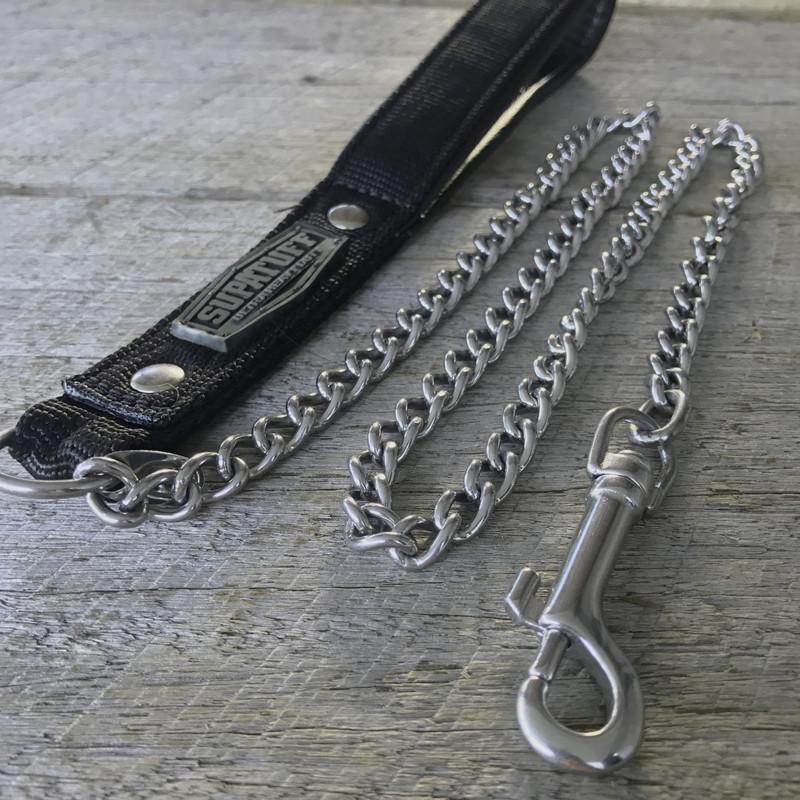
2.5cm width black nylon construction with a stainless steel snap. Suited to reactive dogs, extended stays, recall commands, and long-distance training where a shorter, more manageable line is the appropriate starting point.
$50.00 | View the 5 Metre Leash
Soft Grip Recall Training Leash 9.5m
For: advanced recall work, extended handling sessions where hand comfort matters
Unique soft-ply nylon webbing specifically designed to prevent hand strain during extended sessions, paired with a stainless steel snap hook and leather-reinforced joins at the handle and connection points. 9.5m length by 3cm width, weather and colourfast with no plastic fittings.
$64.99 | View the Soft Grip Recall Leash
10 Metre Recall Leash
For: maximum-distance open space recall training, decompression walks
2.5cm width black nylon with a stainless steel snap, built for reactive dogs, extended stays, and long-distance training requiring the greatest available range while maintaining a physical connection to the handler.
$65.00 | View the 10 Metre Leash
Why ID Matters More During Recall Training Specifically
A dog still building reliable recall is, by definition, at higher risk of a brief separation from the handler than a dog with established recall, since the entire purpose of this training stage is testing the dog's response at increasing distance and distraction. A securely attached dog tag on whichever collar the dog wears alongside the harness during long line sessions ensures fast identification in the rare event a line snaps, a clip fails, or the dog actually does get loose before recall reliability is fully established. This is a low-cost, low-effort addition to the training setup that specifically matters more during this particular training phase than it does for a dog with years of consistent off-leash reliability already behind them.
A securely fitted dog tag pairs naturally with any long line or harness setup, giving fast identification if a brief separation ever happens during the recall training process.
Browse Dog Tags →Pairing a Long Line With the Right Harness
Given the harness attachment recommendation covered earlier in this guide, pairing a long line with a properly fitted harness rather than relying on collar attachment for recall sessions specifically addresses the sudden-force injury risk directly. A harness sized correctly for the dog's chest and girth measurements, checked for proper fit before any long line session, completes the safety setup this guide has covered from both the handler's and the dog's side of the equation.
Frequently Asked Questions About Long Line Recall Training
What length long line should I use for recall training?
Length should match training stage and environment. A 5 metre line suits structured recall practice in smaller or partially enclosed spaces and early-stage training. A 9.5 to 10 metre line suits advanced recall work in open spaces and decompression walks, once the dog has shown reasonably reliable response at shorter distances. Progress from shorter to longer lines incrementally as reliability improves.
Is it true that wrapping a long line around your hand or wrist is dangerous?
Yes, this is a documented injury risk. Wrapping creates a fixed connection point that prevents quick release if the dog bolts. When a dog hits the end of a long line at speed, accumulated energy transfers directly into a wrapped hand or wrist with nowhere to go, resulting in fractures, dislocations, or tendon damage in documented cases. Holding the line loosely in an open palm allows quick release or grip adjustment instead.
Should a long line attach to a collar or a harness?
A harness is generally safer for long line work, distributing the sudden force of a dog hitting the end of the line across the chest and shoulders rather than concentrating it on the neck. A long line on a flat collar risks a sharp jolt of pressure on the trachea if the dog runs the full length at speed. For dogs still building recall reliability, harness attachment removes this risk entirely.
How long does recall training typically take using a long line?
Timelines vary by individual dog, but commonly cited ranges span roughly two to twelve weeks of consistent practice before reliable recall in moderate distraction environments. Progress isn't linear; regression when new distractions appear is normal, not a sign of failure. Short, frequent sessions tend to produce more reliable results than infrequent long ones.
Is it safe to step on a long line to stop a running dog?
Yes, stepping on a trailing long line is a standard, safer technique than grabbing a moving line with bare hands, which carries rope burn and cut risk at speed. Steady foot pressure allows gradual slowing rather than the abrupt force transfer that makes hand-wrapping dangerous. Keep the trailing line visible and accessible rather than letting it tangle in long grass.
Can I use a long line in any public off-leash area in Australia?
Council rules on leash length vary by local government area, and some enforce maximum lead length restrictions in specific public spaces. A trailing long line, even unheld, may not satisfy a council's requirement for direct leash control depending on local bylaw wording. Check current local requirements before using a long line in public, particularly in designated on-leash areas.
Why does my dog ignore the recall cue even with a long line?
The most common cause is a poisoned cue, where the recall word has stopped reliably predicting something positive. This happens when a dog is called only to have something enjoyable end immediately, or when the dog experiences frustration after a slow return. The dog learns the cue is ambiguous or predicts something unpleasant, causing hesitation or avoidance. The fix is ensuring every single recall receives a consistently positive response and reward, never frustration after the fact.
What long line and recall leash options does Rogue Royalty offer?
The range covers a 5 metre black nylon leash, a 9.5 metre soft-grip recall training leash with stainless steel hardware and leather-reinforced joins, and a 10 metre black nylon recall leash, covering the progression from structured shorter-distance training through to advanced open-space recall. All use stainless steel snap hardware with no plastic fittings.

