





Most running-with-dogs guides cover breed selection, basic safety tips, and a recommendation to avoid retractable leads. They stop well short of the specific information that changes outcomes: the exact age thresholds by breed size that determine when running becomes safe for joints, the gait signal that tells you the dog has hit its aerobic limit before it collapses from exhaustion, how the physics of hands-free leash attachment position affects whether a sudden lunge takes you down, and what Australian summer conditions specifically change about the rules that apply in cooler climates.
This guide covers growth plate age thresholds by breed size, the trot-to-canter gait transition as the aerobic limit signal, joint surface impact in Australian urban running environments, the 10 percent weekly mileage rule, hands-free leash attachment physics, Australian heat and pavement temperature rules, and the Rogue Royalty leash and harness range appropriate for each stage of running with a dog.
Growth Plate Thresholds: Why Starting Too Early Causes Permanent Damage
Running is a high-impact repetitive activity. Every footfall during a run sends a load pulse through the paw into the leg bones and joints. For a human adult, this is manageable because bone and cartilage are fully developed. For a young dog, the same load pulse travels through growth plate cartilage that is not yet mineralised and is vulnerable to compression damage from repeated loading.
Growth plates are the zones of cartilage at the ends of long bones where bone lengthening occurs. They close and mineralise on a schedule that varies by breed size, with larger breeds taking significantly longer to close than smaller ones. Repeated impact loading before growth plate closure can cause premature closure, angular limb deformities, or damage to the soft cartilage that predisposes the dog to arthritis well before middle age.
| Breed Size | Typical Weight Range | Growth Plate Closure | Safe Running Start Age | Example Breeds |
|---|---|---|---|---|
| Small | Under 10 kg | ~10 to 12 months | 12 months | Chihuahua, Maltese, Toy Poodle |
| Medium | 10 to 25 kg | ~12 to 14 months | 12 to 14 months | Border Collie, Staffy, Beagle, Kelpie |
| Large | 25 to 45 kg | ~14 to 18 months | 18 months | Labrador, German Shepherd, Rottweiler |
| Giant | Over 45 kg | ~18 to 24 months | 24 months | Great Dane, Mastiff, Saint Bernard |
A veterinary check before starting a running programme is worthwhile regardless of age, because individual dogs vary from population averages and pre-existing joint conditions are not always externally visible before the additional load of running reveals them.
The Gait Signal That Tells You the Dog Has Hit Its Aerobic Limit
This is the most practical and least discussed piece of information in any running-with-dogs guide. Dogs have several distinct gaits that correspond to different energy expenditure levels. Understanding the transition between the two most relevant running gaits gives handlers an observable, real-time signal that requires no devices or fitness trackers to use.
The trot is the natural sustainable running gait. In a trot, the dog moves diagonally paired legs simultaneously in a two-beat rhythm, with two feet on the ground during each step phase. This diagonal movement distributes body weight symmetrically and is highly energy-efficient for sustained movement. A dog comfortably trotting alongside a handler is within its aerobic capacity for that pace.
The canter is a three-beat bounding gait where the dog's forefeet and hindfeet operate more independently, creating a characteristic rocking motion. The canter is significantly less energy-efficient than the trot for sustained distance. When a dog transitions from a trot to a canter at a pace the handler is maintaining, the dog has reached the point where it cannot sustain the trot at that speed and is now working above its aerobic threshold.
Running Surface and Joint Impact in Australian Urban Conditions
Most Australian urban and suburban running routes include significant sections of asphalt and concrete. These sealed surfaces provide no energy absorption at footfall, transmitting the full impact force of each step directly through the paw pads and into the leg joints. For a 30-kilogram dog running at 10 kilometres per hour, each footfall generates several times the dog's body weight in brief peak joint loading.
Grass, dirt trail, and compacted earth surfaces absorb a portion of this load through surface deformation, reducing peak joint stress with each step. The difference between running on sealed and natural surfaces is not significant for an occasional run, but for a dog running three to five times per week over months and years, cumulative sealed surface impact loading accelerates cartilage wear at the carpals, elbows, and stifle joints.
In Australian conditions, this surface consideration is complicated by two additional factors. First, in summer months the sealed surface pavement temperature can reach 60 degrees or above during the day, creating burn risk for paw pads independent of the impact loading consideration. Second, natural trail alternatives in Australian suburban areas often include grass seed hazards from late spring through summer that present a separate paw injury risk.
The 10 Percent Weekly Mileage Rule
Dogs need progressive running conditioning just as human runners do. The equivalent of the 10 percent rule that human runners use for injury prevention applies to dog running programmes: do not increase total weekly running distance by more than 10 percent from one week to the next. This applies both when starting a dog on a new running programme and when returning after a break due to illness, injury, or season.
For a dog starting from zero running experience, the programme begins with short running intervals within walks, not immediate sustained runs. A practical starting structure is 5-minute running intervals within a 20-minute walk, building to 10-minute intervals and then to continuous 15-minute runs before extending further. Each step up should be maintained for at least two to three sessions before progressing, and any session where the dog shows reluctance, lameness, or stiffness the following day warrants stepping back before progressing again.
Rest days matter as much for dogs as for human runners. Three to four running sessions per week with rest days between is more beneficial than daily running, because the musculoskeletal adaptations to running happen during the rest periods between sessions rather than during the sessions themselves.
Hands-Free Leash Physics: Where You Attach the Lead Determines the Impact
Hands-free running leads attach to the handler's body rather than being held in the hand. The position of the attachment point on the handler's body is not simply a comfort question. It determines how the force from a sudden dog lunge is transmitted to the handler.
A low hip attachment, where the belt sits at the iliac crest or below, transmits a sudden lateral force at below the handler's centre of gravity. The result of a sudden lunge at this attachment height is a rotational force that pivots the handler forward and sideways at the hips, which is the position most likely to produce a fall on hard surfaces.
A lumbar attachment, where the belt sits at or just above the natural waist between the hip bones and the lower ribs, places the attachment point closer to the handler's centre of gravity. The same sudden force from a dog lunge transmitted at this height requires the core musculature to resist the load rather than the hips to rotate, which a conditioned runner can manage significantly more reliably than a low hip rotation force. This is why canicross-specific running belts consistently place the leash attachment at lumbar height rather than hip height.
Australian Heat and Pavement Temperature Rules for Running
Australia's climate creates heat management considerations for dog running that do not apply in the northern hemisphere markets where most running-with-dogs content originates. The air temperature threshold above which dog running becomes risky is lower than many Australian owners assume.
At air temperatures above 25 degrees Celsius, the combination of running exertion and ambient heat can push a dog's core temperature toward dangerous levels faster than panting can compensate, particularly in the high humidity conditions common in coastal Queensland, New South Wales, and Northern Territory. At 28 degrees and above with humidity over 60 percent, running sessions for most breeds should be shortened significantly or rescheduled.
The pavement temperature rule covered in the summer dog walking guide applies with greater urgency for running: at 30 degrees air temperature, asphalt surface temperature can reach 60 degrees or above. Paw pads pressed repeatedly and firmly against this surface during running create burn contact far more reliably than during walking, where each step is briefer. The 7-second hand test for pavement temperature applies before any hot-day run: if the pavement is too hot for the back of your hand, it will burn your dog's paws during a run.
The practical Australian rule: run before 9am in summer, check pavement temperature at the route start, stop if the dog shifts from trot to canter and does not return within a minute, and carry water for the dog on any run over 20 minutes in warm conditions.
Breed Suitability: Which Dogs Are Built for Running in Australia
Not all breeds are well-suited to sustained running, and Australia's specific breed population includes several groups at the extremes of running suitability.
High-Suitability Australian Running Breeds
Australian Cattle Dogs (Blue and Red Heelers), Border Collies, Kelpies, Labrador Retrievers, Vizslas, Weimaraners, German Shorthaired Pointers, and Dalmatians are all breeds bred for sustained physical activity at moderate pace. These dogs can build to significant weekly mileage and often require running as part of their exercise programme to maintain physical and mental wellbeing.
Moderate-Suitability Breeds
German Shepherds, Rottweilers, and Staffies suit moderate distances, typically up to 8 to 12 kilometres per session for conditioned adults, but have joint vulnerability considerations that make surface selection and progressive conditioning important. Staffies in particular generate significant body heat and require close monitoring of gait and panting during runs in Australian summer conditions.
Low-Suitability Breeds
All brachycephalic breeds including French Bulldogs, Pugs, English Bulldogs, and Boston Terriers have compressed airways that limit their panting capacity. Panting is the dog's primary heat dissipation mechanism, and running in any Australian conditions above 20 degrees is a medical risk for these breeds. Running beyond very short slow jogs in the coolest morning conditions is not appropriate for any brachycephalic breed.
The Rogue Royalty Running Gear Range
Three products from the Rogue Royalty range suit the specific demands of running with a dog in Australian conditions.
Steel Professional Adjustable Training Leash
For: experienced running dogs where the handler wants both a standard running lead and a hands-free waist option in one piece of equipment
Full-grain bridle leather multifunction lead. Configures as a standard 1.2m running lead, a shortened traffic lead for busy sections, or a hands-free waist lead attached through the loop configuration. All-stainless hardware. No plastic fittings. The hands-free configuration places the waist attachment at the correct lumbar position for balanced force distribution. Used by working handlers for exactly this multi-configuration versatility.
From $84.00 | View the Steel Professional Training Lead
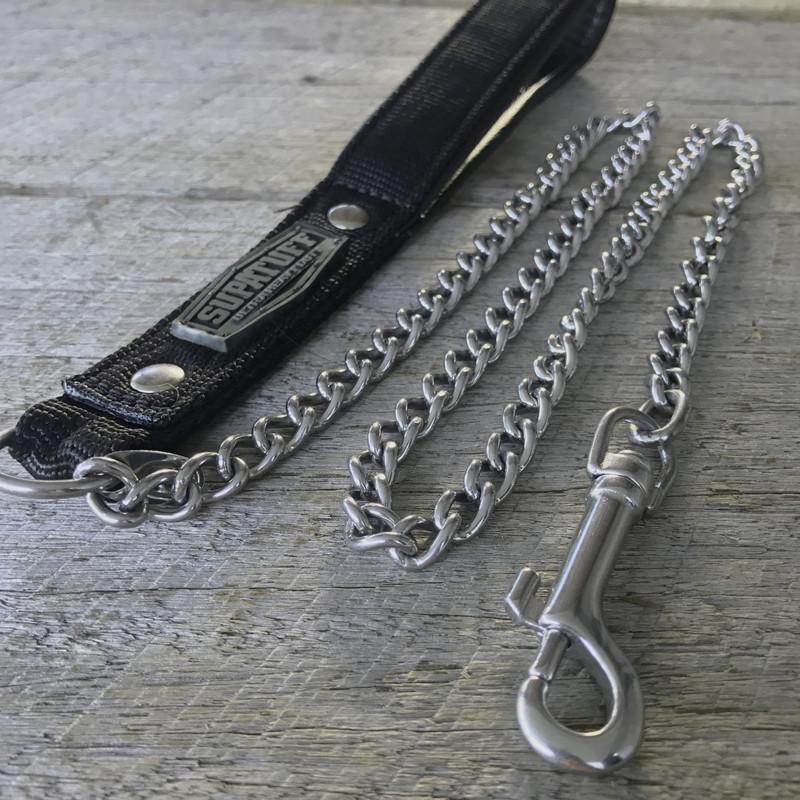
SupaTuff Heavy Duty Bullsnap Lead (120cm)
For: dogs still developing running manners where a standard fixed-length lead is the appropriate tool; the leather-padded handle specifically addresses the rope-burn risk during pace changes
30mm double-ply SupaTuff nylon. Stainless steel bullsnap clip. Leather-padded handle that prevents the rope-burn friction that bare nylon creates during sudden pace changes mid-run. Box-stitched at all joins. No plastic fittings. 120cm length calibrated for running beside the handler without excess lead creating tangle risk. Lifetime guarantee.
From $64.00 | View the SupaTuff Bullsnap Lead
SupaTuff Slim Fit Harness
For: running dogs where harness attachment is preferred over collar; waterproof and lightweight for Australian outdoor conditions
25mm custom double-ply SupaTuff nylon. Four-point independent adjustment. All stainless steel hardware, no plastic fittings. Waterproof and UV-treated. Lightweight profile that does not restrict shoulder movement during running stride. Back-clip for trained running dogs; the slim profile is appropriate for most medium breeds during running.
From $52.00 | View the SupaTuff Slim Fit Harness
From hands-free multifunction leather leads to fixed-length bullsnap leads with leather-padded handles, and lightweight waterproof harnesses. All in all-metal hardware, no plastic fittings.
Browse the Running Lead Range →Building the Running Routine: A Practical Week-by-Week Approach
Once the dog has had a veterinary clearance, is past the growth plate threshold for its breed size, and has reliable loose-lead walking behaviour, the running programme begins conservatively and builds systematically. Rushing any of these prerequisites produces dogs that injure themselves in the early weeks of the programme, which then sets the whole project back by weeks or months of enforced rest.
Weeks one and two: 10-minute walks with 2 to 3 minute running intervals inserted at comfortable pace. Observe the gait throughout and stop running intervals if the dog shifts to canter. Watch the dog the following morning for any stiffness when rising, which is the most reliable early sign of impact-related soreness.
Weeks three and four: extend running intervals to 5 to 8 minutes while keeping total session time similar. If the morning stiffness check remains clear, begin connecting running intervals into a single continuous run toward the end of this phase.
From week five onward, apply the 10 percent rule: increase total weekly running time by no more than 10 percent each week. A dog at 20 minutes of running per week can move to 22 minutes the following week, not to 30 minutes. This conservatism prevents the acute soft tissue injuries that derail most new running dogs and produces a dog that reaches significant mileage with intact joints rather than one that runs hard for three weeks and then spends three months recovering.
The full leash range at Rogue Royalty covers every stage of this running programme, from the early fixed-length sessions to the hands-free configuration for experienced running dogs in their established routine.
Frequently Asked Questions About Running With Your Dog in Australia
At what age can I start running with my dog in Australia?
Safe running age depends on breed size. Small breeds: 12 months. Medium breeds: 12 to 14 months. Large breeds: 18 months. Giant breeds: 24 months. Growth plates close later in larger breeds, and impact loading before closure can cause permanent joint damage. A vet check before starting is recommended for all dogs regardless of age.
What is the gait signal that tells me my dog has reached its limit?
The transition from trot to canter. A trot is the energy-efficient sustainable running gait. When a dog shifts to a canter at a pace the handler maintains, the dog has exceeded its aerobic threshold and is working in energy debt. Slow until the dog returns to a trot. If trot does not return within a minute, stop for a rest break. Never continue running a dog that has shifted to canter.
Why does running surface matter for a dog's joints?
Sealed surfaces transmit full impact force at each footfall into the leg joints with no absorption. Natural surfaces absorb a portion of each step's impact energy. For occasional runs this difference is minor. For dogs running three or more times per week, cumulative sealed surface impact accelerates cartilage wear at the carpals, elbows, and stifle joints. Australian suburban routes should maximise grass and trail sections and minimise sealed surface time where possible.
What is a hands-free dog leash and is it safe for running?
A hands-free lead attaches to a waist belt rather than being held in the hand. Safe for running with dogs that have established loose-lead behaviour at running pace. Not appropriate for dogs still developing running manners, reactive dogs in high-trigger environments, or dogs that lunge unpredictably. The attachment position should be at lumbar height rather than low hip to distribute sudden pull forces through the core rather than rotating the hips forward and sideways.
How hot is too hot to run with my dog in Australia?
Above 25 degrees Celsius combined with high humidity, running becomes risky for most dogs. Above 28 degrees, sessions should be significantly shortened or rescheduled to before 9am. The pavement temperature check applies: if the surface fails the 7-second hand test, it will burn paw pads during a run. Australian summer running should be scheduled to early morning regardless of the day's forecast peak temperature.
What leash should I use for running with my dog?
A fixed-length 120 to 150cm lead for dogs still developing consistent running manners. The Steel Professional Adjustable Training Lead for experienced running dogs where the handler wants both a standard running lead and a hands-free waist configuration in one piece of equipment. Never a retractable lead during running, as it allows acceleration before the lock engages and maintains constant cord tension preventing the loose-lead state running requires.
What Rogue Royalty gear suits running with a dog?
The Steel Professional Adjustable Training Lead in leather for experienced running dogs wanting a hands-free configuration option. The SupaTuff 120cm Bullsnap Lead with leather-padded handle for dogs in earlier running development stages. The SupaTuff Slim Fit Harness for lightweight waterproof harness attachment during runs. All with all-metal hardware and no plastic fittings.

