





A studded collar photographs well in nearly every single online listing, regardless of what's actually underneath the surface. What the photo can't show is whether the studs are embedded into dense, natural hide or pressed through a thin plastic coating that's already starting to lift at the edges by the time it arrives. This is the gap between a studded collar that looks identical online and one that actually survives a dog that plays hard, swims, and wears the collar every single day for years rather than months.
This guide covers the real structural difference between spikes and studs, exactly why budget studded collars fail at the rivet holes specifically, how to spot genuine leather construction before buying online, the leather chemistry behind occasional skin sensitivity, correct width selection by breed, how to maintain and eventually retire a studded collar safely, and the Rogue Royalty RuffNeck range built from full-grain bridle leather rather than coated synthetic.
Spikes vs Studs: A Structural Difference, Not Just a Look
These two terms get used interchangeably in casual conversation, but they describe meaningfully different hardware shapes with different practical implications.
Spikes project outward from the collar surface to a sharp or semi-sharp point, creating an aggressive, pointed silhouette. Studs are flat or domed pieces of metal set into or onto the leather, sitting close to the surface without a projecting point. Beyond the visual difference, this matters functionally: a projecting spike has more opportunity to catch on fabric, fencing, crate wire, or another dog's coat during normal play than a flat stud does. This is why most everyday studded collars, including working and pet-focused ranges rather than purely decorative show pieces, default to the flatter stud design. It delivers the bold aesthetic owners are looking for while keeping snagging and scratch risk during normal use meaningfully lower than a true spike design would.
Why Cheap Studded Collars Fail at the Rivet Holes
This is the specific failure mode almost every disappointed studded collar review describes, even when the reviewer doesn't quite articulate the mechanism. Most budget studded collars are made from PU leather: a plastic coating, typically polyurethane, applied over a fabric or low-grade leather base to mimic the appearance of genuine hide. The studs on these collars are pressed through that thin plastic coating rather than embedded into a dense, fibrous natural material.
The coating around each stud hole is a stress point from day one. Every time the collar flexes during normal wear, walking, and play, that flex concentrates at the stud holes, and the plastic coating begins to crack and peel at exactly those points. Once the coating around a stud fails, the stud no longer has a secure anchor and starts to work loose. From there it's a short path to the stud falling out entirely, usually within weeks to a few months of regular use, not years.
Genuine leather, particularly thick, full-grain bridle leather, behaves completely differently under the same stress. The leather is a dense, naturally fibrous material throughout its full thickness, not a thin coating over a different base. Studs embedded into this kind of leather have far more material gripping the hardware on all sides, and the leather itself flexes and ages without the surface cracking the way a plastic coating does.
| Construction | What Happens at the Stud Holes Over Time |
|---|---|
| PU leather (plastic coating over fabric/low-grade base) | Coating cracks and peels at flex points around each stud; studs loosen and fall out within weeks to months |
| Full-grain genuine leather | Dense fibrous structure grips embedded hardware on all sides; leather ages and softens without surface failure at stud points |
How to Spot Genuine Leather Before You Buy Online
Reading a product listing carefully reveals significantly more useful information than the photos ever do, in nearly every single case worth considering. Genuine leather sellers typically name the leather grade specifically, terms like full-grain, top-grain, or bridle leather, and frequently describe some element of the tanning or finishing process, since these details are genuine selling points worth highlighting. PU leather listings, by contrast, tend to use vaguer language: leather-look, leather-style, or simply leather with no further description, since there's no tanning process or hide grade to describe honestly.
The Leather Chemistry Behind Occasional Skin Sensitivity
Most leather sold globally today, across every category from footwear to furniture to pet products, is chrome-tanned, a process using chromium salts to convert raw hide into finished leather. Published dermatology research has established that chromium can be released from chrome-tanned leather during prolonged skin contact, and this release has been shown to trigger allergic contact dermatitis in chromium-sensitive individuals through controlled use-test studies.
This research has been conducted specifically on human skin contact with chrome-tanned leather goods such as gloves and bracelets, not on dogs directly, so it would be inaccurate to claim a confirmed canine-specific clinical link. What can be stated accurately is that the underlying leather chemistry, chromium release from the tanning process during sustained skin contact, is the same regardless of which species is wearing the leather. For a dog showing unexplained irritation specifically and consistently in the area where a leather collar sits, after ruling out the more common causes such as incorrect fit, trapped moisture, or an unrelated skin condition, this leather chemistry is a reasonable factor worth raising with a vet rather than something to dismiss outright.
Choosing the Right Width for Your Dog's Build
Width matters more for a studded collar than it does for many other styles, since a wide profile carries the bold visual statement most buyers want from a studded collar in the first place, while also serving a genuine functional purpose for larger, more powerful breeds.
For muscular, heavy-necked breeds including Staffies, Rottweilers, Bull Terriers, and other similar builds, a wider collar in the 4.5cm to 5.5cm range distributes leash force and collar pressure across significantly more surface area of the neck than a narrow collar does. This matters beyond comfort: concentrating force on a narrow strip of skin and tissue is both less comfortable for the dog and creates an easier point for a powerful dog to work the collar loose or for the collar itself to roll and twist during active pulling.
For medium and lighter breeds, a proportionally narrower collar in the 3cm to 3.5cm range remains the better fit. A collar sized for a Rottweiler's neck looks and sits disproportionately on a Kelpie or Border Collie, even though both could technically be measured into the same circumference range at certain points in their growth. Matching width to the dog's actual build, not just neck circumference in isolation, gives the most appropriate and comfortable fit.
Keeping a Studded Leather Collar in Good Condition
A genuine leather studded collar needs a different care routine than a synthetic alternative, and getting this right is part of what makes the higher upfront cost of real leather pay off over years rather than months. Leather should be wiped down with a clean, damp cloth to remove surface dirt and salt residue after beach trips or muddy walks, then allowed to air dry away from direct heat or direct sun before any further conditioning. Drying leather too quickly near a heater, in a hot car, or in full summer sun causes the surface to stiffen and crack, and this damage shows up faster around the stud holes specifically, since those points already concentrate flex stress during normal wear.
Conditioning every one to three months or so with a leather-specific balm keeps the hide supple and helps prevent the drying and cracking that eventually compromises any embedded hardware, including studs. More frequent conditioning, closer to once monthly, is worth it for dogs that swim regularly or live in coastal areas where salt exposure accelerates leather drying. A well-maintained bridle leather collar actually improves with this kind of regular care, softening and moulding to the individual dog's neck shape over months of wear in a way that meaningfully sets it apart from any synthetic alternative, which can only degrade from its starting condition rather than improve with use.
Check embedded studs periodically as part of the same maintenance routine, looking for any sign of looseness or a stud sitting at a different angle than its neighbours, which can indicate the surrounding leather or stitching is under stress at that point. On a genuine leather collar this is a rare event rather than an expected failure mode, but catching it early, before a stud falls out entirely and potentially becomes a choking hazard if the dog mouths or swallows it, is easy enough with an occasional visual check during normal handling.
When to Retire a Studded Collar
Even well-maintained leather eventually reaches the end of its functional life, and a studded collar specifically has more failure points to monitor than a plain flat collar because of the embedded hardware. Replace the collar if the leather shows visible cracking that doesn't respond to conditioning, if the stitching at the buckle or D-ring attachment shows fraying or loosening, if any stud becomes loose enough to wiggle noticeably by hand, or if the buckle mechanism no longer holds its adjustment reliably under normal leash tension.
For a large or powerful dog specifically and without exception, a compromised collar represents a substantially higher risk than the same wear pattern would on a small, calm dog, simply because the forces involved during a sudden pull or unexpected lunge are substantially greater in every case. Treating collar inspection as a routine part of dog ownership, the same way checking a harness or leash for wear has become standard practice, catches problems while they're still a minor fix rather than a failure during an actual walk.
The Rogue Royalty RuffNeck Range
The RuffNeck studded collar range is handmade from genuine bridle leather with studs embedded into the hide rather than pressed through a plastic coating, covering both wide and regular fit profiles to suit different breed builds.
RuffNeck Black and Chrome (Wide Fit)
For: muscular, heavy-necked breeds needing maximum width and presence
Premium bridle leather with studs embedded into the hide, not pressed through a coating. Soft napa leather lining for comfort against the neck. Heavy-duty solid steel D-ring and stainless steel roller buckle. Wide fit profile distributes pressure evenly across the throat, suited to Staffies, Bull Terriers, and similar muscular breeds.
From $95.00 | View RuffNeck Black and Chrome
RuffNeck Buckskin and Chrome (Regular Fit)
For: medium breeds wanting RuffNeck styling in a slimmer 3.5cm profile
The same studded styling and bridle leather construction as the wide fit range, in a 35mm regular profile suited to medium breeds that don't need the bulk of the wide fit version. Solid metal hardware throughout, napa leather lining, handmade craftsmanship.
From $52.50 | View RuffNeck Buckskin Regular Fit
Matching Hardware Finish and Pairing With an ID Tag
The RuffNeck range and similar studded collars typically come in a choice of hardware finish, commonly chrome or brass, and choosing a finish that matches the rest of a dog's gear kit, including the leash clip and any ID tag, gives a more deliberately put-together look than mixing finishes arbitrarily. A chrome-studded collar paired with a brass leash clip and a gold-finish tag reads as mismatched in a way that a coordinated finish doesn't, a detail that matters more on a bold, visually prominent studded collar than it would on a plain, low-key flat collar where hardware finish is barely noticed.
Beyond the aesthetic consideration, a studded collar still needs to serve its core identification function alongside the visual statement. A securely attached ID tag in a matching finish, engraved with a current phone number, remains essential regardless of how striking the collar itself looks, since the studs and leather construction contribute nothing toward getting a lost dog identified and returned. The split ring or tag attachment point should be checked with the same regularity as the studs themselves, since this small piece of hardware is frequently the actual weak point in an otherwise robust studded collar setup.
Studded Collars and Play Safety
For dogs that regularly play off-leash together with other dogs at the local park or beach, the flat stud design carries meaningfully lower entanglement and scratch risk during contact play than a true projecting spike design, since there's far less opportunity for a flat stud to catch on another dog's coat, collar, or harness during normal rough play. This is one of the practical reasons most everyday studded collars, including the RuffNeck range, use embedded flat studs rather than the sharper outward spike style more commonly seen on purely decorative or show-context collars.
Regardless of stud style, any collar with raised hardware should still come off during unsupervised crate time or extended periods alone, since any texture on a collar carries some entanglement risk if it catches on crate wire, fencing, or furniture while the dog isn't being directly supervised.
Genuine bridle leather with studs embedded into the hide, wide and regular fit profiles, solid metal hardware throughout. A 10-year craftsmanship warranty on every RuffNeck collar in the range.
Browse the Leather Collar Range →Pairing a Studded Collar With the Right Lead
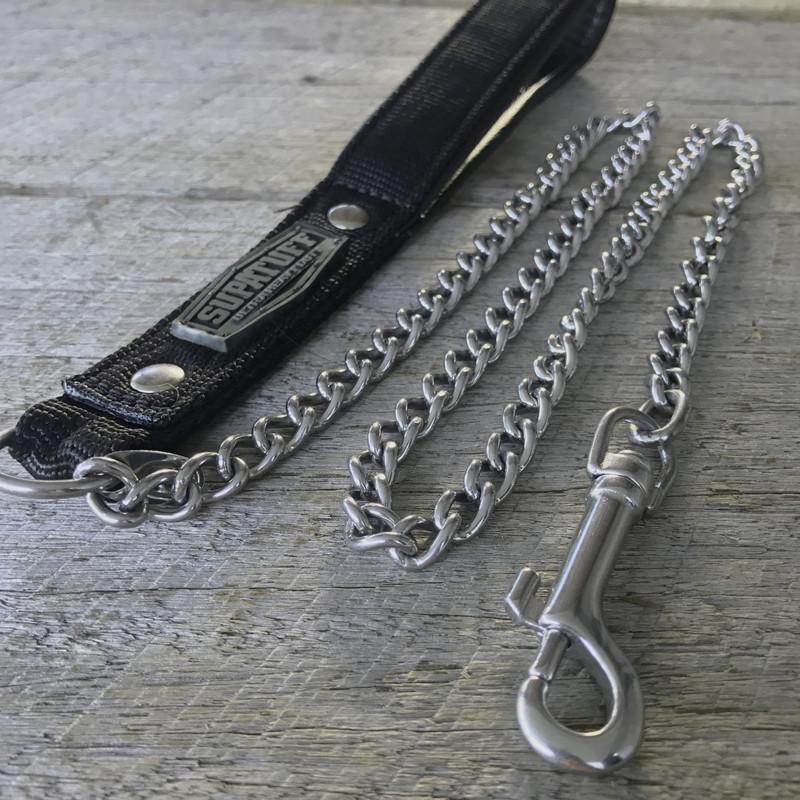
A studded leather collar pairs naturally with a matching leather lead rather than a SupaTuff nylon option, since the aesthetic and the maintenance routine, periodic conditioning to keep the leather supple, are consistent across both pieces. The leather leash range includes options in matching hardware finishes to complete a coordinated leather kit from collar through to lead.
Frequently Asked Questions About Studded Dog Collars in Australia
What is the difference between a spiked dog collar and a studded dog collar?
Spikes project outward to a sharp point, while studs are flat or domed pieces set close to the collar surface without a projecting point. This matters beyond looks: projecting spikes catch more easily on fabric, fencing, or another dog's coat during play, while flat studs sit close enough to avoid most snagging. Most everyday studded collars use the flatter stud design for this reason.
Why do cheap studded dog collars fall apart so quickly?
Most budget studded collars use PU leather, a plastic coating over a fabric base, with studs pressed through the coating rather than embedded into dense natural hide. The coating cracks and peels at each stud hole within weeks of normal flexing, causing studs to loosen and fall out. Genuine leather grips embedded hardware far longer because it's a dense fibrous material throughout, not a thin plastic skin.
How can I tell if a studded collar is genuine leather or PU leather before buying online?
Check for specific language: genuine leather sellers name the grade, such as full-grain, top-grain, or bridle leather. PU leather listings use vaguer terms like leather-look or leather-style. Price is also a signal: a wide, lined, studded genuine leather collar costs meaningfully more to produce than an equivalent PU version, so an unusually low price on a visually identical product is worth a closer look at the material description.
Can the leather in a dog collar cause a skin reaction?
It's possible in sensitive individuals. Most leather is chrome-tanned, and published research shows chromium can be released from chrome-tanned leather during prolonged skin contact, triggering allergic contact dermatitis in chromium-sensitive people. This research is on human skin contact rather than dogs specifically, but the same leather chemistry applies regardless of species. For persistent, unexplained collar-area irritation, this is worth discussing with a vet alongside more common causes like fit or moisture.
What collar width is correct for a studded collar on a large or muscular breed?
Wider is generally better for large, muscular breeds, with 4.5cm to 5.5cm suiting most Staffies, Rottweilers, and Bull Terriers. A wider collar distributes force across more neck surface area, reducing concentrated pressure. Narrower collars in the 3cm to 3.5cm range suit medium and lighter breeds where a wide profile would sit disproportionately.
Are studded collars safe for dogs that play with other dogs?
Flat stud designs sitting close to the collar surface carry lower entanglement and scratch risk during play than pointed, outward-projecting spikes. For dogs that regularly play off-leash, flat studs are the more sensible choice. Regardless of style, any studded collar should come off during unsupervised crate time, since raised hardware carries some entanglement risk if caught on crate wire or fencing.
What studded collars does Rogue Royalty offer?
The RuffNeck range covers studded collars in genuine bridle leather across wide fit and regular fit profiles, with studs embedded into the hide rather than pressed through plastic coating. The wide fit suits muscular breeds at 4.5cm to 5.5cm width, while the regular fit offers a slimmer 3.5cm profile for medium breeds. Every collar is handmade with solid metal hardware, napa leather lining, and a 10-year craftsmanship warranty.

