





The tactical collar market in Australia has grown significantly in the last few years, and so has the gap between what the term actually means and what it is used to describe. A search for tactical dog collars in Australia returns dozens of imported 1000D nylon collars with MOLLE attachment points, Velcro patch panels, and control handles. Some of them are well-built. Many of them use the tactical label as an aesthetic choice rather than a construction standard.
This guide covers what makes a dog collar truly tactical at the construction level, which specific features justify the label and which are marketing additions, why Australian conditions matter when choosing between nylon and leather tactical-specification collars, which Australian breeds generate the kind of demands that justify a tactical collar, and how the Rogue Royalty SupaTuff SECURITY collar and wide-fit leather range position against imported alternatives.
What Does "Tactical" Actually Mean in a Dog Collar?
The tactical label has a genuine meaning at the construction level and a separate meaning as a visual aesthetic. Understanding the difference helps owners make better decisions for their specific dog and use case.
At the construction level, a tactical collar is a collar built to handle the demands of working, training, and high-drive dogs. The specific features that make a collar tactically functional rather than tactically styled are three: an integrated control handle, all-metal hardware at every connection point, and strap width appropriate for the forces the dog generates.
The visual aesthetic of a tactical collar uses the design language of military and police K9 equipment: dark colourways, MOLLE webbing, Velcro patch panels, and control handles. These aesthetic elements are present on collars across a wide range of construction quality levels. A collar can have all the visual markers of a tactical collar and fail under the first hard reactive lunge if the D-ring is stamped zinc and the handle stitching is a single pass.
Why the Control Handle Is the Defining Functional Feature
Of the three construction elements that define a functional tactical collar, the control handle is the most distinctly tactical. Standard collars do not have it. The handle changes what the handler can do in a high-stakes moment in a way that no other collar feature does.
When a high-drive dog reacts suddenly to a trigger in a public environment, leash management takes time. The handler must identify the trigger, recognise the dog's arousal state, take up lead slack, adjust body position, and redirect through the lead. Each of these steps takes fractions of a second, and the cumulative delay is long enough for a reactive dog to commit to a lunge before the handler has completed the management sequence.
A control handle allows the handler to grip the dog directly at the collar with one hand in a single movement. There is no slack to take up, no lead to manage. The handler's hand is on the dog. This is the feature that most clearly separates a tactical collar from a standard collar for working and training contexts, and it is the feature most absent from collars that use the tactical aesthetic without the functional standard.
Why All-Metal Hardware Is a Safety Requirement for Tactical Use
Tactical and working dog use involves higher peak forces at the D-ring and buckle connection points than casual suburban walking. The difference between an everyday walk and a working or training session is the frequency and magnitude of sudden high-force events: reactive lunges, rapid direction changes, sudden restraint, and the physical demands of training scenarios.
Plastic hardware fails suddenly under peak load. The material reaches its rated limit and fractures in a single brittle event without progressive warning. This failure mode most commonly occurs during the highest-force event the collar experiences, which is exactly the moment the collar needs to hold in tactical and training use.
Solid metal hardware, whether solid brass, stainless steel, or high-grade aluminium alloy, deforms progressively under overload. A D-ring under excessive load shows a visible bend before fracturing. A buckle under excessive load becomes stiff to operate before failing. These are observable warning signs that give the handler time to identify and replace the compromised hardware before structural failure.
For Belgian Malinois, German Shepherds, Rottweilers, Bull Arabs, and similar high-drive large breeds, the difference between plastic and solid metal hardware at the D-ring is a safety specification. Every collar in the Rogue Royalty range uses solid metal hardware at all connection points with no plastic at any load-bearing junction.
How Collar Width Affects Tactical Performance
Collar width in tactical use serves two functions: pressure distribution during leash events and escape resistance. Both become more significant as the dog's size and drive level increase.
A narrow collar on a large, high-drive dog concentrates any leash force, including sudden reactive lunge forces, across a small neck contact area. A wide-fit collar distributes the same force across a proportionally larger surface area, reducing peak pressure at any point during the event. For dogs generating the kind of sudden peak forces that tactical use involves, this distribution difference is a comfort and safety variable, not a minor preference.
Escape resistance increases with collar width because a wider collar presents a greater geometric obstacle to backing out. A dog attempting to reverse out of a collar by lowering the head and pulling backward has a harder time moving a 50mm wide collar over the skull than a 20mm narrow collar. For high-drive dogs with a broad skull relative to neck circumference, such as Rottweilers and Bull Mastiffs, this geometric resistance provided by a wide-fit collar is a meaningful safety feature.
Australian Conditions and Tactical Collar Choice: Nylon vs Leather
Most tactical collars sold in Australia are imported 1000D military nylon designs built for northern hemisphere markets. The construction is often solid, but the specific material and hardware choices are not always optimised for Australian conditions, particularly for coastal and high-UV use.
| Feature | Imported 1000D Nylon Tactical | SupaTuff SECURITY (Australian) | Wide-Fit Leather (Australian) |
|---|---|---|---|
| Hardware | Varies: some solid metal, some stamped zinc or chrome-plated | All-stainless steel throughout | Solid brass throughout |
| Salt/coastal resistance | Depends on hardware metal grade: chrome-plated hardware corrodes in coastal conditions | All-stainless resists salt corrosion consistently | Not suited to regular salt water immersion |
| UV performance | Varies by nylon grade: some imported nylon fades and stiffens faster under Australian UV | UV-treated double-ply SupaTuff | Bridle leather handles UV with conditioning |
| Fit over time | Maintains shape consistently; does not conform to individual dog | Maintains shape; rinse and reuse | Softens and conforms to individual dog's neck |
| Best use context | Training and working; verify hardware grade before purchasing | Coastal, wet, field, and active outdoor use | Everyday dry conditions; training and handling |
Which Australian Breeds Benefit Most from a Tactical-Specification Collar
The features that define a tactical collar, specifically the control handle, all-metal hardware, and wide-fit profile, provide the most benefit to breeds that generate significant leash force and require close-range handling capability. In Australia, these are the breeds where a tactical-specification collar is a functional requirement rather than an aesthetic preference.
Belgian Malinois
The Malinois is the breed for which the tactical collar was essentially developed. High drive, rapid movement, and sensitivity to handler positioning make close-range control through a collar handle a standard management tool in Malinois handling. The breed's lean, muscular build and moderate neck size mean proper width selection is important: wide enough for pressure distribution and escape resistance, but proportional to the body rather than oversized.
German Shepherds
German Shepherds in working and high-drive lines generate significant reactive force and require collars that stay centred under sudden load without rotating or migrating. The breed's deep chest and proportionally longer neck suit a wide-fit collar that stays positioned at the base of the neck rather than riding up toward the throat during active movement.
Rottweilers and Bull Arabs
Both breeds combine substantial body mass with high drive and a broad skull that makes collar slip a genuine concern in reactive situations. The wide-fit collar profile and solid metal hardware combination provides both the escape resistance and hardware reliability these breeds require. For Australian Bull Arab owners specifically, a wide-fit collar at 48 to 55mm is standard for adult males.
American and Staffordshire Bull Terriers
Staffies combine high energy with muscular builds and genuine enthusiasm that can be physically impactful on handlers and bystanders. A control handle collar on a Staffy gives the handler close-range management capability that leash management alone does not provide in tight public spaces or training environments.
When a Leather Wide-Fit Collar Is the Right Tactical Choice
Most tactical collar guides in Australia recommend nylon as the default for tactical use. This reflects the visual association between military aesthetics and nylon construction rather than a genuine performance comparison. Full-grain bridle leather in a wide-fit profile with solid brass hardware handles the same peak loads as a quality nylon tactical collar for dogs in everyday and training use, with the additional benefit of developing a conforming fit to the individual dog's neck over months of wear.
For working dogs in consistently wet, muddy, or coastal conditions, waterproof nylon is the more practical choice. For working and high-drive dogs in dry everyday suburban and training conditions, a quality wide-fit leather collar provides tactical-function performance with a premium finish that improves over time rather than degrading.
The Rogue Royalty Ruthless and RuffNeck wide-fit leather collar ranges provide the construction standard for tactical everyday use: full-grain bridle leather, napa calfskin inner, solid brass hardware, and wide-fit profiles covering 33 to 74cm neck circumference. These are not styled as tactical collars, but they meet or exceed the construction specifications of most imported tactical collars sold in Australia at a fraction of the import aesthetic markup.
Why Choose Rogue Royalty for Tactical-Specification Dog Collars in Australia
Rogue Royalty has been building dog gear for working, high-drive, and active breeds in Australia since 2009, with over 30,000 customers relying on the collar range in daily active use. Every collar in the range meets the construction standard that tactical use requires: all-metal hardware at every connection point, strap width appropriate for the dog's size and the forces it generates, and construction suited to the Australian conditions the collar will actually face rather than northern hemisphere conditions it will not.
The SupaTuff SECURITY collar is built specifically for the security, patrol, and training context where the tactical collar category originated. The wide-fit leather range provides the same load-bearing performance in a construction that develops and improves with use.
The Rogue Royalty Tactical-Specification Collar Range
SupaTuff SECURITY Collar (Wide Fit)
For: working dogs, patrol and security use, coastal and field conditions, dogs requiring waterproof construction with tactical-specification hardware
Double-ply SupaTuff nylon construction. All-stainless steel hardware throughout. Wide-fit profile for large and extra-large breeds. No plastic at any connection point. Waterproof and UV-treated for Australian outdoor conditions. Lifetime guarantee.
$76.00 AUD | View the SupaTuff SECURITY Collar
SupaTuff Strong Dog Collar (Wide Fit, Black)
For: high-drive large breeds in active everyday training and outdoor use; the waterproof tactical-specification collar for non-security contexts
Double-ply SupaTuff nylon. All-stainless steel hardware. Wide-fit through slim-fit sizing for all breed sizes. Waterproof, rot-resistant, UV-treated. No plastic hardware. Lifetime guarantee.
From $69.60 AUD | View the SupaTuff Wide Fit Collar
Wide Fit Leather Collar Range
For: working and high-drive dogs in dry everyday conditions where tactical-function construction and premium leather aesthetics are both priorities
Full-grain bridle leather with napa calfskin inner. Solid brass hardware throughout. Available Small through XXXL covering 33 to 74cm neck circumference. 10-year craftsmanship warranty. No plastic at any load-bearing point.
From $66.50 AUD | Browse the Wide Fit Leather Collar Range
Classic Wide Fit Leather Collar (Brown and Chrome)
For: the entry point of the wide-fit leather range; large breeds needing tactical-function construction at the most accessible price in the leather segment
Full-grain bridle leather with napa calfskin inner. Double-pin roller buckle. Solid non-rust metal hardware. Available Small through XXXL. 10-year craftsmanship warranty.
From $66.50 AUD | View the Classic Wide Fit Leather Collar
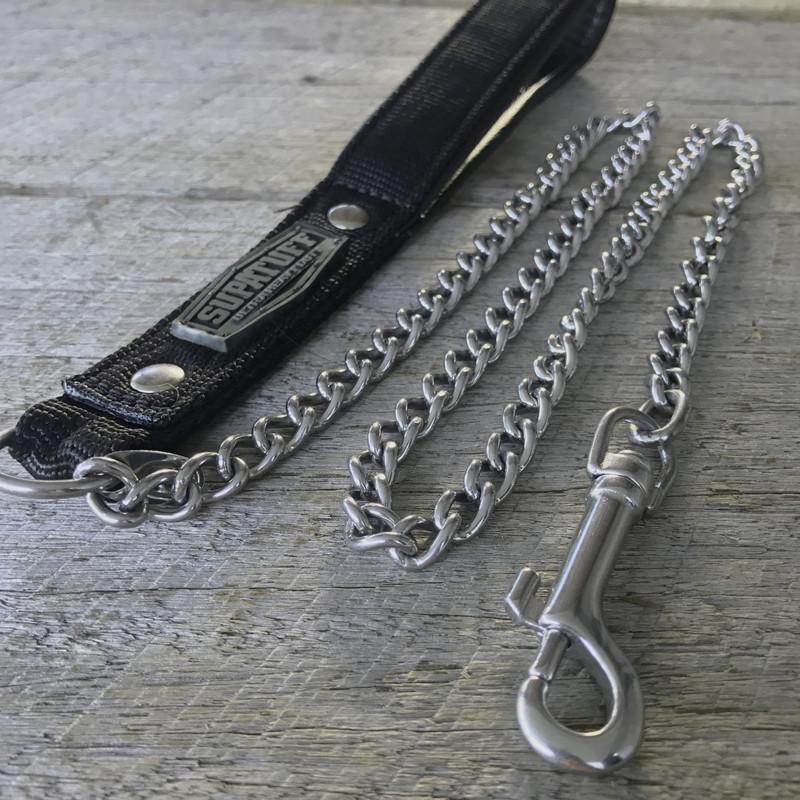
Pair any tactical-specification collar with the Rogue Royalty dog leash range in matching all-metal hardware to complete the collar and lead system without introducing dissimilar metal corrosion at the snap clip to D-ring contact point.
SupaTuff SECURITY from $76.00. Wide-fit leather from $66.50. All-metal hardware. No plastic at any connection point across the full range.
Browse the Full SupaTuff Range →What Australian Dog Owners Say About Rogue Royalty
Thick, well made, durable and padded on the inside for comfort. Its such a beautiful collar! The leather is great for my dogs sensitive skin and she looks badass!
I absolutely love this colour on my girl and the quality is great ..ideal for a girl like mine who loves hanging off the back of the ute.
Love the quality, and the design, and our looks awesome, thanks
Amazing quality collars!
Great product and service
Frequently Asked Questions: Tactical Dog Collars Australia
What is a tactical dog collar?
A collar built to handle working, training, and high-drive dogs. The defining functional features are an integrated control handle for one-handed close-range management, all-metal hardware at every connection point, and strap width appropriate for the dog's size and drive level. The term is also used as a marketing aesthetic on many imported collars that carry the visual style without meeting the construction standard, so evaluating the specific features matters more than the label.
Why does a tactical collar need a control handle?
A control handle allows the handler to grip the dog directly at the collar in a single movement when a reactive event occurs faster than leash management allows. It eliminates the steps of taking up slack, adjusting position, and redirecting through the lead, replacing them with a direct collar grip. This is the feature most absent from collars that use tactical aesthetics without tactical function.
What is the best tactical collar for a large dog in Australia?
The SupaTuff SECURITY collar for wet, coastal, and field conditions: double-ply waterproof nylon, all-stainless hardware, wide-fit profile, Australian construction. The wide-fit leather collar range for dry everyday suburban and training conditions: full-grain bridle leather, solid brass hardware, napa calfskin inner. Both provide all-metal hardware and appropriate strap width for large and high-drive breeds.
Is a leather collar tactical enough for a working or high-drive dog?
Full-grain bridle leather with solid brass hardware in a wide-fit profile handles the same peak loads as quality nylon for everyday and training use. The tactical label in Australia almost exclusively refers to nylon with military aesthetics, but leather with solid metal hardware provides equivalent load-bearing performance with the benefit of developing a conforming fit over time. For consistently wet or field conditions, waterproof nylon is more practical.
What breeds benefit most from a tactical-specification collar in Australia?
Belgian Malinois, German Shepherds, Rottweilers, Bull Arabs, Dobermanns, American Staffies, and working-line mixed breeds with high drive and significant body mass. These are the breeds where a control handle provides genuine handling benefit, where all-metal hardware is a safety requirement, and where wide-fit pressure distribution produces meaningful advantages under sudden peak loads.
Why does hardware matter more for tactical collars than everyday collars?
Tactical use involves higher-frequency and higher-magnitude peak force events than casual walking. Plastic hardware fails suddenly at its load limit without warning, typically during the highest-force event, exactly when the collar needs to hold. Solid metal hardware deforms progressively with observable warning before failure. For tactical and working use this distinction is a safety specification.
How do I choose between SupaTuff and leather for a tactical collar in Australia?
SupaTuff SECURITY for dogs in wet, coastal, or field conditions requiring waterproof construction that rinses clean and is ready to use again immediately. Wide-fit leather for dogs in dry everyday suburban and training conditions where a conforming fit developing over time and long daily wearing comfort matter alongside load-bearing performance. Both provide all-metal hardware and wide-fit profiles for large and high-drive breeds.

