





Search for what is the best dog harness in Australia and you will find the same article written ten different ways: front clip versus back clip, mesh versus neoprene, Rabbitgoo versus Ruffwear. Every guide reaches the same conclusion by a slightly different route and most of them are missing the conversation that actually determines whether a harness is worth buying.
Clip position is one variable. It matters. But a poorly constructed harness with the correct clip position will still chafe your dog's armpits, fail at the hardware under the first hard lunge, and need replacing within a year. The most important questions about any dog harness are about material quality, hardware grade, inner lining, and adjustment system. These are the variables that separate a harness that serves your dog well for years from one that looked right in a product photo and disappointed in practice.
This guide covers what those variables actually are, why they matter more than clip position alone, what Australian conditions specifically require from harness materials, the advantages of full-grain leather that no competitor guide discusses, why plastic hardware is the hidden failure point in most harnesses sold in Australia, and how to identify a harness worth buying before you commit.
Why Most "Best Harness" Guides Miss the Point
The majority of dog harness guides in Australia are structured as product round-ups: six harnesses from $30 to $105, ranked by clip position and value. This format answers the question "which budget harness should I buy this week" and does not answer the question "what makes a harness worth buying at all." The two questions have different answers.
A harness worth buying is one that fits correctly, stays fitted across the dog's range of motion, does not cause friction or discomfort at any contact point, is built from materials that perform under the specific conditions the Australian dog lives in, and uses hardware that will not fail suddenly under the leash forces generated by a large or active dog. These are construction and material questions, not clip position questions.
Clip position determines the mechanical interaction between the harness and the dog during a pull event. It is the right variable for the specific question of pull management. It is the wrong variable for the broader question of whether a harness is worth buying, because the same clip position is available on harnesses at every quality level from excellent to poor.
What Is the Best Inner Lining for a Dog Harness?
The inner contact surface of a harness strap is what touches the dog's body at every contact point across every walk. Over weeks and months of daily use, this surface creates friction against the coat and skin at each movement. The inner lining material determines how that friction accumulates.
Napa Calfskin Inner Lining
Napa leather is a soft, smooth, full-grain calfskin material used as the inner contact surface on quality leather harnesses. Its tight, smooth grain creates an exceptionally low-friction surface that slides against the coat rather than catching on it at each movement. For short-coated breeds, it contacts skin directly without creating friction sores. For long-coated breeds, it slides against the coat rather than catching on individual hairs and causing the matting at strap contact lines that rougher materials produce over weeks of wear. Napa inner lining is the specific feature most responsible for the armpit-chafe-free performance of quality leather harnesses that competitors describe but cannot explain.
Padded Mesh Lining
Padded mesh is the most common inner lining in the $30-$105 harness market. It is marketed as breathable and comfortable. The reality in Australian conditions is more complex. Mesh creates friction against short coats and catches on long coats more than smooth alternatives. In Australian summer temperatures above 25 degrees, foam padding beneath mesh traps heat against the dog's chest and torso during activity rather than ventilating as the marketing implies. And in the coastal and humid environments common across Queensland, northern New South Wales, and Western Australia, mesh harness lining retains moisture and salt after beach or rain outings in ways that smooth alternatives do not.
Bare Nylon Webbing
An unlined nylon webbing interior provides the lowest-cost construction and the least comfort. Raw nylon edges create friction against coat and skin and abrade progressively. For everyday suburban walks at moderate pace, the difference from mesh may be minor. For dogs walked daily for extended distances or active breeds generating more body movement per walk, bare nylon creates measurable coat damage at contact points over weeks of use.
Why Plastic Hardware Is the Most Common Hidden Harness Failure Point
The majority of harnesses sold in Australia at price points between $30 and $105 use plastic buckles and plastic D-rings at some or all connection points. This is the single most common quality compromise in the harness market and the one most frequently responsible for sudden harness failure during high-force events.
Plastic hardware fails suddenly. When a plastic buckle reaches its load limit, it fractures in a single brittle event. There is no visible progressive deterioration in the moments before failure. The buckle looks intact until the moment it is not. This failure mode typically occurs during the highest-force event the harness experiences: a reactive lunge, a sudden sprint, or a hard end-of-lead stop. These are precisely the moments when the harness needs to be most reliable and when sudden failure has the most serious consequences.
Solid brass and all-stainless steel hardware fails progressively. Under overload, metal deforms before it fractures. A buckle under excessive load will become stiffer to operate, a D-ring under excessive load develops a visible bend. These are observable warning signals that precede failure and give the owner time to identify the problem and replace the hardware before structural failure occurs.
What Is the Advantage of Four-Point Adjustment?
A standard two-point adjustment harness allows the owner to adjust the neck strap and the girth strap independently. For a dog with body proportions that align reasonably with the harness design's assumptions, two-point adjustment provides adequate fit. For dogs with non-standard proportions, two-point adjustment produces a specific problem: tightening one strap to correct one dimension forces the other strap into a wrong position.
The most common example is the deep-chested breed. A German Shepherd, Rottweiler, Dobermann, Weimaraner, or Boxer has a long sternum-to-girth distance relative to chest circumference. A harness sized correctly by girth will often have a chest plate too short for the individual dog's body depth, forcing the girth strap forward into the armpit area regardless of how the girth adjustment is set. No amount of two-point adjustment resolves a geometry mismatch between the dog's body and the harness chest plate length.
A four-point adjustment harness with independent adjustment at the top strap, bottom strap, and both side straps allows each dimension to be set independently. The girth can be tightened without changing the neck opening. The chest plate position can be adjusted without affecting the girth. This means the harness can be correctly fitted to a much wider range of individual body shapes within the same nominal size, including the deep-chested, barrel-chested, and other non-standard proportions that two-point designs consistently fail to fit well.
What Is the Best Dog Harness Material for Australian Conditions?
Australia's climate places specific demands on harness materials that most guides do not address because they are written for northern hemisphere markets where the conditions are fundamentally different. The specific Australian factors are high UV intensity, coastal salt exposure in all major coastal cities, summer temperatures that regularly exceed 30 degrees Celsius, and the active outdoor lifestyle that Australian dog owners maintain year-round rather than only in mild weather.
| Material | Best Australian Context | Limitations in Australian Conditions |
|---|---|---|
| Full-grain bridle leather with napa inner | Everyday suburban use in dry conditions; all breeds in non-water contexts | Not suitable for regular immersion; requires conditioning every 6-8 weeks |
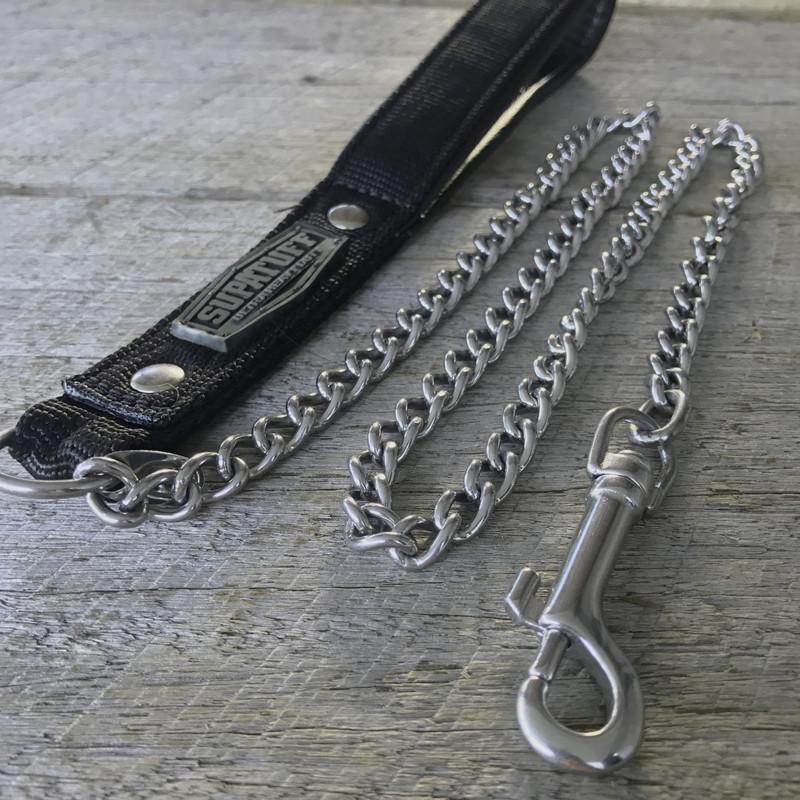
| Double-ply SupaTuff waterproof nylon | Coastal dogs, beach outings, water-loving breeds, working dogs in field conditions | Does not develop a conforming fit to the individual body over time as leather does |
| Standard padded mesh nylon | Occasional suburban walks in mild conditions | Traps heat in summer above 25°C; degrades faster under UV; holds salt moisture after coastal use |
| Standard unlined nylon webbing | Budget everyday use for calm, light-activity dogs | Creates coat friction; abrades faster under Australian UV; no thermal management in summer |
How Do I Know If a Dog Harness Fits Correctly?
The two-finger rule covers the basic static fit check: two flat fingers should slide horizontally under every strap with gentle pressure. This check catches harnesses that are too tight or too loose when the dog is standing still. It does not catch harnesses that shift position during movement, which is a separate and equally important fit variable.
A harness that fits correctly under static check should also pass the movement test: after the static two-finger check is confirmed at every strap, watch the dog take several steps and make a direction change. The harness should maintain its centred position without rotating to one side or shifting forward or backward. A harness that passes the static check but rotates or shifts during movement is either incorrectly adjusted at one or more straps, or has a chest plate width that does not match the individual dog's chest profile. No amount of strap tightening resolves a chest plate width mismatch.
Benefits of a Quality Dog Harness vs a Budget Alternative
The benefits of investing in a quality harness rather than a budget alternative are cumulative rather than immediate. On the first day, a budget harness at $35 and a quality harness at $250 perform similarly visible functions: both go over the dog's head, both buckle at the sides, both have a D-ring for lead attachment. The differences emerge across weeks and months of daily use.
A budget harness with padded mesh lining begins showing coat damage at contact points within weeks. The plastic hardware develops micro-fatigue at the buckle joints under daily loading. The adjustment buckles loosen slightly with each wearing cycle. The mesh traps moisture after rainy walks and salt after beach visits. Within twelve months of daily use in Australian conditions, a $35 harness is typically ready for replacement.
A quality leather harness with napa inner lining, solid brass hardware, and four-point adjustment performs differently across the same period. The leather softens at flexion points and develops a conforming fit specific to the individual dog's body contours. The napa inner remains smooth at contact points with no coat damage accumulating. The solid brass hardware shows no fatigue under daily loading. The four-point adjustment maintains correct fit across seasonal coat changes. After twelve months, the harness is broken in rather than worn out. After five years of daily use, the harness looks better and fits better than it did in month one.
Why Choose Rogue Royalty for Your Dog's Harness
Rogue Royalty has been handcrafting dog gear in Australia since 2009, supplying over 30,000 customers across the country with working and companion dog equipment built to the standards that daily Australian use demands. The harness range is built on two specifications that address the full spectrum of Australian dog owner needs.
The Attila leather harness uses full-grain bridle leather as the outer material and napa calfskin as the inner lining at every contact point. No rough surface touches the dog's coat or skin at any strap position. The four-point independent adjustment covers the complete range of breed proportions from standard to deep-chested. The integrated top handle provides close-range body control for the moments when lead management alone is not fast enough. Solid brass hardware throughout, no plastic at any connection point. The 10-year craftsmanship warranty reflects the construction quality that backs this performance claim across years of daily use rather than months.
The SupaTuff slim-fit harness uses double-ply waterproof nylon with all-stainless steel hardware for the dogs and lifestyles where leather is not the practical choice: coastal dogs, water-loving breeds, working dogs in field conditions, and active outdoor lifestyles where the harness needs to be rinsed clean and used again the next morning without maintenance. Four-point independent adjustment covers small to medium breeds. Lifetime guarantee.
The Rogue Royalty Harness Range
Attila Leather Harness (Black and Brass)
For: medium to extra-large breeds in everyday suburban use; deep-chested or non-standard proportions needing four-point independent adjustment
Full-grain bridle leather outer with napa calfskin inner lining at every contact point. Four independent adjustment straps (top, bottom, both sides). Integrated top handle. Solid brass hardware throughout, no plastic fittings. Available Small through Extra Large. 10-year craftsmanship warranty.
From $250.00 | View the Attila Black and Brass Harness
Attila Leather Harness (Brown and Brass)
For: the same breed range and construction in a warm brown bridle leather colourway that develops a rich patina with use
Identical construction to the black Attila. Full-grain bridle leather, napa inner, four-point adjustment, integrated top handle, and solid brass hardware throughout. 10-year craftsmanship warranty.
From $250.00 | View the Attila Brown and Brass Harness
SupaTuff Slim Fit Harness
For: small to medium breeds, coastal dogs, water-going breeds, and active outdoor lifestyles requiring waterproof and wash-and-go construction
25mm double-ply SupaTuff nylon with four-point independent adjustment. All-stainless steel hardware, no plastic fittings. Waterproof and UV-treated. Lightweight profile. Lifetime guarantee.
From $52.00 | View the SupaTuff Slim Fit Harness
Browse the full leather harness range to see all available sizes and colourways, and pair your harness with the matching lead range in the same all-metal hardware standard.
What Australian Dog Owners Say About Rogue Royalty
Thick, well made, durable and padded on the inside for comfort. Its such a beautiful collar! The leather is great for my dogs sensitive skin and she looks badass!
I absolutely love this colour on my girl and the quality is great ..ideal for a girl like mine who loves hanging off the back of the ute.
Love the quality, and the design, and our looks awesome, thanks
Full-grain leather with napa inner. Waterproof SupaTuff nylon. Four-point independent adjustment. No plastic hardware on any harness in the range.
Browse the Full Harness Range →Frequently Asked Questions: What Is the Best Dog Harness?
What is the best dog harness for Australian conditions?
Full-grain leather with a napa calfskin inner for dogs in dry suburban everyday use, conforming to the individual body over time and providing a smooth low-friction surface that handles Australian UV and outdoor conditions. Double-ply waterproof nylon with all-stainless hardware for coastal dogs, water-going breeds, and active outdoor lifestyles. Both material types outperform standard padded mesh under sustained Australian conditions.
What should I look for when buying a dog harness?
In order of importance: smooth inner lining to prevent coat friction and armpit chafing; solid metal hardware at every buckle and D-ring; four-point independent adjustment to fit non-standard body proportions; double-ply strap construction that shows progressive delamination warning before failure; and correct fit confirmed by both the static two-finger check and the movement rotation test.
Is a leather dog harness better than a nylon one?
Each suits different contexts. Leather is the better everyday choice for dry suburban conditions, developing a conforming fit over time. Quality waterproof nylon is the better choice for coastal environments, swimming breeds, and working dogs in field conditions. Many Australian dog owners use leather for everyday wear and waterproof nylon for water and active outdoor sessions.
Why does hardware quality matter so much in a dog harness?
Plastic hardware fails suddenly under peak load without visible warning. Metal hardware deforms progressively with observable warning signs before failure. For large or strong breeds generating significant leash force, this failure mode difference is a safety consideration. The failure typically happens during the highest-force event, such as a reactive lunge, exactly when the harness most needs to hold.
What is a four-point adjustment harness and why is it better?
Four-point adjustment provides independent control at the top strap, bottom strap, and both side straps. Standard two-point adjustment creates a geometry conflict when fitting dogs with non-standard proportions: tightening one strap to correct one dimension forces the other strap into a wrong position. Four-point adjustment removes this conflict by allowing each dimension to be set independently, fitting a wider range of individual body shapes correctly.
Does clip position really determine the best dog harness?
Clip position is one variable among several and is overweighted by most harness guides. Front-clip redirects pulling dogs effectively. Back-clip suits trained dogs that do not generate significant leash tension. But the same clip positions are available on harnesses at every quality level. A high-quality back-clip harness will serve a trained dog better than a low-quality front-clip harness. Clip position should be the fourth or fifth consideration after inner lining, hardware grade, adjustment system, and strap construction.
What harnesses does Rogue Royalty offer?
The Attila leather harness in black and brass and brown and brass for medium to extra-large breeds: full-grain leather, napa inner, four-point adjustment, integrated top handle, solid brass hardware, 10-year warranty. The SupaTuff slim-fit harness for small to medium breeds and active coastal dogs: double-ply waterproof nylon, four-point adjustment, all-stainless hardware, lifetime guarantee. No plastic hardware on any product in either range.

