





Most dog owners own one leash and use it for everything. That works until it doesn't, the day you're managing a reactive dog on a busy path, trying to practice recall in a park, or navigating a crowded vet waiting room with a leash that's two metres too long. Different situations call for different leash types, and understanding which one to reach for makes a real difference to both safety and training outcomes.
This guide covers every leash type in the Rogue Royalty range, when to use each one, why retractable leads actively undermine training for dogs that pull, what the bull snap clip difference means in practice, leather versus nylon, and a quick-reference situation table so you can match the right leash to any walk or training context.
The Core Leash Types and What Each One Is Built For
Understanding the categories first makes every other decision easier. There are four distinct leash types used across different walking and training contexts, and they serve different functional purposes rather than being interchangeable options across the same use cases.
Standard Fixed-Length Lead (1.2 to 1.8 m)
This is the everyday workhorse. A fixed-length lead of 1.2 to 1.8 metres gives the dog enough room to walk naturally alongside the handler without creating trailing excess that wraps around legs, poles, or other pedestrians. It provides predictable distance, easy shortening at crossings, and is the correct tool for loose-lead training because the fixed length teaches the dog what "slack" feels like without the mechanism confusion of a retractable lead.
The 1.2 metre end of this range is better for crowded urban footpaths where keeping the dog closer is a courtesy and safety consideration. The 1.8 metre end suits quieter walking environments where a bit more natural movement is appropriate. For dogs still building leash manners, a fixed-length lead is the only training-compatible option in this category.
Short Traffic Lead or Close-Control Lead (30 to 60 cm)
Not a standalone walking lead, but an essential addition to any dog owner's kit. The short traffic lead is used for moments requiring the dog to be held very close: walking through a busy café strip, sitting in a vet waiting room, stepping off a kerb into traffic, or passing another dog on a narrow shared path. Many quality standard leads include a second handle closer to the clip for exactly this purpose, allowing the handler to shorten the effective length instantly without changing equipment.
Long Line Recall Lead (5 to 10 m)
Specifically designed for recall training and controlled freedom in spaces where genuine off-leash is not appropriate or safe. A long line maintains a physical safety connection while giving the dog enough distance to practice recall as a meaningful skill. The handler lets the line out as the dog moves away, then calls the dog back. A dog cannot fully self-reward by running off since the line limits range, but the distance is large enough that a genuine recall response is being built and tested.
A 5 metre line suits earlier training stages or smaller, more enclosed spaces. A 9.5 to 10 metre line suits more advanced recall work in open environments once the dog has baseline reliability at shorter distances.
Multifunction Lead (Variable Configuration)
A multifunction leash uses multiple clip points and a longer overall length to serve as several different lead types depending on which attachment points are used. A single multifunction lead can configure as a standard-length everyday lead, a hands-free lead worn around the waist, a tethering lead, a lead for two dogs simultaneously, or a longer training lead. This is the tool used by working dog handlers, police handlers, and competition trainers who need versatility across multiple daily tasks without carrying a bag of different leads.
Why Retractable Leads Undermine Training for Pullers
Retractable leads are one of the most widely sold dog products on the market and one of the most consistently recommended against by dog trainers and RSPCA guidance. The reason is mechanical and simple.
A dog that pulls forward and feels the cord extend learns that tension produces forward movement and more distance. That is the opposite of what loose-lead training requires. Every walk on a retractable lead where the dog pulls and the cord extends reinforces pulling as the correct strategy for getting somewhere. The mechanism also maintains a low level of constant resistance against the cord, which means the dog is never experiencing genuine slack and cannot learn what a relaxed, loose lead feels like as a distinct state.
Situation-by-Situation Leash Selection Guide
| Situation | Best Leash Type | Why |
|---|---|---|
| Suburban footpaths, roads nearby | Fixed lead, 1.2 to 1.5 m | Predictable distance; easy to shorten at crossings; loose-lead training compatible |
| Busy café strips, vet waiting rooms | Short traffic lead or second handle, 30 to 60 cm | Keeps dog close; reduces tangle risk; clear to other people the dog is under direct control |
| Recall training in a park or reserve | Long line, 5 to 10 m | Practices real distance recall with safety connection maintained |
| Strong or powerful dog that pulls | Fixed lead, stainless steel bull snap, heavy-ply nylon or leather | Hardware rated for sustained force; no plastic fittings to fail; bull snap locks positively |
| Working handler, multiple daily configurations | Multifunction 6-in-1 lead | Covers everyday, hands-free, tether, two-dog, and training in one piece of equipment |
| Dog that swims or works in wet conditions | SupaTuff heavy nylon bullsnap lead | Waterproof; rust-resistant stainless steel; no leather or organic material to deteriorate |
| Reactive dog on a structured walk | Fixed lead, 1.2 to 1.5 m, never retractable | Predictable, consistent distance helps manage threshold; no cord extension to add uncertainty |
Leather vs Nylon: Which Material Suits Your Dog and Lifestyle
The material question comes down to the dog's lifestyle and the handler's preferences, not a universal hierarchy of one being better than the other.
Full-Grain Bridle Leather
Leather softens and develops a comfortable grip specific to the handler's hand over months of use. The material doesn't cause the rope burn that thin nylon cord can produce on a sudden hard pull, because the wider, smoother surface distributes contact force across a broader area of the palm. Leather with a napa-lined inner handle or padded sections is considerably more comfortable for extended daily use than an equivalent synthetic grip.
The practical tradeoff is maintenance. Leather needs conditioning every few months to prevent stiffening and cracking, and it is not the best choice for dogs that swim regularly or work in consistently wet conditions where the material can absorb water and deteriorate over time. For urban daily walks and handling, bridle leather is the most comfortable and durable long-term choice.
SupaTuff Heavy Nylon
The SupaTuff webbing used in Rogue Royalty's nylon lead range is custom-made to specific weight and width specifications rather than standard commercial nylon. It is waterproof, rot-resistant, colourfast, and weather-resistant. The stainless steel hardware throughout, with no plastic fittings at any point, means there is no weak link in the connection chain. For a dog working in all-weather conditions, swimming, or being handled by multiple people who won't maintain a leather conditioning routine, SupaTuff nylon is the practical choice.
What the Bull Snap Clip Actually Does Differently
Most general dog leash guides don't explain the hardware because it looks like a minor detail. For a large, powerful dog it isn't minor at all. The clip connecting the leash to the collar or harness is the single point where the entire system either holds or fails under a hard pull.
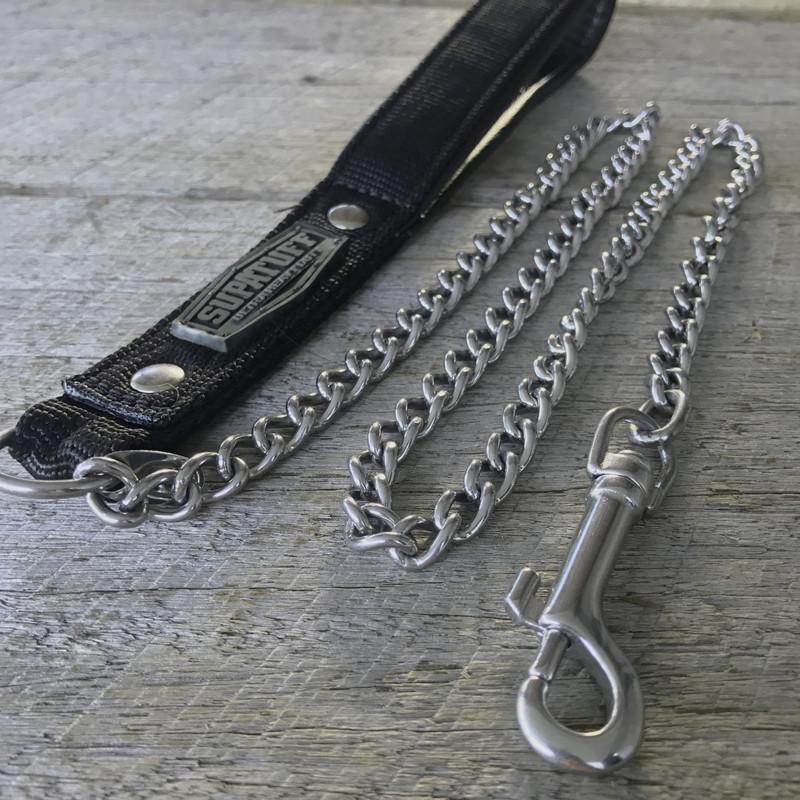
A standard trigger snap uses a spring-loaded gate that opens when the trigger is pressed. Under repeated sustained tension from a pulling dog, the spring gate flexes with each pull and can gradually weaken, or in lower-quality versions, the gate can be pushed open by a combination of downward and lateral force simultaneously. A bull snap uses a solid rotating barrel that must be physically rotated to open and locks positively closed when released. The barrel mechanism cannot be opened by tension alone, which is why bull snaps are the standard hardware choice on working dog and security handling equipment where clip failure is not an acceptable outcome.
The Rogue Royalty Leash Range
The full Rogue Royalty leash range covers every situation in the table above.
SupaTuff Heavy Duty Bullsnap Lead (120 cm)
For: large and powerful dogs, strong pullers, dogs in wet conditions
30 mm custom SupaTuff double-ply nylon webbing with a stainless steel bull snap clip. Leather-padded handle for comfort. No plastic fittings. Lifetime guarantee. Box-stitched and reinforced at all stress points.
From $64.00 | View the Bullsnap Lead
Steel Professional Adjustable Multifunction Leash
For: working handlers, police and security, owners who need one lead for multiple configurations
Handmade bridle leather with multiple attachment points configuring as a standard lead, hands-free waist lead, tether, two-dog lead, or long-distance training lead. Used by police, security, military, and competition handlers. Premium-grade leather with stainless steel fittings throughout.
From $84.00 | View the Multifunction Lead
Soft Grip Recall Training Lead (9.5 m)
For: recall training at distance, controlled off-leash practice, long-distance socialisation
Unique soft-ply nylon webbing designed specifically to prevent hand burn during active handling of a long line. Stainless steel snap hook, leather-reinforced joins at the handle and head-latch. 9.5 metres by 3 cm width. No plastic fittings.
$64.99 | View the Recall Lead
Everyday bullsnap leads, recall training long lines, leather multifunction leads, and SupaTuff heavy nylon, all with stainless steel hardware and no plastic fittings throughout.
Browse the Full Leash Range →Hardware That Fails and Hardware That Holds: What to Check Before You Buy
The weakest point in any leash system is the clip. The leash material and handle quality matter for comfort and durability, but if the clip fails under a hard pull, none of the rest matters. Most general leash guides skip hardware quality entirely, which is why owners discover the problem mid-walk rather than at the point of purchase.
What Plastic Fittings Actually Mean for Load-Bearing Hardware
Plastic clips, swivel points, and D-rings appear on budget and mid-range leads because they are cheap to manufacture and look similar to metal equivalents in product photography. Under sustained pulling force from a large dog, plastic hardware flexes before it fails, which means the failure doesn't always happen on the first hard pull. It happens after the plastic has been stressed repeatedly and has developed micro-fractures invisible to the eye, then fails suddenly under a load that previous pulls absorbed.
Stainless steel hardware, the type used throughout the Rogue Royalty SupaTuff range, does not flex under normal leash force. It either holds or, in cases of extreme overload well beyond its rated capacity, deforms visibly before failing, giving the handler a warning rather than a sudden separation. For any dog over approximately 25 kilograms that pulls actively during walks, removing plastic hardware from the connection chain is the practical safety decision rather than a premium preference.
Swivel Points and Tangling Prevention
A leash without a swivel point between the clip and the lead body will twist progressively as the dog moves and changes direction, tightening the lead into a corkscrew that shortens effective length and makes handling awkward. A rotating swivel between clip and lead allows the dog to move naturally without transferring that rotation into the lead itself. On a long line used for recall training, a swivel point at the clip end is particularly important because the dog covers more ground and changes direction more frequently than during a standard walk, accelerating the twisting problem in leads without one.
Australian Walking Conditions and Why They Change the Leash Decision
Australian dog walking conditions create some specific equipment considerations that general guides written for northern hemisphere markets don't always address.
Coastal and Saltwater Environments
Dogs walked near beaches, estuaries, and tidal areas expose their leash hardware to salt spray and saltwater immersion regularly. Standard zinc-plated hardware, which appears silver in colour but is not stainless steel, corrodes visibly within weeks of regular saltwater exposure and develops pitting and rust that weakens the metal while staining the dog's coat orange. Stainless steel hardware is specifically resistant to saltwater corrosion rather than just fresh water, which is why it matters more in Australian coastal areas than in typical European or American walking environments where freshwater rain is the primary weather exposure.
High-UV and High-Temperature Environments
Nylon webbing degrades under sustained UV exposure over months and years, becoming brittle and losing tensile strength without any obvious outward change in appearance. SupaTuff custom webbing is treated for colorfastness and UV resistance, but any nylon lead stored or left in direct sunlight regularly will degrade faster than one stored in shade. Leather, paradoxically, handles UV exposure better than untreated nylon because the natural fats and conditioning treatments in quality bridle leather provide a level of UV protection that plain nylon doesn't have. Leather that is regularly conditioned and stored away from direct sunlight will outlast an equivalently maintained nylon lead in high-UV Australian conditions.
The Dual-Lead System for Australian Parks and Reserves
Most Australian councils require dogs to be on lead in public areas outside designated off-leash zones, including many parks and reserves that appear open and uncrowded. Running a dual-lead system, a standard fixed-length lead for footpath and on-lead zone walking, and a long line for designated training areas or on-lead parks where practicing recall is appropriate, covers both the legal compliance requirement and the training need without compromising either one. The long line approach in an on-leash park is specifically appropriate for recall training because it maintains legal compliance with the on-lead requirement while still allowing meaningful training distance.
Pairing the Leash With the Right Attachment Point
Equipment decisions work as a system, not individual choices. The leash you choose and the attachment point on the collar or harness work together to determine how much control you have and where pulling force is directed.
For a dog still learning loose-lead manners, a front-clip harness paired with a fixed-length lead redirects the dog's forward momentum sideways rather than allowing full straight-line pulling. A back-clip harness on the same dog gives less steering control and in some cases can actively encourage forward momentum by giving the dog something to lean against. The training leash collection and the harness range are designed to work together for exactly this reason.
For fully trained dogs walking calmly, the attachment point matters less and the choice can be purely about comfort and preference. For powerful working dogs managed by a handler who needs a secure hold point, the leather leash range paired with a wide-fit collar or the Attila harness gives the most reliable system for sustained handling.
Frequently Asked Questions About Dog Leash Types
What is the best leash length for everyday dog walking in Australia?
A fixed-length leash of 1.2 to 1.8 metres suits most everyday walking on suburban footpaths and shared paths. This gives enough room for natural walking without creating a long trailing length that wraps around legs or poles. For busy areas needing close control, shortening to 50 to 60 centimetres using a second handle or short traffic lead is the practical solution.
Why are retractable leashes bad for dogs that pull?
Retractable leads teach pulling by design. When a dog pulls and the cord extends, the dog learns that tension produces forward movement. A dog on a retractable lead also experiences constant low-level resistance, making it impossible to feel a truly loose lead. Trainers and RSPCA Queensland consistently recommend fixed-length leashes for any dog still building loose-lead manners.
What leash suits a strong dog that pulls on walks?
A fixed-length leash with heavy-duty bull snap hardware, no plastic fittings, double-ply webbing or thick leather, and a padded grip. Pair it with a front-clip harness to redirect forward momentum. The hardware matters: a stainless steel bull snap that locks positively is significantly more reliable than a trigger snap on a powerful dog.
What is a multifunction leash and when should I use one?
A multifunction leash uses multiple clip points to configure as a standard lead, hands-free waist lead, tether, double-dog lead, or long training lead. It suits working handlers, competition handlers, and owners who need one piece of equipment to cover multiple daily tasks. Rogue Royalty's 6-in-1 leather multifunction lead is used by police, security, and military handlers worldwide.
Is leather or nylon better for a dog leash?
Both suit different priorities. Leather develops a softened, comfortable grip with use, distributes pull force across a broad palm surface, and suits daily urban walking. Heavy-grade SupaTuff nylon is waterproof, easier to clean, and handles wet conditions better. For dogs that swim regularly or work in all weather, nylon with stainless steel hardware is the practical choice.
What leash length do I need for recall training?
A long line of 5 to 10 metres. A 5 metre line suits earlier training stages in smaller spaces. A 9.5 to 10 metre line suits more advanced work in open environments. The long line maintains a safety connection while giving the dog real distance to practice a recall response, rather than the short distances where recall is too easy to be meaningful training.
What makes a bull snap clip different from a standard trigger snap?
A bull snap uses a rotating barrel mechanism that locks positively when closed and cannot be opened by tension alone. A trigger snap relies on a spring-loaded gate that can flex and weaken under repeated high-tension loads. For large, powerful dogs whose leash experiences significant regular force, a stainless steel bull snap is considerably more reliable than a trigger snap of equivalent size.

