





Most dog leash training failures aren't about the dog. They're about the method and the gear. After sixteen years building dog gear and working with professional handlers, I've watched the same pattern on repeat: the owner buys a retractable leash, clips it to a flat collar, expects the dog to figure out heel position on its own, then escalates to an aversive tool when the dog doesn't. This guide covers what dog leash training actually means, the accessories that genuinely help (and the ones that hurt), and the step-by-step method that works for puppies, adults, and rescue dogs that have already learned bad leash habits.
What leash training actually means
Leash training isn't about the dog learning not to pull. It's about the dog learning that the leash is information, not punishment. A well-trained dog reads slight tension in the line as a cue to slow, check in, or change direction. The leash becomes part of the communication, not the dominant force keeping the dog in line.
The end goal is loose leash walking: the dog walks beside or near the handler with a J-shaped leash between you, ignoring most environmental distractions and checking in occasionally. Formal heel position (the dog's shoulder aligned with your knee) is a separate, more advanced skill used in obedience competition.
If your dog is pulling, lunging, or zig-zagging, the leash skill hasn't been trained yet. That's the problem to solve.
When to start leash training a puppy
The American Kennel Club recommends starting leash work around 8 to 10 weeks of age, the same window most puppies come home. Start indoors with a soft, lightweight collar and a short, light leash. Let the puppy drag the leash for short supervised periods so they get used to the weight and feel before any actual walking pressure happens.
Brachycephalic breeds (French Bulldog, Pug, Boston Terrier, English Bulldog) should start with a properly fitted Y-front harness rather than a collar from day one. The anatomy doesn't tolerate neck pressure on a developing dog.
Don't rush outside. Most leash training failures trace back to taking the puppy to a busy park before they understand the basics indoors.
The dog leash training accessories you actually need
Six items cover almost every training scenario. The rest is marketing.
A properly fitted flat collar
For ID, not for leash pressure on puppies and small dogs. Our handmade leather collar range covers this category in full-grain vegetable-tanned hide that lasts a decade.
A 4 to 6 foot leash matched to the dog
The ASPCA recommends 4 to 6 feet for general walking. Four feet for traffic work and busy environments, six feet for everyday walks. Avoid retractable leashes during training: the constant variable tension teaches the dog that pulling extends the leash, which is the opposite of what you want. A proper leather leash sits in this category, and our training leash range covers the wider lengths used for recall work.
A no-pull Y-front harness
For dogs that pull (which is most of them in the first few months), a properly fitted Y-front harness is the right tool. The Y design follows the dog's anatomy and doesn't restrict shoulder movement, which H-front harnesses can do. Our Active X harness range covers everyday training scenarios with front and back clip options.
A treat pouch
A pouch worn on the hip means you can mark and reward in under a second. Reward timing is the single biggest variable in how fast a dog learns. Fumbling for treats in your pocket guarantees late delivery and slow learning.
A clicker (optional)
A clicker provides a precise auditory marker for the moment the dog gets it right. Optional because verbal markers ("yes," "good") work too. Use whichever you can deploy consistently.
A long line for advanced work
A 10 to 33 foot leather or biothane long line for recall training, scent work, and structured off-leash transitions. Not for everyday walking. Used in open environments where a regular leash is too short and full off-leash is too risky.
How to leash train a dog: the actual method
The method works for puppies, adults, and rescue dogs. The timeline differs. The steps don't.
Stage 1: Indoor leash conditioning
Clip the leash to the collar or harness inside the house. Let the dog wear it for 5 to 10 minutes while you reward calm behavior. Repeat for a few days until the dog ignores the leash entirely.
Stage 2: Yield to leash pressure
Stand still. Apply gentle, steady pressure on the leash. The moment the dog moves toward you (even a step), mark with your clicker or verbal cue and reward. Repeat 10 to 15 times per session. The dog is learning that pressure means come toward me, not pull harder.
Stage 3: Low-distraction walking
Move to a quiet backyard, hallway, or empty driveway. Walk at a normal pace. The instant the leash tightens, stop. Wait. The moment the dog steps back toward you or releases the tension, mark and reward, then continue walking. This is the hardest stage for owners because it requires patience. Most owners give up here.
Stage 4: Build duration
Add distance. Start with 30 seconds of loose leash walking, then a minute, then five minutes. Reward intermittently at first, then less often as the dog builds reliability.
Stage 5: Add distractions gradually
Move to slightly more distracting environments: a quiet street, then a park during off hours, then busier areas. Stay below the dog's threshold. If the dog is too excited to take treats, you've added too much distraction too fast. Back up to easier conditions.
Stage 6: Generalize
Practice in new environments, with new people walking, around other dogs. Generalization is where most dogs reveal that they only know the cue in one location. The skill needs to be practiced everywhere.
How to stop a dog from pulling
Three approaches work, used together.
Stop walking the moment the leash tightens. The walk doesn't continue until the dog releases pressure. Every. Single. Time. Consistency is the entire mechanism.
Change direction when the dog forges ahead. The dog learns that pulling forward gets them somewhere new (often the opposite direction), so pulling becomes counterproductive.
Reward heavily when the leash is loose. Most owners only respond to pulling. Reward the absence of pulling and the dog learns which state earns the walk.
For dogs that have already been pulling for years, expect 4 to 8 weeks of consistent practice before the behavior changes. For puppies trained from day one, expect a few months to reach reliable loose leash walking in mildly distracting environments.
How long does leash training take
Puppies starting at 8 to 10 weeks can reach reliable loose leash walking in calm environments by 4 to 6 months, with consistent practice. Full reliability in distracting environments takes 12 to 18 months.
Adult dogs starting fresh take 2 to 4 months of daily practice for the basics.
Adult dogs with established pulling habits take longer, usually 4 to 8 months. The dog has to unlearn before they relearn.
Reactive dogs (dogs that lunge or bark at triggers on leash) are a different category. Reactivity needs counter-conditioning and threshold management alongside basic leash skills. Work with a certified trainer for these cases.
Common leash training mistakes
Using a retractable leash during training. The variable tension teaches the dog that pulling extends the leash.
Skipping indoor stages. Most owners try to leash train at a busy park. The dog can't focus there. Start in the easiest environment and work up.
Inconsistent stop-on-pull. If you stop sometimes and let the dog drag you other times, the dog learns that pulling works often enough to keep trying.
Long sessions. Five to ten minutes of focused training beats forty-five minutes of half-attention. End sessions while the dog is still engaged.
Switching tools every two weeks. Pick a setup (collar or harness, leash length, marker word) and commit for at least 30 days. Constantly changing equipment confuses the dog.
Reward timing. Late rewards reinforce the wrong behavior. The treat needs to arrive within a second of the correct action.
Leash training adult and rescue dogs
Adult dogs and rescues need the same method with two adjustments.
Start with leash pressure conditioning indoors as if they were a puppy. Most adult dogs have a history with leashes, and not always a good one. Reset the relationship with the leash before adding outdoor distractions.
Use lower-distraction environments for longer. A rescue who's never walked on leash before is overwhelmed at a park. Use a quiet street or empty parking lot for the first month.
Be patient on timeline. A 5-year-old dog who has pulled on every walk for 5 years isn't going to walk politely after one training session. Eight weeks of consistent practice is the realistic minimum.
What we make at Rogue Royalty for leash training
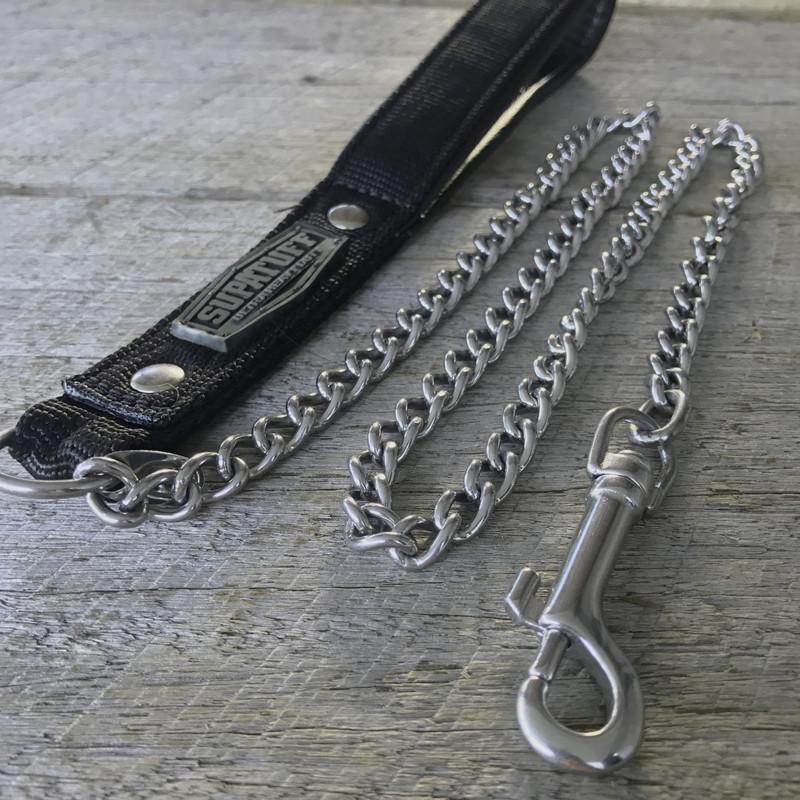
We've been hand-building dog gear in our Australian workshop since 2009. Our leather leash range covers everyday training with full-grain vegetable-tanned hide and solid brass or stainless steel hardware. For multi-configuration training work, our 6-in-1 multifunction training leash converts between traffic lead, standard walking length, hands-free waist lead, and double-ended setups. For heavy-duty work with strong dogs, the Supatuff Bullsnap Leash is the workhorse most professional handlers reach for.
For pulling and training pressure, our harness range covers everything from puppy training to working dog applications. For complete sizing, see our sizing guide. Every piece ships with our craftsmanship guarantee.
For more on the relationship between harnesses and collars in training, see our harness vs collar guide. For the deeper buyer's checklist on quality, see our guide to high quality leather dog leashes.
The bottom line
Dog leash training is a method, not a product. The right accessories make the method easier to execute, but no piece of gear replaces consistent practice with proper timing and reward placement. Start indoors, build slowly, stay below the dog's distraction threshold, and stop walking the moment the leash tightens.
For everyday training gear that lasts a decade, see our leather leash range and harness range. For training-specific configurations, the 6-in-1 multifunction leash covers most working setups in one tool.
Loyalty deserves royalty. Train with the right gear, properly fitted.
Frequently asked questions
What age should you start leash training a puppy?
Around 8 to 10 weeks. Start indoors with a soft collar and light leash. Outdoor walking pressure comes later, once the puppy is comfortable wearing and dragging the leash.
What's the best leash for training a dog?
A 4 to 6 foot flat leather or webbing leash with a solid brass or stainless bolt snap. Avoid retractable leashes during training. They teach the dog that pulling works.
Should I use a collar or harness for leash training?
For most dogs, a Y-front harness during the pulling phase, transitioning to a collar once loose leash walking is reliable. Brachycephalic breeds should use a harness exclusively.
How long does it take to leash train a dog?
Puppies starting at 8 weeks reach basic loose leash walking in 4 to 6 months. Adult rescues with pulling history take 4 to 8 months of consistent practice.
Why does my dog pull on the leash?
Dogs naturally walk faster than humans, and most pulling is reinforced because the dog learns that pulling gets them where they want to go. The fix is consistency: the walk stops when the leash tightens, always.
Are retractable leashes good for training?
No. The variable tension teaches the dog that pulling extends the leash. Use a fixed-length 4 to 6 foot leash during training.
What is loose leash walking?
The dog walks beside or near the handler with a J-shaped leash between you, ignoring most environmental distractions and checking in occasionally. It's the practical goal of most leash training.
Do I need a clicker for leash training?
No. A verbal marker ("yes" or "good") works just as well. Use whichever you can deploy consistently within a second of the correct behavior.

